

Pakistan’s election regulatory body says country’s upcoming polls likely by October 11

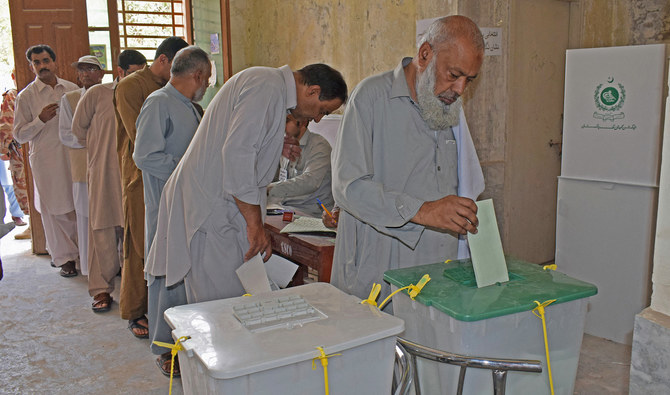
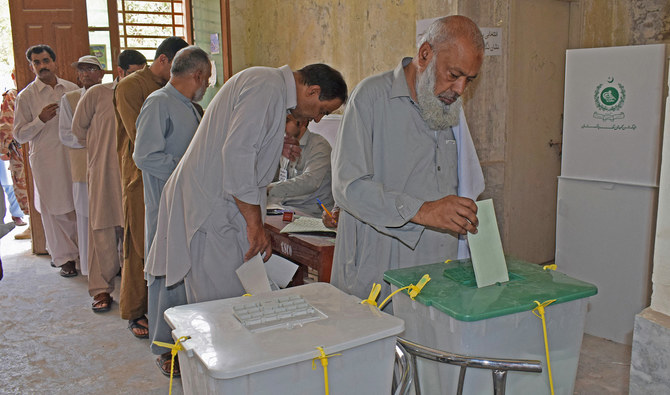
A Pakistani man casts his vote at a polling station during Pakistan's general election in Quetta on July 25, 2018. (AFP/File)
Short Url
Updated 20 July 2023
Follow

Pakistan’s election regulatory body says country’s upcoming polls likely by October 11

  • Senior ECP official informs the upcoming general elections will be held on the basis of old constituencies
  • He says the ECP is coordinating with other institutions and has requested the judiciary for ROs and DROs

ISLAMABAD: Pakistan’s election regulatory authority said on Thursday it would hold the next general elections by October 11 if the National Assembly decided to complete its constitutional tenure until August 12.

President Dr. Arif Alvi already called the farewell sessions of the upper and lower houses of parliament earlier today as the South Asian nation prepares to go to polls in the coming months.

Pakistan’s ruling coalition also hinted at the possibility of dissolving the National Assembly and hand over the reins to a caretaker administration four days before the expiration of its term during political deliberations this month.

However, the government did not specify the exact date since it is the Election Commission of Pakistan’s prerogative to determine the exact time for the electoral contest after a legislation granting it complete autonomy earlier this year.

“If the assembly is dissolved on the completion of the term on August 12, the election will be held before October 11,” said the ECP’s special secretary Zafar Iqbal during a media briefing. “If the assembly is dissolved before then, elections will be held in three months.”

He expressed certainty the ECP would get enough security personnel to arrange the electoral exercise in a peaceful environment.

“The delimitation of constituencies is complete,” he continued. “The election will be held on the basis of the old constituencies.”

Iqbal said the ECP was coordinating with relevant institutions and had also approached the judiciary for returning and district returning officers.


Rating firm S&P says it won’t rush Iran war downgrades, sees risks for countries like Pakistan

Updated 12 March 2026
Follow

Rating firm S&P says it won’t rush Iran war downgrades, sees risks for countries like Pakistan

  • Agency says it is monitoring indebted energy importers as higher oil prices strain finances
  • Gulf economies seen better placed to weather shock, though Bahrain flagged as vulnerable

LONDON: S&P Global ‌said it would not make any knee-jerk sovereign rating cuts following the outbreak of war in the ​Middle East, but warned on Thursday that soaring oil and gas prices were putting a number of already cash-strapped countries at risk.

The firm’s top analysts said in a webinar that the conflict, which has involved US and Israeli strikes ‌against Iran and Iranian ‌strikes against Israel, ​US ‌bases ⁠and Gulf ​states, ⁠was now moving from a low- to moderate-risk scenario.

Most Gulf countries had enough fiscal buffers, however, to weather the crisis for a while, with more lowly rated Bahrain the only clear exception.

Qatar’s banking sector could ⁠also struggle if there were significant ‌deposit outflows in ‌reaction to the conflict, although there ​was no evidence ‌of such strains at the moment, they ‌said.

“We don’t want to jump the gun and just say things are bad,” S&P’s head global sovereign analyst, Roberto Sifon-Arevalo, said.

The longer the crisis ‌was prolonged, though, “the more difficult it is going to be,” he ⁠added.

Sifon-Arevalo ⁠said Asia was the second-most exposed region, due to many of its countries being significant Gulf oil and gas importers.

India, Thailand and Indonesia have relatively lower reserves of oil, while the region also had already heavily indebted countries such as Pakistan, Bangladesh and Sri Lanka whose finances would be further hurt by rising energy prices.

“We ​are closely monitoring ​these (countries) to see how the credit stories evolve,” Sifon-Arevalo said.