

Pakistani dealers threaten petrol pump shutdown over profit margin, smuggled fuel from Iran

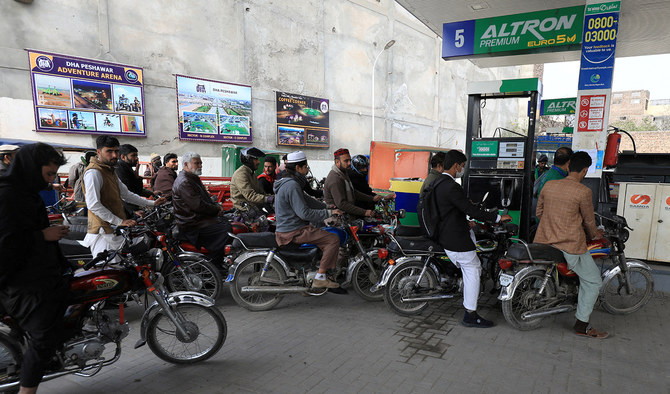
People wait for their turn to get fuel at a petrol station in Peshawar, Pakistan on January 30, 2023. (REUTERS/File)
Short Url
Updated 20 July 2023
Follow

Pakistani dealers threaten petrol pump shutdown over profit margin, smuggled fuel from Iran

  • Dealers say rising utilities costs, high interest rates have eroded their income and profitability since last year
  • They maintain their diesel sales have dropped by 30 percent due to uninterrupted and illegal oil supply from Iran

KARACHI: Pakistani petroleum dealers on Thursday threatened to shut down petrol pumps from Saturday for an indefinite period in a bid to force the government to raise their margin.

Chairman of the Pakistan Petroleum Dealers Association (PPDA) Abdul Sami Khan announced to close all fuel stations across the country, starting 6 am from July 22.

“The prices of utilities, interest rates, and labor costs have doubled since the last year and these rising costs have eroded our income and profitability,” he said while addressing a news conference at the Karachi Press Club.

“We have been demanding to increase our margin from Rs6 per liter to Rs11 at the current prices since it is not feasible for us to continue our business at this rate,” he added while pointing out the inflation rate that hit 38 percent in May this year.

Khan said the association of petroleum dealers was compelled to announce the shutdown since the government did not fulfill its commitment of raising the profit margin.

“The government back in 1999 had promised to increase dealers’ margin to five percent but we are drawing only 2.4 percent as of today,” he continued.

The PPDA chairman said fuel sales had also suffered due to an influx of petroleum products smuggled from neighboring Iran.

“The smuggling of Iranian diesel has tanked our sales by almost 30 percent,” he informed, adding that the association cancelled the licenses of 20 dealers who were involved in the sale of smuggled fuel.

Speaking at the press conference, Tariq Tanoli, a petroleum dealer, informed the Iranian diesel was available at a discounted price of Rs55 per liter.

He added the dealers had consistently been reporting that nearly 35 percent of diesel sold in the local market was illegally flowing from Iran.

Tanoli maintained the smuggled oil was previously confined only to Balochistan province which shares a huge border with Iran, though it had now penetrated the market across the country and was even available at makeshift petrol pumps.

Tariq Hasan, another petroleum dealer, told Arab News that some of the oil marketing companies’ sales had dropped by 40 percent mainly due to the sale of Iranian diesel.

“The financial position of the companies is very tight due to 30 to 40 percent drop in their sales and squeezing margins,” he said, adding: “This is one of the reasons why Shell decided to exit Pakistan.”

Hasan believed that a strong mafia was behind the smuggling racket which was not within the control of the relevant government authorities.


Sindh assembly passes resolution rejecting move to separate Karachi

Updated 21 February 2026
Follow

Sindh assembly passes resolution rejecting move to separate Karachi

  • Chief Minister Shah cites constitutional safeguards against altering provincial boundaries
  • Calls to separate Karachi intensified amid governance concerns after a mall fire last month

ISLAMABAD: The provincial assembly of Pakistan’s southern Sindh province on Saturday passed a resolution rejecting any move to separate Karachi, declaring its territorial integrity “non-negotiable” amid political calls to carve the city out as a separate administrative unit.

The resolution comes after fresh demands by the Muttahida Qaumi Movement (MQM) and other voices to grant Karachi provincial or federal status following governance challenges highlighted by the deadly Gul Plaza fire earlier this year that killed 80 people.

Karachi, Pakistan’s largest and most densely populated city, is the country’s main commercial hub and contributes a significant share to the national economy.

Chief Minister Syed Murad Ali Shah tabled the resolution in the assembly, condemning what he described as “divisive statements” about breaking up Sindh or detaching Karachi.

“The province that played a foundational role in the creation of Pakistan cannot allow the fragmentation of its own historic homeland,” Shah told lawmakers, adding that any attempt to divide Sindh or separate Karachi was contrary to the constitution and democratic norms.

Citing Article 239 of Pakistan’s 1973 Constitution, which requires the consent of not less than two-thirds of a provincial assembly to alter provincial boundaries, Shah said any such move could not proceed without the assembly’s approval.

“If any such move is attempted, it is this Assembly — by a two-thirds majority — that will decide,” he said.

The resolution reaffirmed that Karachi would “forever remain” an integral part of Sindh and directed the provincial government to forward the motion to the president, prime minister and parliamentary leadership for record.

Shah said the resolution was not aimed at anyone but referred to the shifting stance of MQM in the debate while warning that opposing the resolution would amount to supporting the division of Sindh.

The party has been a major political force in Karachi with a significant vote bank in the city and has frequently criticized Shah’s provincial administration over its governance of Pakistan’s largest metropolis.

Taha Ahmed Khan, a senior MQM leader, acknowledged that his party had “presented its demand openly on television channels with clear and logical arguments” to separate Karachi from Sindh.

“It is a purely constitutional debate,” he told Arab News by phone. “We are aware that the Pakistan Peoples Party, which rules the province, holds a two-thirds majority and that a new province cannot be created at this stage. But that does not mean new provinces can never be formed.”

Calls to alter Karachi’s status have periodically surfaced amid longstanding complaints over governance, infrastructure and administrative control in the megacity, though no formal proposal to redraw provincial boundaries has been introduced at the federal level.