

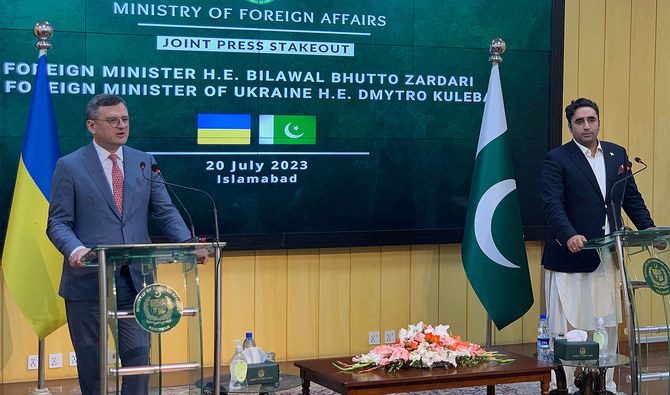

ISLAMABAD: Pakistan’s foreign minister Bilawal Bhutto-Zardari denied on Thursday his country had supplied any weapons to Ukraine in its ongoing war with Russia while expressing Islamabad's support for the revival of the Black Sea grain initiative.
Bhutto-Zardari issued the statement during a joint news conference with his Ukrainian counterpart, Dmytro Kuleba, who arrived in Islamabad on a two-day visit earlier today.
Pakistan has not condemned Russia since it invaded Ukraine last year in February, though it raised concern over the war and urged China and the Organization of Islamic Cooperation (OIC) to mediate the crisis.
Kuleba's visit comes at a time of warming ties between Islamabad and Moscow, with Pakistan beginning oil imports from Russia earlier this year.
Multiple media reports in recent months claimed the administration in Islamabad was supplying weapons to Ukraine in its war against Russia, which the Pakistani minister called unfounded.
“Since the war began, we have not concluded any agreement for defense supplies to Ukraine, keeping in view our principled, consistent, and nonpartisan position,” he told reporters in a joint media briefing.
The Ukrainian foreign minister also corroborated the statement.
“I can confirm that there are no contracts or intergovernmental arrangements between Ukraine and Pakistan in this area,” Kuleba told reporters, adding that military and technical cooperation between the two countries dated back to the contracts signed in 1996 and led to the production of high-quality tanks in Pakistan with the support of the Ukrainian defense industry.
Asked about Russia’s decision to quit the Black Sea grain deal, the Pakistani minister called the understanding a positive initiative of the United Nations, Türkiye and Ukraine. He added the restoration of the deal would not only serve the interest of Russia but also much of the world’s developing nations.
The deal allowed Ukraine to export grain via the Black Sea and expire at the end of Monday after Russia said it would suspend its participation.
The deal, brokered by the United Nations and Turkey last July, aimed to alleviate a global food crisis by allowing Ukrainian grain blocked by the Russia-Ukraine conflict to be exported safely.
“I will be reaching out to the United Nations Secretary General, to my counterpart in Türkiye, in Russia, to discuss Pakistan’s concerns and our desire for the Black Sea grain initiative to be restored,” Bilawal-Bhutto added.
He said he shared with his Ukrainian counterpart Pakistan’s deep concern over the prevailing conflict and offered condolences on the loss of precious lives and immense human suffering.
“We have a vested interest in promoting peace and reconciliation and hope for a peaceful resolution through dialogue and diplomacy,” he added.
In his remarks, Kuleba thanked Pakistan for providing Ukraine with humanitarian assistance at a time when his country needed it the most.
“We know that Pakistan supports our territorial integrity, and the rest is in the hands of the Pakistani government to choose appropriate forms of finding a way to support a country that is fighting for its sovereignty and territorial integrity against a much stronger neighbor,” he commented.
The Ukrainian minister said he had briefed his Pakistani counterpart during delegation level talks about the opportunities offered by his country in the area of digitization of state services to make it more convenient for the government to engage with for its citizens.
He said Ukraine would also appreciate if Pakistan voiced its support of the continuation of the Black Sea grain deal.
“I was happy to hear from Bhutto-Zardari that Pakistan will engage in this matter with the United Nations and European Union as facilitators of the Black Sea grain initiative,” he added.


