Iraqis furious over government’s demolition of 300-year-old minaret

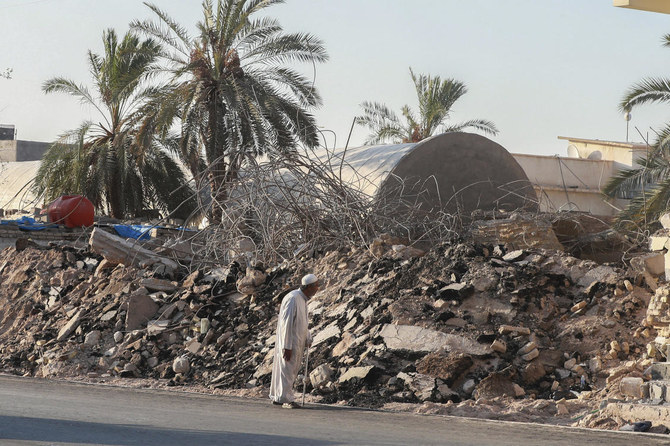
A man walks past the rubble of a demolished al-Siraji Mosque in Basra, Iraq. (AP)
Short Url
Updated 20 July 2023
Follow

Iraqis furious over government’s demolition of 300-year-old minaret

  • Demolition has ignited a wave of outrage among advocates for the preservation of Iraq’s cultural heritage

BASRA: For three centuries, the Al-Siraji Mosque, with its minaret fashioned from weathered bricks and its pinnacle inlaid with blue ceramic tiles, was a distinctive feature of the city of Basra in southern Iraq.
In recent years, it was one of the few tourist attractions in the oil-rich but neglected city, although locals complained that the minaret jutted out into the street, snarling traffic.
In the early hours Friday morning, the 11-meter-high (33-foot-high) minaret was razed to the ground, with the governor of Basra attending the demolition, igniting a wave of social media backlash among advocates for the preservation of Iraq’s cultural heritage.
Heritage sites in Iraq, home to multiple civilizations going back more than six millennia, have been hard hit by looting and damage over the decades of conflict before and after the US invasion of 2003. Most notoriously, the militant Daesh group demolished numerous ancient sites in northern Iraq, including Islamic shrines, raising outrage among Iraqis and abroad.
Amid the relative calm that has prevailed in recent years, the country has seen a resurgence of archaeology. Many stolen artifacts have been returned, and damaged heritage sites like the Al-Nouri mosque in Mosul wrecked by Daesh have been restored after Iraq appealed for international funding to help.
“However, this time, it is the actions of official authorities that have put an end to our heritage,” said Jaafar Jotheri, an assistant professor of Geoarchaeology at Al-Qadisiyah University in Iraq.
The Siraji Mosque with its minaret was built in 1727. The mosque itself was not included in the demolition.
Basra’s governor, Asaad Al-Eidani, said in public statements that the local government had received permission from Iraq’s Sunni Endowment Office, which has authority over Sunni religious sites, for the minaret’s demolition. He said the whole mosque would be replaced with a modern, better-designed one.
“Some may say it’s historical, but it was in the middle of the street, and we took it down to expand the street for the public interest,” the governor said in a video posted on the official Facebook page of Basra Governorate Media Office.
The governor’s office did not respond to a request for comment.
“The minaret predates the street,” Jotheri said, “and it is one of the oldest sites in Basra. It was not encroaching on the street; rather, they encroached upon it.”
The minaret’s significance “lies not in its religious context, but rather its historical value,” said Adil Sadik, an oil engineer from Basra. “This minaret does not belong to any individual or particular group; rather, it is the collective property of the city and a cherished part of its collective memory.”
The minaret’s destruction has drawn attention to the gaps in Iraq’s legal framework for heritage preservation. The country has two separate laws, the Antique and Heritage Protection Law and the Religious Endowments Law, which sometimes conflict. In the case of religious historical sites, the authority of the Endowments often supersedes that of the State Board of Antiquities and Heritage of Iraq.
Ahmed Al-Olayawi, spokesperson for the Ministry of Culture, criticized the destruction of the minaret. He said that the ministry had previously submitted proposals to the Basra government for the minaret to be dismantled and relocated away from the street. Al-Olayawi called for a judicial inquiry into the demolition.
The Sunni Endowment Office, in an official statement, denied granting permission for the demolition and voiced its shock.
“We requested the Basra governorate to relocate the minaret, not destroy it,” the head of the Sunni Endowment, Mishaan Al-Khazraji, said in a televised speech.
Ali Nazim, a resident of Basra, said that he agreed with the goal of expanding the street and allowing for a better flow of traffic, but “the way it was done has caused anger.”
The incident has fueled a broader conversation about the preservation of Iraq’s historical sites and cultural heritage.
“In other countries, they protect even a tree during street expansions,” said Ali Hilal, an Iraqi photographer dedicated to promoting historical sites in Iraq. “Why did we destroy a 3-century-old site to widen the street?”
After the uproar, the Basra governor said a Turkish company specialized in heritage preservation might take charge of rebuilding the minaret from the rubble.
Jotheri said he doubts that’s possible. He noted that the bricks of the minaret were not numbered to allow for reassembly, and the use of a bulldozer damaged the unique features of the bricks.
”Every visitor to Basra over the past 300 years has seen and formed memories with” the iconic minaret, he said. “But now, neither my son nor your son will have the chance to witness it.”


Gaza’s living conditions worsen as strong winds and hypothermia kill 5

Updated 59 min 12 sec ago
Follow

Gaza’s living conditions worsen as strong winds and hypothermia kill 5

  • Hundreds of tents and makeshift shelters were blown away or heavily damaged, the UN humanitarian office reported

DEIR AL-BALAH, Gaza Strip: Strong winter winds collapsed walls onto flimsy tents for Palestinians displaced by war in Gaza, killing at least four people, hospital authorities said Tuesday.
Dangerous living conditions persist in Gaza after more than two years of devastating Israeli bombardment and aid shortfalls. A ceasefire has been in effect since Oct. 10. But aid groups say that Palestinians broadly lack the shelter necessary to withstand frequent winter storms.
The dead include two women, a girl and a man, according to Shifa Hospital, Gaza City’s largest, which received the bodies.
The Gaza Health Ministry said Tuesday a 1-year-old boy died of hypothermia overnight, while the spokesman for the UN’s children agency said over 100 children and teenagers have been killed by “military means” since the ceasefire began.
Meanwhile, Israel’s military said it exchanged fire Tuesday with six people spotted near its troops deployed in southern Gaza, killing at least two of them in western Rafah.
Family mourns relatives killed by wall collapse
Three members of the same family — 72-year-old Mohamed Hamouda, his 15-year-old granddaughter and his daughter-in-law — were killed when an 8-meter (26-foot) high wall collapsed onto their tent in a coastal area along the Mediterranean shore of Gaza City, Shifa Hospital said. At least five others were injured.
Their relatives on Tuesday began removing the rubble that had buried their loved ones and rebuilding the tent shelters for survivors.
“The world has allowed us to witness death in all its forms,” Bassel Hamouda said after the funeral. “It’s true the bombing may have temporarily stopped, but we have witnessed every conceivable cause of death in the world in the Gaza Strip.”
A second woman was killed when a wall fell on her tent in the western part of the city, Shifa Hospital said.
Hundreds of tents and makeshift shelters were blown away or heavily damaged, the UN humanitarian office reported.
The UN and its humanitarian partners were distributing tents, tarps, blankets and clothes as well as nutrition and hygiene items across Gaza, said the UN Office for the Coordination of Humanitarian Affairs.
The majority of Palestinians live in makeshift tents since their homes were reduced to rubble during the war. When storms strike the territory, Palestinian rescue workers warn people against seeking shelter inside damaged buildings for fears of collapse. Aid groups say not enough shelter materials are entering Gaza during the truce.
In the central town of Zawaida, Associated Press footage showed inundated tents Tuesday morning, with people trying to rebuild their shelters.
Yasmin Shalha, a displaced woman from the northern town of Beit Lahiya, stood against winds that lifted the tarps of tents around her as she stitched hers back together with needle and thread. She said it had fallen on top of her family the night before, as they slept.
“The winds were very, very strong. The tent collapsed over us,” the mother of five told AP. “As you can see, our situation is dire.”
On the shore in southern Gaza, tents were swept into the Mediterranean. Families pulled what was left from the sea, while some built sand barriers to hold back rising water.
“The sea took our mattresses, our tents, our food and everything we owned,” Shaban Abu Ishaq said, as he dragged part of his tent out of the sea in the Muwasi area of Khan Younis.
Mohamed Al-Sawalha, a 72-year-old man from the northern refugee camp of Jabaliya, said the conditions most Palestinians in Gaza endure are barely livable.
“It doesn’t work neither in summer nor in winter,” he said of the tent. “We left behind houses and buildings (with) doors that could be opened and closed. Now we live in a tent. Even sheep don’t live like we do.”
Residents aren’t able to return to their homes in Israeli-controlled areas of the Gaza Strip.
Child death toll in Gaza rises
Gaza’s Health Ministry said the 1-year-old in the central town of Deir Al-Balah was the seventh fatality due to the cold conditions since winter started. Others included a baby just seven days old and a 4-year-old girl, whose deaths were announced Monday.
The ministry, part of the Hamas-run government, says more than 440 people were killed by Israeli fire and their bodies brought to hospitals since the ceasefire went into effect. The ministry maintains detailed casualty records that are seen as generally reliable by UN agencies and independent experts.
UNICEF spokesman James Elder said Tuesday at least 100 children under the age of 18 — 60 boys and 40 girls — have been killed since the truce began due to military operations, including drone strikes, airstrikes, tank shelling and use of live ammunition. Those figures, he said, reflect incidents where enough details have been compiled to warrant recording, but the total toll is expected to be higher. He said hundreds of children have been wounded.
While “bombings and shootings have slowed” during the ceasefire, they have not stopped, Elder told reporters at a UN briefing in Geneva by video from Gaza City. “So what the world now calls calm would be considered a crisis anywhere else,” he said.
Gaza’s population of more than 2 million people has been struggling to keep the cold weather and storms at bay while facing shortages of humanitarian aid and a lack of more substantial temporary housing, which is badly needed during the winter months. It’s the third winter since the war between Israel and Hamas started on Oct. 7, 2023, when militants stormed into southern Israel and killed around 1,200 people and abducted 251 others into Gaza.
Gaza’s Health Ministry says more than 71,400 Palestinians have been killed in Israel’s retaliatory offensive.