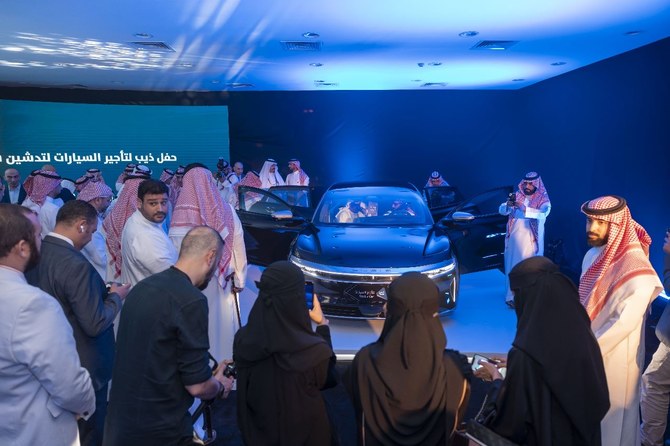

RIYADH: Saudi residents and tourists can now rent electric vehicles from Lucid Motors as part of the Kingdom’s sustainability drive, the Transport General Authority has announced.
The initiative is being rolled out with 10 Lucid EVs, which will be available for rent through Theeb Rent A Car.
The development is aligned with Saudi Arabia’s efforts to embrace renewable energy sources in line with its sustainable goals to ensure net-zero emissions by 2060.
Moreover, the Kingdom’s National Strategy for Transport and Logistics is also focusing on raising the share of electric car use across Saudi Arabia to 25 percent by the end of this decade.
The availability of Lucid cars for rental is also expected to boost the use of clean energy sources in the Kingdom, enhance environmental sustainability, and reduce carbon emissions.
Saudi Arabia’s sovereign wealth fund is Lucid Motors’ largest shareholder. After injecting around $1.8 billion in June as part of a $3 billion stock sale, the Public Investment Fund owns roughly 60.5 percent of the EV maker’s common stock. To date, the fund has invested $9 billion in Lucid.
Saleh Al-Zowayeed, director of corporate communications and the official spokesman of the Transport General Authority, told Arab News that the organization was working toward encouraging the community to use electric cars.
He said: “This initiative is an innovative and clean solution that provides new opportunities to achieve environmental sustainability and improve the quality of life.
“It promotes the use of clean energy and encourages the use of electric cars as an environmentally friendly option.”

Naif Al-Theeb, CEO Theeb Rent A Car and Fawaz Al-Suhali, vice president of land transport at TGA (Supplied)
Mohammed Al-Kadi, director of marketing at Theeb Rent a Car, said that the rental company hoped to expand its variety of vehicles in the future.
He said: “This initiative falls in line with Vision 2030. Our goal is not only to offer Lucid cars. We hope to offer a variety of electric cars in the future. There will soon be luxury and economically friendly choices.”
Al-Kadi added that Theeb Rent a Car provided charging for all electric cars.
He said: “We also provide electric car charging stations for everyone with an electric car to come and charge their vehicle free of charge. The service is available for customers and the general public.”
Some 10 Lucid cars will be available for rent from July 23. Two models will be offered: Grand Touring for SR3,500 ($933) a day and Air Dream for SR4,500 a day.
Customers can reserve their car of choice at the Riyadh head office or through the website at theebonline.com.

Mohammed Al-Kadi, director of marketing and PR at Theeb Rent A Car (Supplied)
In March, Faisal Sultan, Lucid Motors’ vice president and managing director in the Middle East, told Arab News that the company would roll out its first fully Saudi-assembled electric car in September in the coastal city of Jeddah.
“Very exciting things are happening at Lucid, and if you take a flight to Jeddah and drive to King Abdullah Economic City, where our plant is going to be located … Pretty soon we are going to start putting equipment in that,” said Sultan.
In May 2022, Lucid Motors signed deals to build a production factory in Saudi Arabia with an annual capacity of 155,000 zero-emission EVs.
The deals were estimated to provide financing and incentives worth $3.4 billion to Lucid over the next 15 years to build and operate the manufacturing facility in the Kingdom.
Saudi Minister of Industry and Mineral Resources Bandar Alkhorayef had earlier revealed that 85 percent of the EV factory’s production would be exported, reflecting Saudi Arabia’s competitive location and abilities.