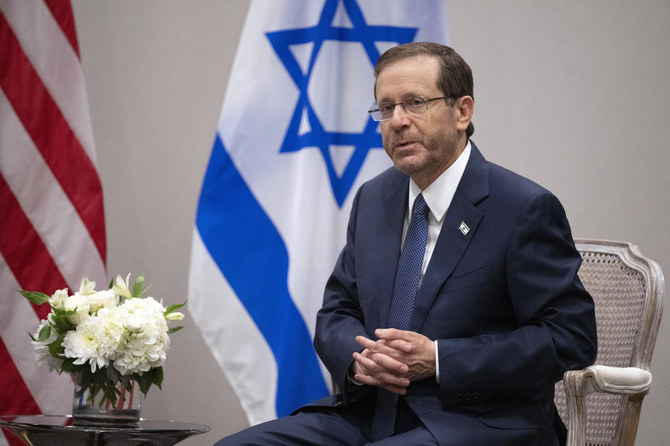
WASHINGTON: Israel’s president speaks to Congress on Wednesday in an appearance aimed at demonstrating what he calls the “unbreakable bond” between Israel and the United States, despite US concerns over Prime Minister Benjamin Netanyahu’s judicial overhaul and settlement construction in the occupied West Bank.
Isaac Herzog becomes the second Israeli president, after his father, Chaim Herzog, to address Congress. His speech will mark modern Israel’s celebration of its 75th year.
But the visit by Israel’s figurehead president also is exposing the difficulties that Democrats face in balancing longstanding US support for ally Israel with disapproval of some actions by Netanyahu’s government, a coalition of ultranationalist and ultra-Orthodox parties.
The House on Tuesday passed a Republican-led resolution reaffirming its support for Israel with strong bipartisan approval — an implicit rebuke of a leading Democrat who over the weekend called the country a “racist state” but later apologized.
The resolution, introduced by Rep. August Pfluger, R-Texas, passed with more than 400 lawmakers backing the measure. It did not mention Rep. Pramila Jayapal, D-Washington, by name but was clearly a response to her recent remarks about Israel. The measure was drafted soon after she criticized Israel and its treatment of Palestinians at a conference on Saturday.
Jayapal, the chair of the Congressional Progressive Caucus, walked back the comments the next day, insisting her comments were aimed at Netanyahu and not at Israel.
“I do not believe the idea of Israel as a nation is racist,” Jayapal said in a statement. “I do, however, believe that Netanyahu’s extreme right-wing government has engaged in discriminatory and outright racist policies and that there are extreme racists driving that policy within the leadership of the current government.”
The GOP-led effort highlighted the divide among House Democrats over Israel, with younger progressives adopting a more critical stance toward the longtime US ally than party leaders.
Rep. Rashida Tlaib, D-Michigan, the only Palestinian-American in Congress, is boycotting Herzog’s speech Wednesday and criticized the resolution as normalizing violence against those living in the occupied West Bank, given the Netanyahu government’s approval of expanded Jewish settlements there.
“We’re here again reaffirming Congress’ support for apartheid,” Tlaib said during floor debate Tuesday on the Republican measure. “Policing the words of women of color who dare to speak up about truths, about oppression.”
Over at the White House on Tuesday, Herzog sought to assure Biden that Israel remains committed to democracy amid deepening US concerns over Netanyahu’s plans to overhaul his country’s judicial system.
Netanyahu and his allies say the overhaul is needed to rein in the powers of unelected judges. Opponents say the plan will destroy Israel’s fragile system of checks and balances and move the country toward authoritarian rule.
Herzog has appealed for a compromise that has thus far proven elusive. Many American Jewish groups and Democratic lawmakers have expressed concerns about the plan.
Herzog’s visit comes weeks after Israeli forces carried out one of their most intensive operations in the occupied West Bank in two decades, with a two-day air and ground offensive in Jenin, a militant stronghold. Senior members of Netanyahu’s government have been pushing for increased construction and other measures to cement Israel’s control over the occupied West Bank in response to a more than yearlong wave of violence with the Palestinians.
US officials have broadly supported Israel’s right to defend itself from militant attacks but have also urged restraint to minimize harm to civilians and have lobbied against additional settlements that would further diminish the chances of securing a two-state solution between Israel and the Palestinians.
With differences in plain view, Biden sought to stress the importance of the US-Israeli relationship in his brief remarks before reporters Tuesday.
“This is a friendship I believe is just simply unbreakable,” Biden said. “As I confirmed to Prime Minister Benjamin Netanyahu yesterday, America’s commitment to Israel is firm and it is ironclad.”
Ahead of Herzog’s visit, Biden spoke with Netanyahu by phone and invited him to meet in the US this fall, although the president expressed reservations about several of the Netanyahu hard-right coalition’s policies.
Herzog said the Biden-Netanyahu conversation sent an important message to the region.
“I was pleased to hear about your conversation with Prime Minister Netanyahu in which you focused on our ironclad military and security cooperation because there are some enemies of ours that sometimes mistake the fact that we may have some differences as impacting our unbreakable bond,” Herzog said.
The Biden administration declined to say whether Biden would host Netanyahu at the White House — as the Israeli leader has hoped — or in New York on the margins of the UN General Assembly.
White House visits are typically standard protocol for Israeli prime ministers, and the delay in Netanyahu receiving one has become an issue in Israel, with opponents citing it as a reflection of deteriorating relations with the US.


![]()

Israeli president says his speech to Congress highlights an ‘unbreakable bond’ despite US unease
Short Url
https://arab.news/numnu
Israeli president says his speech to Congress highlights an ‘unbreakable bond’ despite US unease
- Herzog’s speech will mark modern Israel’s celebration of its 75th year
- White House visits are typically standard protocol for Israeli prime ministers, and the delay in Netanyahu receiving one has become an issue in Israel


Latest updates







© 2026 SAUDI RESEARCH & PUBLISHING COMPANY, All Rights Reserved And subject to Terms of Use Agreement.