

India’s Yamuna river laps walls of Taj Mahal after heavy rain

This photograph taken on July 17, 2023 shows flooded banks of river Yamuna along the Taj Mahal in Agra. (REUTERS)
Short Url
Updated 19 July 2023
Follow

India’s Yamuna river laps walls of Taj Mahal after heavy rain

  • River flowing alongside Taj Mahal rose to 152 meters on Tuesday, well above warning level for potential danger
  • Last time the river reached walls of the monument, built by Mughal Emperor Shah Jahan, was 45 years ago in 1978

AGRA: A river that runs through the northern Indian state of Uttar Pradesh has risen to lap the compound walls of the iconic Taj Mahal in Agra city, causing concern about damage to the 17th-century white marble monument.

The water level of the Yamuna river has increased over the last few days after unusually heavy rain in northern India, including Uttar Pradesh, which has received 108 percent of its normal rainfall since the four-month monsoon season began on June 1.

According to India’s Central Water Commission (CWC), the portion of the river flowing alongside the Taj Mahal rose to 152 meters (499 feet) late on Tuesday, well above the warning level for potential danger of 151.4 meters. The level considered dangerous is 152.4 meters.

Local media outlets reported that the last time the river reached the walls of the monument, built by Mughal Emperor Shah Jahan in memory of his queen Mumtaz Mahal, was 45 years ago, in 1978.

CWC data also indicates that its station near the monument recorded the river’s highest flood level that year at 154.76 meters.

Visuals from the area on Tuesday showed the red sandstone boundary wall of the Taj Mahal surrounded by muddy water, with pieces of garbage floating in it, the mausoleum itself looming over the scene, untouched by the river.

Officials from the Archaeological Survey of India (ASI), which oversees the Taj Mahal along with several other monuments in the country, said there was “no serious concern” about the monument at present.

“If it rains more, or the water stays this high for some days, we will need to assess the situation again,” said Raj Kumar Patel, superintendent archaeologist with ASI.
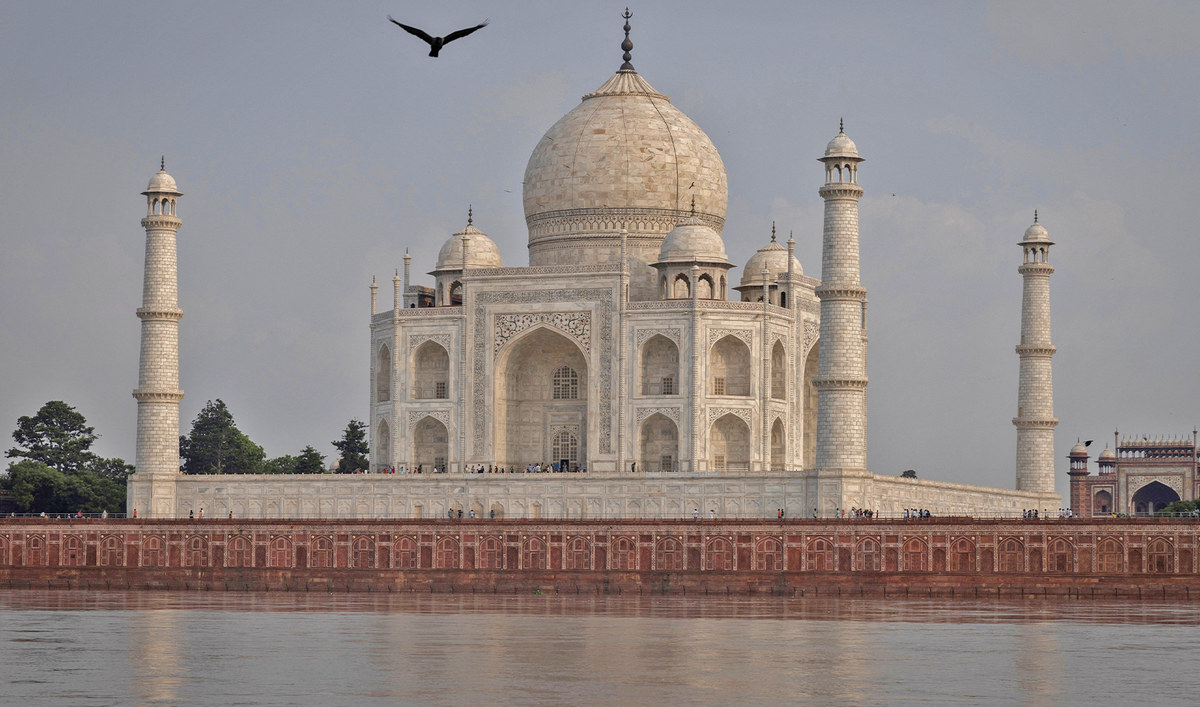


Tourists walk inside the historic Taj Mahal as the Yamuna river overflows following heavy rains, in Agra, India, on July 18, 2023 (REUTERS)

Several other monuments and gardens located in the vicinity of the Taj Mahal, closer to the banks of the Yamuna, however, “have been submerged” and damaged, he said.

These include the tomb of Itimad-ud-Daulah, often called “baby Taj,” which dates back to the 1600s, and Mehtab Bagh, also from the same period, whose structure has been damaged and garden area — currently under water — completely destroyed.

Tourists from around the world continued to stream in through the gates of the Taj Mahal on Tuesday evening, undeterred by the rising water levels.

“It is crazy to see the water go up so much, but to see the Taj Mahal was beautiful,” said Mathew Kreton, 20, a student from Lucerne, Switzerland.


A man takes a picture of the historic Taj Mahal as the Yamuna River overflows following heavy rains, in Agra, India, on July 18, 2023. (REUTERS)

Local residents were more concerned, fearing the river would eventually invade their homes.

“We have kept our belongings on top so that they do not float away. Along with that we are staying on alert,” said Sundar Dubey, 49, who lives near the temple.
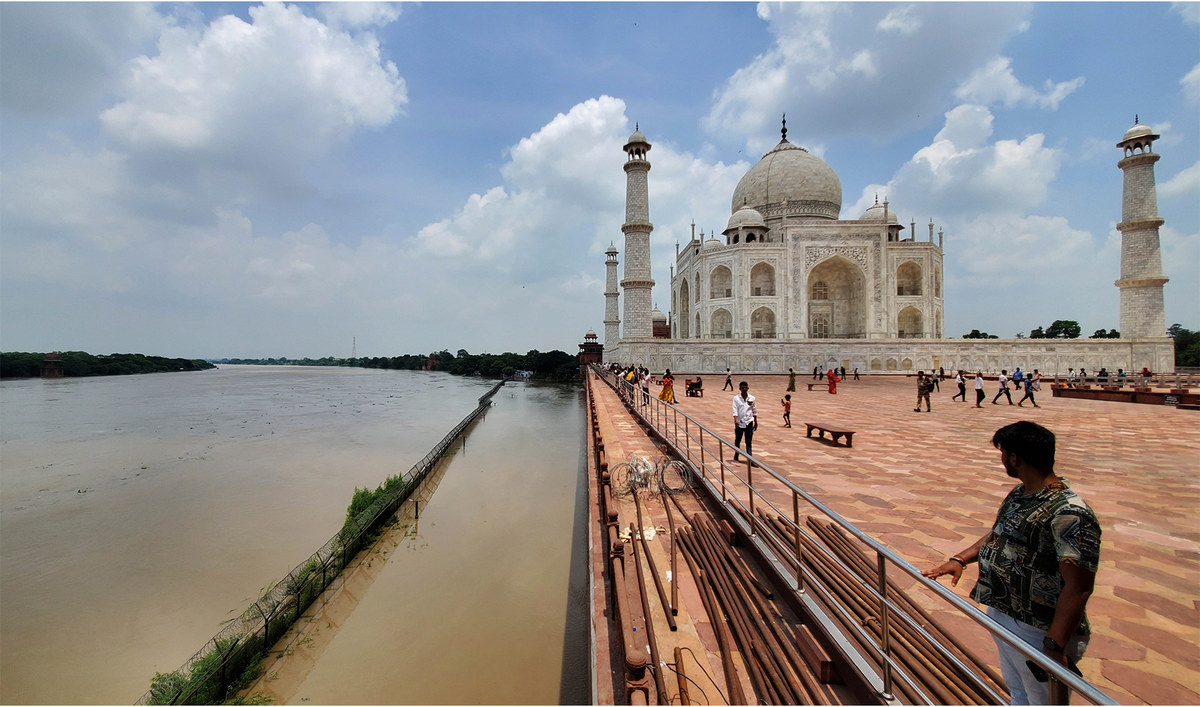


The swollen Yamuna River rises to the periphery of the Taj Mahal, the first time in 45 years, in Agra, India, on July 19, 2023. (AP)


Thai and Cambodian top diplomats meet in China to solidify ceasefire

Updated 58 min 22 sec ago
Follow

Thai and Cambodian top diplomats meet in China to solidify ceasefire

  • The ceasefire agreement comes with a 72-hour observation period, at the end of which Thailand agreed to repatriate 18 Cambodian soldiers it has held as prisoners since earlier fighting in July

BEIJING: Top diplomats from Thailand and Cambodia kicked off two days of talks in China on Sunday as Beijing seeks to strengthen its role in mediating the two countries’ border dispute, a day after they signed a new ceasefire.
The ceasefire agreement signed on Saturday calls for a halt to weeks of fighting along their contested border that has killed more than 100 people and displaced over half a million in both countries.
Thai Foreign Minister Sihasak Phuangketkeow and Cambodian Foreign Minister Prak Sokhonn were set to meet in China’s southwestern Yunnan province for talks mediated by their Chinese counterpart, Wang Yi.
The talks aim to ensure a sustained ceasefire and promote lasting peace between the countries, according to a statement by Sihasak’s office.
Wang was scheduled to join both bilateral meetings with each of the diplomats and a trilateral talk on Monday.
China has welcomed the ceasefire announcement, which freezes the front lines and allows for displaced civilians to return to their homes near the border.
“China stands ready to continue to provide (the) platform and create conditions for Cambodia and Thailand to have fuller and more detailed communication,” a Chinese Foreign Ministry statement read.
The ceasefire agreement comes with a 72-hour observation period, at the end of which Thailand agreed to repatriate 18 Cambodian soldiers it has held as prisoners since earlier fighting in July. Their release has been a major demand of the Cambodian side.
China has sought to position itself as a mediator in the crisis, along with the United States and Malaysia.
A July ceasefire was brokered by Malaysia and pushed through by pressure from US President Donald Trump, who threatened to withhold trade privileges unless Thailand and Cambodia agreed.
Despite those deals, Thailand and Cambodia carried on a bitter propaganda war, and minor cross-border violence continued, erupting into heavy fighting in early December.
Prak Sokhonn, in a statement after his meeting with Wang, expressed deep appreciation for China’s “vital role” in supporting the ceasefire.
China also announced 20 million yuan ($2.8 million) of emergency humanitarian aid for Cambodia to assist the displaced.
The first batch of Chinese aid, including food, tents and blankets, arrived in Cambodia on Sunday, Wang Wenbin, Chinese ambassador to Cambodia, wrote on Facebook.
Sihasak said Sunday he hoped the meetings would convey to China that it should both support a sustainable ceasefire and send a signal to Cambodia against reviving the conflict or attempting to create further ones.
“Thailand does not see China merely as a mediator in our conflict with Cambodia but wants China to play a constructive role in ensuring a sustainable ceasefire by sending such signals to Cambodia as well,” he said.