

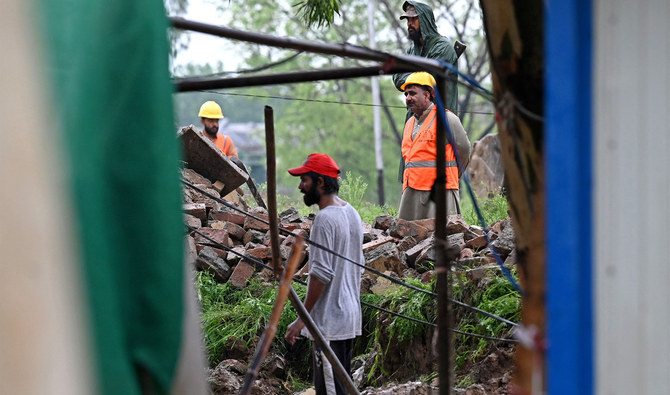
11 people killed after wall collapses in Pakistan’s capital amid torrential rain

Rescue workers search during a rescue operation at the site after a wall collapsed during heavy monsoon rains, on the outskirts of Islamabad, Pakistan, on July 19, 2023. (AFP)
Short Url
Updated 19 July 2023
Follow

11 people killed after wall collapses in Pakistan’s capital amid torrential rain

  • Police officials say rescue workers are still busy removing the rubble of the wall to look for survivors
  • Monsoon rains began in Pakistan toward the end of the last month and have so far claimed over 100 lives

ISLAMABAD: Eleven people lost their lives on Wednesday morning after a wall came crashing down near an under-construction bridge in Pakistan’s federal capital amid torrential rain, which also lashed the neighboring city of Rawalpindi.

The National Weather Forecasting Center of the Pakistan Meteorological Department predicted heavy monsoon rains starting from July 18 and indicated that they were likely to intensify on July 19.

It specifically mentioned the possibility of urban flooding in low-lying areas of Islamabad and Rawalpindi, as well as in other cities located in the upper and central parts of the country, adding that the recent spell of rainfall would continue until July 22 and was likely to trigger landslides in the vulnerable areas of Murree, Kashmir, Gilgit Baltistan, and hilly areas of Khyber Pakhtunkhwa during the period.

“At least 10 to 12 people were killed while five injured when the wall of an under-construction bridge collapsed near the Golra Mor interchange in Islamabad,” a police official told Arab News over the phone.



A man cries outside the mortuary after he lost his son by monsoon rains on the outskirts of Islamabad, Pakistan, on July 19, 2023. (AP)

He added the station house officer (SHO) of the relevant police precinct would confirm the number of casualties as rescue officials were still busy removing the rubble of the collapsed wall to look for survivors.

Meanwhile, Pakistan’s national and provincial disaster management authorities held a meeting with the army along with the flood forecasting center, rescue services, and other related bodies before putting them on high alert to deal with flood-related situations.

Monsoon rains began in Pakistan toward the end of the last month and have so far killed more than 100 people.

Last year, the unprecedented rainfall in Pakistan caused major flash floods across the country, destroying houses, crops, and other public infrastructure and causing an estimated damage of over $30 billion.

The floods that submerged one-third of the country at one point affected 33 million people and claimed 1,700 lives.

The erratic weather patterns in Pakistan, including several heatwaves in recent years, have been attributed to global climate change.

According to the Global Climate Risk Index (2021), Pakistan ranks as the eighth most vulnerable country in the world to long-term climate risk despite contributing less than one percent of global carbon emissions.


Pakistan urged to shift climate finance to local level as weather risks intensify

Updated 8 sec ago
Follow

Pakistan urged to shift climate finance to local level as weather risks intensify

  • Khurram Schehzad says climate governance must be brought closer to vulnerable communities
  • Pakistan faces mounting climate shocks despite contributing less than 1% to global emissions

KARACHI: Pakistan needs to move climate finance closer to local governments to protect communities from increasingly severe weather shocks, a senior government adviser said on Saturday, as policymakers warned that centralized approaches were failing to reach those most exposed.

Pakistan has been facing increasingly erratic weather patterns, including frequent heatwaves, unprecedented rains, storms, cyclones, floods and droughts.

The country has stepped up efforts to strengthen national climate resilience following devastating floods in 2022 and 2025 that displaced millions, destroyed infrastructure and farmland and caused multibillion-dollar economic losses.

Khurram Schehzad, adviser to the finance minister, emphasized the importance of decentralizing climate action by examining the role of local governments in climate finance during a panel discussion held at the Institute of Business Administration in Karachi.

“There is an urgent need to shift climate governance and climate finance closer to the communities most exposed to climate risks,” he said, according to a statement circulated after the discussion.

“While global climate discourse often focuses on pledges and frameworks, climate resilience is ultimately built through execution, access to finance and delivery at the local level,” he added.

The discussion focused on how cities and districts could be empowered to design and bankroll locally grounded adaptation projects and bridge gaps between national climate commitments and on-the-ground delivery.

Panelists said Pakistan’s climate response must move beyond strategy documents toward practical financing mechanisms that enable households, farmers, small businesses and local administrations to invest in resilience.

Schehzad highlighted several pathways, including climate-smart agricultural lending for smallholders, energy transition finance for households and micro-enterprises, affordable climate-resilient housing, results-based financing instruments and risk-sharing frameworks to de-risk private investment.

Participants also pointed to structural challenges, including planning bottlenecks and limited fiscal space at the local level, calling for reforms to simplify approval processes for small-scale adaptation projects.