

Election data shows over 50 million Pakistanis aged 18-35 crucial vote in upcoming general polls

1 / 3
In this photo, taken on July 25, 2018, Pakistani women voters wait to get their ballot papers to cast their votes during Pakistan's general election at a polling station in Lahore. (AFP/File)
2 / 3
3 / 3
Short Url
Updated 18 July 2023
Follow

Election data shows over 50 million Pakistanis aged 18-35 crucial vote in upcoming general polls

  • A total of 126 million Pakistanis are set to cast votes in upcoming polls, Pakistan’s election regulator says
  • 23.5 million Pakistani voters are aged between18 to 25 while 32.6 million fall within 26 to 35 age bracket

ISLAMABAD: The highest number of voters in Pakistan fall in the 18-25 and 26-35 age groups, data by the country’s election regulator showed on Monday, meaning young voters in the South Asian country would hold sway in the upcoming polls if they take to the ballot box in large numbers.

Pakistan’s Prime Minister Shehbaz Sharif said last week his government’s tenure would expire in August, after which a caretaker government will take over the country’s reins and conduct general elections by either October or November.

According to a United Nations Development Program (UNDP) report in 2018, 64 percent of Pakistan’s total population comprises of people below the age of 30, and 29 percent of its population is aged between 15 to 29 years. As per the report, this makes Pakistan one of the youngest countries in the world, and second only to Afghanistan in South Asia.

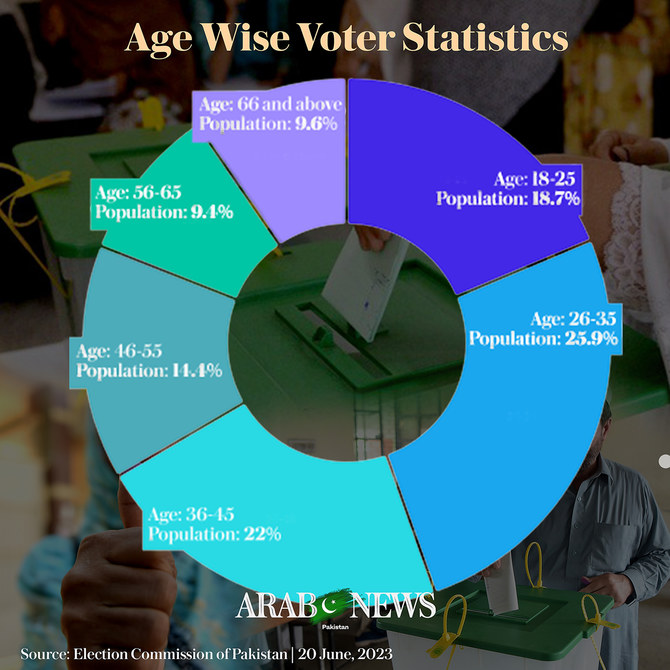
According to voter statistics shared by the Election Commission of Pakistan (ECP) on social media, over 126 million Pakistani citizens are set to cast their votes in the upcoming elections, out of which 23.5 million (18.66 percent) fall within the 18 to 25-year age group. Meanwhile, 32.6 million (25.91 percent) registered voters fall within the 26-35 age bracket.

The data showed that Pakistani voters who fall within the 36 to 45-year age group make up 27.7 million (22.03 percent) of the total voters while 18.1 million (14.38 percent) of the voters are aged between 46 to 55 years. Pakistani voters who fall within the 56-65-year age bracket number to about 11.8 million and 9.44 percent of the total voters.

Meanwhile, the ECP data showed that Pakistani voters aged 66 and above make up about 12.09 million (9.61 percent) of the total voters.

Pakistan’s political parties have increasingly turned their attention toward social media platforms such as Facebook, Twitter and video-sharing platform YouTube in recent years to engage younger audiences and promote their narratives. Former prime minister Imran Khan’s Pakistan Tehreek-e-Insaf (PTI) is arguably the most popular political party on social media, and is often regarded as the most favored by the country’s young population.


China backs Pakistan in fight against militancy after deadly Balochistan attacks

Updated 03 February 2026
Follow

China backs Pakistan in fight against militancy after deadly Balochistan attacks

  • China is a major ally and investor in Pakistan and has pledged over $65 billion in major infrastructure projects, including in Balochistan
  • Chinese Foreign Ministry spokesperson Lin Jian says ‘we mourn for lives lost, and our hearts go out to injured and those who lost loved ones’

ISLAMABAD: China condemns the recent attacks that killed more than 200 people in Pakistan’s southwestern Balochistan province, a Chinese foreign ministry spokesperson said on Tuesday, reaffirming Beijing’s support for Pakistan in its fight against militancy.

The Baloch Liberation Army (BLA) group launched coordinated attacks in several cities across Balochistan on Saturday, killing 33 civilians and 17 security personnel. Officials said 117 militants were killed in skirmishes and follow-up operations.

Balochistan, which borders Iran and Afghanistan, is the site of a decades-long insurgency waged by Baloch separatist groups who often attack security forces, foreigners and non-local Pakistanis and kidnap government officials.

China is a major ally and investor in Pakistan and has pledged over $65 billion in investment in road, infrastructure and development projects under the China-Pakistan Economic Corridor (CPEC).

“China strongly condemns the [Balochistan] attacks... We mourn for the lives lost, and our hearts go out to the injured and those who lost their loved ones,” Chinese Foreign Ministry spokesperson Lin Jian said at a press briefing on Tuesday.

“China firmly opposes any form of terrorism and will as always firmly support Pakistan in combating terrorism, maintaining solidarity and social stability, and protecting the safety of the people.”

Chinese nationals working in Pakistan have often been targeted by militants, particularly in the southwestern Balochistan province, where China is developing a deep seaport that is touted as the crown jewel of CPEC.

Interior Minister Mohsin Naqvi said last week the attacks, claimed by the separatist Baloch Liberation Army (BLA), were planned from India. New Delhi rejected the allegation as “baseless,” saying Islamabad was attempting to deflect attention from its internal challenges.

Balochistan is home to vast reserves of minerals and hydrocarbons. Separatist militant groups such as the BLA blame Islamabad for exploiting Balochistan’s natural resources and denying locals a share in them. The military and civilian government reject these allegations and say they are investing in the province’s development.