

Pakistan’s moon-sighting committee meets today to sight Muharram crescent

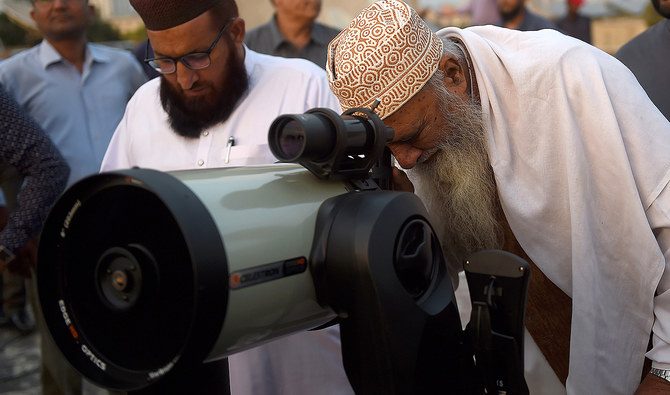
In this photo, taken on March 22, 2023, a member of Pakistan's Ramadan moon-sighting committee uses a telescope to observe the appearance of the Ramadan Moon in Karachi. (AFP/File)
Short Url
Updated 18 July 2023
Follow

Pakistan’s moon-sighting committee meets today to sight Muharram crescent

  • Muharram marks the beginning of the new year in the Islamic lunar calendar
  • Ruet chairman Moulana Abdul Khabir Azad to preside over meeting in Quetta

ISLAMABAD: Pakistan’s central moon-sighting committee, the Ruet-e-Hilal Committee (RHC) will meet today, Tuesday, for the sighting of the crescent for the Islamic month of Muharram, the state-run Radio Pakistan said.

Muharram marks the beginning of the new year in the Islamic lunar calendar during which Shia Muslims across Pakistan hold gatherings and organize processions to pay homage to Imam Hussain, the grandson of Prophet Muhammad (peace be upon him). Shia Muslims across the country mourn Imam Hussain’s martyrdom, which took place on the 10th of Muharram, which is also known as the ‘Day of Ashura’ during which large rallies and processions are held.

In Pakistan, the chairman of the central RHC announces the decision about the sighting of the crescent on the basis of testimonies received from different corners of the country.

“The Central Ruet-e-Hilal Committee meets in Quetta on Tuesday evening for sighting the Crescent of Muharram-ul-Haram 1445 Hijri,” Radio Pakistan said in a report. “Chairman of the Committee Moulana Abdul Khabir Azad will preside over the meeting.”

The state-run website said meetings of the RHC’s zonal and district committees would also be held at their respective headquarters.

Every year, Pakistan beefs up security for Muharram processions and blocks phone and Internet services on Muharram 8, 9, and 10 as part of stringent security measures to prevent sectarian violence. These measures are taken in several cities across Pakistan including Islamabad, Lahore, Peshawar, Karachi, Rawalpindi and others.

Since 2020, the government has advised religious leaders to ensure strict coronavirus precautions are followed during Muharram processions. Pakistan’s pandemic task force, the National Command and Operation Center (NCOC) asked Muslims to follow officially prescribed health precautions during Muharram congregations which included wearing face masks and maintaining a distance of six feet from one another.

Coronavirus cases and deaths from the pandemic, however, have drastically gone down in the country since Pakistan started administering vaccine doses to the masses in 2021.


Pakistan, UK sign £35 million Green Compact to strengthen climate resilience

Updated 21 December 2025
Follow

Pakistan, UK sign £35 million Green Compact to strengthen climate resilience

  • Pakistan ranks among nations most vulnerable to climate change and has seen erratic changes in its weather patterns
  • UK will help Pakistan mobilize climate finance, strengthen regulatory frameworks and develop bankable climate projects

ISLAMABAD: Pakistan and the United Kingdom (UK) have formalized a comprehensive climate partnership with the launch of a Green Compact that aims to enhance climate resilience, accelerate clean energy transition and scale up nature-based solutions, including mangrove conservation, Pakistani state media reported on Sunday.

The agreement, signed in Islamabad by Federal Minister for Climate Change and Environmental Coordination Dr. Musadik Malik and UK Minister for International Development Jennifer Chapman, unlocks £35 million in targeted support for green development and long-term climate action, according to Radio Pakistan broadcaster.

Pakistan ranks among nations most vulnerable to climate change and has seen erratic changes in its weather patterns that have led to frequent heatwaves, untimely rains, storms, cyclones, floods and droughts in recent years. In 2022, monsoon floods killed over 1,700 people, displaced another 33 million and caused over $30 billion losses, while another 1,037 people were killed in floods this year.

Mohammad Saleem Shaikh, a spokesperson for Pakistan’s Ministry of Climate Change, described the compact as a “decisive move toward action-oriented climate cooperation,” noting that its implementation over the next decade will be critical for Pakistan which regularly faces floods, heatwaves and water stress.

“The Compact is structured around five core pillars: climate finance and investment, clean energy transition, nature-based solutions, innovation and youth empowerment, and adaptation and resilience,” the report read.

“Under the agreement, the UK will work with Pakistan to mobilize public and private climate finance, strengthen regulatory frameworks for green investment, and develop bankable climate projects.”

Clean energy forms a central component of Pakistan’s transition, with Islamabad planning to expand solar and wind generation to reduce fossil fuel dependence, improve energy security and stabilize power costs, according to Shaikh.

“Renewable energy is now economically competitive, making the transition both environmentally and financially viable,” he was quoted as saying.

“Nature-based solutions, particularly large-scale mangrove restoration, will protect coastal communities from storm surges and erosion while enhancing biodiversity and carbon sequestration.”

Under the Compact, technical support, mentoring and access to investors will be provided to climate-smart startups and young innovators, reflecting Pakistan’s recognition of youth-led initiatives as central to future climate solutions.

On the occasion, Chapman, on her first official visit to Pakistan, underscored the urgency of climate action, highlighting the UK’s support for renewable energy, mangrove and ecosystem restoration, early-warning systems, climate budgeting and international investment flows into Pakistan.

Shaikh described the Green Compact as “a strategic turning point” in Pakistan–UK relations on climate change, saying its effective implementation is essential for Pakistan to meet its national climate targets.