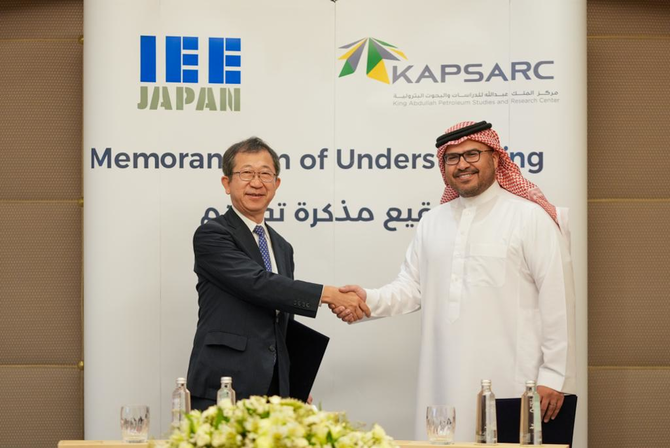

RIYADH: Saudi Arabia’s King Abdullah Petroleum Studies and Research Center has signed an agreement with the Institute of Energy Economics, Japan to work closer together to help their countries achieve their net-zero goals.
The organizations have agreed to develop joint strategies and roadmaps as part of the Saudi-Japan Lighthouse Initiative for Clean Energy Cooperation.
The project is designed to serve as a beacon for other countries looking to slash their carbon emissions, according to a press release.
The Kingdom aims to decarbonize and reach net-zero emissions by 2060 or sooner, while Japan is aiming to reach that level by 2050.
The signing of the agreement came after Crown Prince Mohammed bin Salman held a bilateral meeting with Japanese Prime Minister Kishida Fumio in Jeddah on Sunday.
President of KAPSARC Fahad Al-Ajlan stated that the work his organization has already done with the Japanese institution goes beyond energy policy, climate, and sustainability, and also encompasses enablers such as technology and finance to ensure a just and inclusive energy transition.
“This transition is crucial not only for our two countries but also for the global population of over 3 billion people currently without access to energy,” he added.
Chairman and CEO of the IEEJ Tatsuya Terazawa added: “I am excited to raise the level of cooperation with KAPSARC to a higher level with this MoU.
“We need to turn expectations for energy transition into reality. I believe that IEEJ and KAPSARC could lead the world in this important task together.”
The initiative, also known as Manar, seeks to highlight Saudi Arabia and Japan’s leadership in clean energy projects and sustainable advanced materials, as well as to ensure the supply chain’s resilience.
Manar will support the ongoing efforts that Saudi Arabia is undertaking to become a hub for clean energy, mineral resources and supply chains.
The MoU framework encompasses joint workshops and events, participation in international conferences, peer review of research and policy papers and exchange of researchers.
The Kingdom aims to decarbonize and reach net-zero emissions by 2060 or sooner, utilizing the low cost of renewable and clean hydrogen, as well as Saudi Arabia’s strategic location on global trading routes for energy supplies.
The efforts will facilitate the participation of leading companies from the Kingdom and Japan, and expand on their existing collaboration, to produce multiple components in the energy supply chain, enabling the development of the Lighthouse projects.
The partnership will create Lighthouse projects that serve as roadmaps for the transition to clean energy, concentrating on topics including hydrogen, ammonia, and e-fuel.
It will also serve topics such as the circular economy, carbon recycling, direct air capture, and crucial minerals needed for the energy sector.
The partnership will also work in the area of supply chain resilience, sustainable advanced materials, research, and knowledge sharing.
Saudi Arabia and Japan are expected to diversify their long-standing trade relations in the energy sector as both countries work together to pursue goals of common interest, Saudi Energy Minister Prince Abdulaziz bin Salman said on the sidelines of Kishida’s visit.