

‘Kingdom of opportunities’: Saudi Arabia invites entrepreneurs to join flagship projects at G20 summit

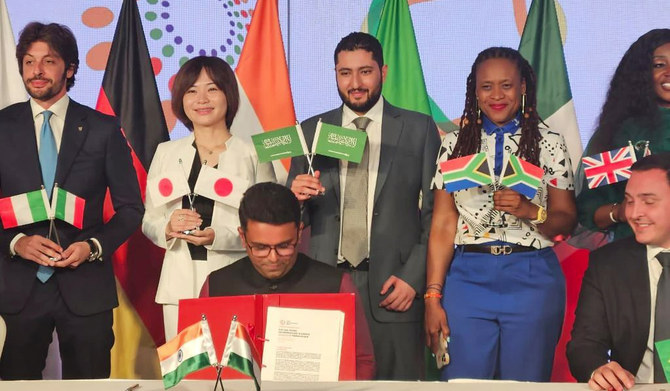
Saudi delegation head Prince Fahad bin Mansour, center, is surrounded by international delegates to the G20 Young Entrepreneurs Alliance Summit in New Delhi on July 15, 2023. (AN photo)
Short Url
Updated 16 July 2023
Follow

‘Kingdom of opportunities’: Saudi Arabia invites entrepreneurs to join flagship projects at G20 summit

  • Prince Fahad bin Mansour calls on ‘dreamers, innovators and creators’ to join NEOM
  • Young Entrepreneurs Alliance Summit focused on energy transition, circular economy

NEW DELHI: The Saudi delegation to the G20 Young Entrepreneurs Alliance Summit in New Delhi on Saturday invited young innovators to expand their businesses into the Kingdom and join its flagship projects.

The summit, which ran from July 13-15 was held under the Indian presidency of the G20. Hosted by Young Indians, a group of businessmen that is part of the Confederation of Indian Industry, it drew hundreds of participants from the G20 member nations and focused on inclusive trade, cooperation in green-energy transition, the adoption of a circular economy, and ways to tap into the potential of global digital transformation to support inclusive growth.

The Saudi delegation was led by Prince Fahad bin Mansour, chairman of Saudi Arabia’s Entrepreneurship Vision and president of the Saudi G20 Young Entrepreneurs Alliance.

“We are biban — which means doors,” Prince Fahad told the summit’s participants. “Each one of us is an open door to the Kingdom of Saudi Arabia, and we are out here to welcome you to the kingdom of opportunities.”

He invited global entrepreneurs to relocate, expand, or start new businesses in Saudi Arabia with the assistance of the summit’s strategic partner, the Kingdom’s investment brand Invest Saudi.

“They will assist you through your journey,” Prince Fahad said. “They are here today with us to make sure you get all the support needed to be in Saudi.”

He also made a special invitation “for dreamers, innovators and creators” to join NEOM — the Kingdom’s flagship $500 billion smart city project.

“This is the nation of entrepreneurs, and you are invited to participate in building this giga project and join more than 1,000 entrepreneurs who are already in NEOM,” he said.

The summit concluded with a communique issued by representatives of the G20 on behalf of millions of young entrepreneurs, which included recommendations to increase connectivity and digitization, and to address the global food crisis.

YEA members called on global leaders to address digital inclusion and cybersecurity challenges for emerging businesses, increase access to capital for young entrepreneurs, address barriers to inclusive trade, increase the inclusion of women and other marginalized groups in entrepreneurial opportunities, and to support green innovation and a transition to a global circular economy.

“We believe immediate commitments by G20 governments with respect to the areas we have highlighted can send a powerful message to those within our societies who can best lead this effort — our young entrepreneurs,” the communique read.

“We submit these recommendations in the spirit of partnership and in the firm belief that encouraging young entrepreneurs across our societies will lead to dynamism, growth and the economic and social renewal of our planet.”


Saudi Arabia champions AI and sustainable growth at UN tourism meeting in Kuwait

Updated 12 February 2026
Follow

Saudi Arabia champions AI and sustainable growth at UN tourism meeting in Kuwait

  • Saudi Tourism Minister says tourism today accounts for approximately 10 percent of the world economy, contributing about $10 trillion to global GDP 

KUWAIT CITY: Saudi Arabia’s Tourism Minister Ahmed Al-Khateeb has called for stronger international cooperation to build a tourism ecosystem that is integrated, resilient, and future-ready, the Saudi Press Agency reported Thursday.

In a opening address at the 52nd UN Tourism Regional Commission for the Middle East in Kuwait City, he noted that tourism is “no longer a peripheral activity but a massive engine of economic development.”

“With an estimated contribution exceeding $10 trillion to global GDP, tourism today accounts for approximately 10 percent of the world economy,” said Al-Khateeb, speaking as president of the 26th UN Tourism General Assembly. The three-day conference opened on Feb. 10.

He pointed to the Middle East’s exceptional recovery, which recorded a 39 percent increase in international arrivals in 2025 compared to 2019, welcoming nearly 100 million visitors last year.

The minister highlighted Saudi Arabia’s driving force behind these regional statistics, noting that the Kingdom now represents approximately 30% of the Middle East tourism market in both visitor numbers and spending.

“We are proud that Saudi tourism’s uninterrupted growth has become a driving force for regional tourism, and we look forward to continuing our close cooperation with UN Tourism to share our expertise with the world,” he said.

Focus on AI

Addressing the meeting’s central theme of Artificial Intelligence (AI), Al-Khateeb emphasized the need for responsible innovation. He described AI as a key enabler for growth but stressed that the “human touch” defining the hospitality sector must be maintained and the workforce protected.

On the sidelines of the regional commission, the minister met with counterparts from across the region to explore ways to promote regional cooperation and alignment to enhance resilience and build tourism industries that can drive inclusive economic and social development.

Al-Khateeb also met with leading investors from Kuwait to discuss investments in the Kingdom’s tourism sector and explore new opportunities to leverage Saudi Arabia’s integrated investment ecosystem, designed to enable regional and international investors to achieve sustainable, long-term value.

The 52nd UN Tourism Regional Commission for the Middle East is the first held in the region since the 26th UN Tourism General Assembly, hosted in Riyadh last November. 

That assembly resulted in the historic “Riyadh Declaration on the Future of Tourism,” which established a global consensus on sustainability, inclusive growth, and the responsible adoption of human-centric AI for the next fifty years.