

Jordan restaurant offers mansaf-lovers an opportunity for a nap after meals

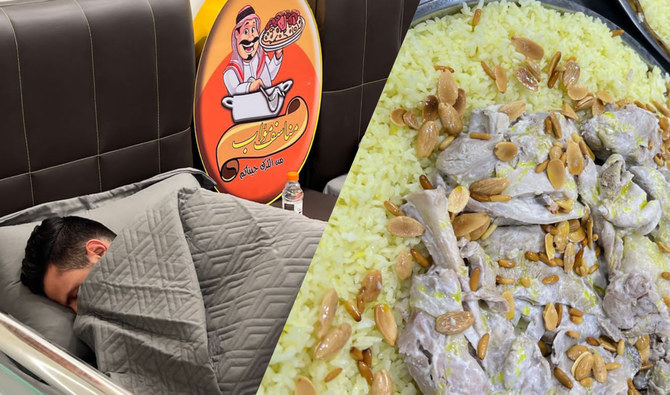
This combination of photos, created on July 15, 2023, features the Jordanian iconic dish “mansaf” (right) and a customer during during a post-meal nap nap in a restaurant in Amman. (Supplied)
Short Url
Updated 15 July 2023
Follow

Jordan restaurant offers mansaf-lovers an opportunity for a nap after meals

  • Mansaf is a traditional Levantine dish made of lamb cooked in a sauce of fermented dried yogurt
  • The air-conditioned “bedroom” offers mansaf-lovers a good post-meal napping opportunity

AMMAN: With the Jordanian iconic dish “mansaf” believed to cause severe sleepiness, a restaurant in Amman is offering its customers a napping opportunity to overcome their post-meal tiredness.

Mansaf is thought to cause drowsiness due to its high-fat ingredients, especially during hot weather, prompting lovers of Jordan’s celebrated national dish to avoid restaurants and only eat it at home where they can have a quick nap.

However, a restaurant in Jordan’s capital Amman has solved the post-meal sleepiness of mansaf by providing lovers of the traditional Levantine dish with beds for a quick nap.

Named “Moab” after the ancient Kingdom of Moab in Jordan’s southern city of Karak, the restaurant only serves mansaf.

“The idea to put beds in the restaurant started as a joke and decoration to reflect the sleepiness mansaf-eaters’ experience after they have the high-fat meal,” Musab Mubeideen, son of the restaurant’s owner, told Arab News.

He said that mansaf “is a fat-laden meal cooked with lamb meat, rice and jameed (ghee), and these ingredients put together are just a recipe for sleepiness and total tiredness.”

Mubaideen is from the city of Karak, 90 km south of Amman, which is famous for its high-quality “jameed.”

“Why don’t you put beds in the restaurant,” said a customer, who was rubbing his eyes and was sleepy after eating mansaf. Then other customers told us the same,” Mubaideen said.

“So we brought beds and set them up in a separate section in the restaurant. Customers now really use them for a quick nap after they have mansaf,” he said.

The “bedroom,” he said, has an air-conditioner and is also quiet, offering mansaf-lovers a good napping opportunity. “They also can have traditional Jordanian coffee there.”

Mansaf, meaning a large platter, is a traditional Levantine dish made of lamb cooked in a sauce of fermented dried yogurt and served with rice or bulgar. The Jordanian version of mansaf uses bread on the bottom of the plate.

Sotheby’s to bring coveted Rembrandt lion drawing to Diriyah

Updated 18 January 2026
Follow

Sotheby’s to bring coveted Rembrandt lion drawing to Diriyah

DUBAI: Later this month, Sotheby’s will bring to Saudi Arabia what it describes as the most important Rembrandt drawing to appear at auction in 50 years. Estimated at $15–20 million, “Young Lion Resting” comes to market from The Leiden Collection, one of the world’s most important private collections of 17th-century Dutch and Flemish art.

The drawing will be on public view at Diriyah’s Bujairi Terrace from Jan. 24 to 25, alongside the full contents of “Origins II” — Sotheby’s forthcoming second auction in Saudi Arabia — ahead of its offering at Sotheby’s New York on Feb. 4, 2026. The entire proceeds from the sale will benefit Panthera, the world’s leading organization dedicated to the conservation of wild cats. The work is being sold by The Leiden Collection in partnership with its co-owner, philanthropist Jon Ayers, the chairman of the board of Panthera.

Established in 2006, Panthera was founded by the late wildlife biologist Dr. Alan Rabinowitz and Dr. Thomas S. Kaplan. The organization is actively engaged in the Middle East, where it is spearheading the reintroduction of the critically endangered Arabian leopard to AlUla, in partnership with the Royal Commission for AlUla.

“Young Lion Resting” is one of only six known Rembrandt drawings of lions and the only example remaining in private hands. Executed when Rembrandt was in his early to mid-thirties, the work captures the animal’s power and restless energy with striking immediacy, suggesting it was drawn from life. Long before Rembrandt sketched a lion in 17th-century Europe, lions roamed northwest Arabia, their presence still echoed in AlUla’s ancient rock carvings and the Lion Tombs of Dadan.

For Dr. Kaplan, the drawing holds personal significance as his first Rembrandt acquisition. From 2017 to 2024, he served as chairman of the International Alliance for the Protection of Heritage, of which Saudi Arabia is a founding member.

The Diriyah exhibition will also present, for the first time, the full range of works offered in “Origins II,” a 64-lot sale of modern and contemporary art, culminating in an open-air auction on Jan. 31 at 7.30 pm.