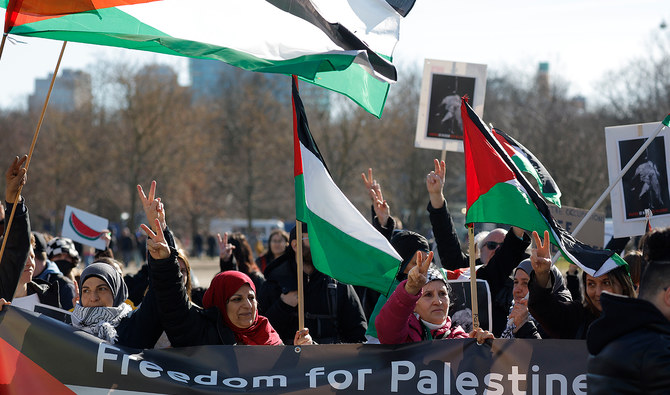

ISLAMABAD: Pakistan has an “important opportunity” to approach the World Court to support the rights of Palestinians, the Human Rights Watch (HRW) global advocacy group said on Friday, adding the move would also allow Pakistan to advance key principles of the international human rights laws.
Pakistan does not recognize the state of Israel and calls for an independent Palestinian state based on “internationally agreed parameters” and the pre-1967 borders with Al-Quds Al-Sharif as its capital.
While the South Asian country has long been calling out Israel for its atrocities against the people of Palestine, its foreign minister, Bilawal Bhutto Zardari, this year recognized Israel’s apartheid at a UN news conference as well.
According to the HRW, Pakistan can help shape the International Court of Justice’s (ICJ) approach toward Israeli rights violations by making an official submission part of the court record.
“Pakistan has an important opportunity to support Palestinian rights at the World Court and in doing so to advance key principles of international law that protect human rights globally,” the HRW said in an article published on Saturday.
“A Pakistan submission should urge the court to broadly assess the legal consequences of the 56-year-old occupation [of Palestine], including violations of core principles of international law, discriminatory laws, policies and practices of successive Israeli governments, and the consequences of these for international human rights, humanitarian and criminal law.”
Pakistan should make it clear to the court in its submission that so long as Israeli authorities continue to occupy the Palestinian territory, they are required to ensure that Palestinians living under occupation have the full protection of the rights guaranteed to everyone under international human rights law, using as a benchmark the rights they grant Israeli citizens, as well as protections they are owed under the international humanitarian law, according to the article.
“[Pakistan] should also encourage the court to take stock of the increasingly transparent reality that Israeli authorities methodologically privilege Jewish Israelis, who are governed under the same body of laws with the same rights and privileges wherever they live, while systematically discriminating against Palestinians wherever they live,” it said.
The South Asian country, the article read, should also urge the court to consider the consequences of Israeli authorities’ failure to regard the occupation as temporary as Israel has made clear its intent to maintain overriding control over the West Bank in perpetuity.
Pakistan should also ask the court to make clear that Israeli authorities’ treatment of Palestinians is racial discrimination and indicate that Israeli authorities are committing the crimes of apartheid and persecution as defined under the international law, it added.
UN member countries have an obligation to take action against the crimes against humanity of apartheid and persecution, to end complicity in such crimes, and to press for accountability, according to the HRW. Silence, inaction, and denial in the face of Israeli crimes against humanity pose a grave challenge to the rules-based international order.
Last week, Pakistani Prime Minister Shehbaz Sharif said what Israel was doing in Palestine constituted “war crimes for all practical purposes” and called out the international community for remaining silent over the atrocities.
Sharif’s statement followed repeated raids by Israeli forces on the Jenin refugee camp in the occupied West Bank that resulted in the killing of multiple Palestinians this month.