
RIYADH: The famous black shirts. The Haka. And of course, the devastating rugby.
New Zealand’s All Blacks are sporting royalty, a team that transcends rugby and one of the world’s major attractions when the biggest matches come around.
And they do not come bigger than the Rugby World Cup 2023.
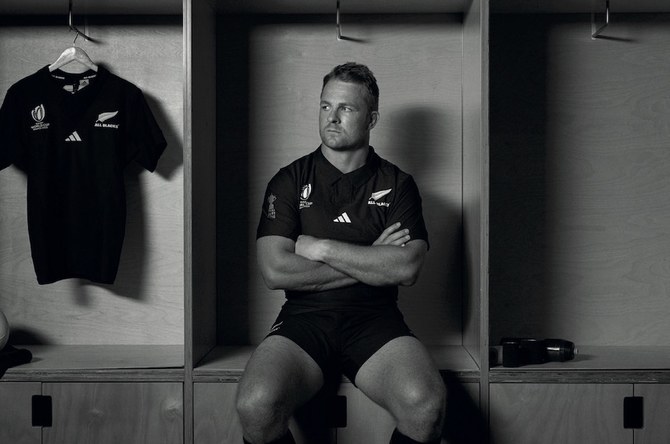
When the 10th edition of the tournament kicks off in France in September, the Kiwis will once again be among the favorites, and to launch their new shirt for the tournament, the design of the team’s new adidas shirts was entrusted to underground French artist Fey the Wolf, known for his passion for the color black.
There was only one place to start, the famous badge.
Fey said: “I was watching the ferns first and I wanted to twist it to my way, doing something minimalist.
“I found this fern and I used it to find my own style. I was watching the old logo and the old jerseys that the All Blacks had through the years, and I was inspired by that, and I wanted to do it something different, something minimalist, and something that would look pure.
“And I found this idea of doing the fern in the one line to symbolize the unity and the brotherhood of the team.”
While Fey studied old footage of the All Blacks uniform and badge for inspiration, he also incorporated elements from his own homeland.
“When I started thinking how to design the fern, I was looking at the silver fern, the fern from New Zealand.
“They are more sharp, more pointed. And I also watched the fern that came from France, they’re called Osmunda royal. The leaves are more rounded. I wanted something like a mix of both, to be the bridge between New Zealand and France,” he added.
Fey, who noted that there was “no more iconic jersey in sport” than that of the All Blacks, also revealed that the design process, eventually, came naturally to him.
He said: “It was not difficult because it was organic. We had a brief before, and we had a conversation with the players.
“Like I say, it was very organic, because I was at work doing my thing and I had the idea at the moment, so I asked for a break. I went outside with a paper and a pen, and I said, ‘yeah, I want to do the fern.’
“So, I tried different ways, probably 10 or 12 ferns, but the right one was in maybe in the first three.”
Matt Fielding, category director for adidas Rugby, said that Fey was told to enter the design process with an open mind and to create something fresh.
“We did a lot of the work behind the briefing of what the jersey should be and how we could connect credibly and relevantly France and New Zealand, rather than looking back into the years of cultural history.
“We wanted to do something more unexpected and something different to what we’ve done before, which is why we asked Fey to take a look actually more at the relevance between what he can bring and also keeping in check with the ideals of the All Blacks and what makes them so iconic,” Fielding added.
The 2023 Rugby World Cup kicks off on Sept. 8, appropriately with New Zealand taking on hosts France in Pool A.
Ben Herath, who heads up the design team for adidas Rugby, said that the jersey worn by the All Blacks for the last World Cup had also incorporated elements from the host nation.
“I think what’s important to remember is always what we’ve done before, and I think in 2019 the stars were aligning in terms of how we brought something different to the jersey that was relevant between Japan and New Zealand,” he added.
When Fey was approached in 2021, the sporting brand was looking for something “unexpected.”
Herath said: “Obviously the selection of the artist was key to that in terms of how we bring something different, how we look toward a new audience, and also how we can bring New Zealand rugby into France as being the host nation of the World Cup.
“But it’s always about the iconic New Zealand jersey. And so, we want to make sure that, as the mantra that comes from NZR says, we don’t own this jersey, we’re looking after it, leaving in a better place. So, we need to be part of that legacy, handing it on.”
He noted that the jersey of the All Blacks was an icon that transcended rugby to symbolize something larger.
“With that comes a lot of responsibility, honor as well. And therefore, as we work on the jersey, it’s always aimed at the highest levels of play. What we see is the best players in the world, the best team in the world, and to make sure that everything we’re doing is contributing to their success and building on the legacy of the jersey.”
Herath pointed out that part of the design process, and production of the jersey, was to involve the players at every step of the way.
“It’s been an incredible partnership throughout the three years as well, because they’ve really helped in shaping the jersey. I think one of the incredible things is just watching their reaction every time we’ve brought a prototype to them to wear,” he added.
Fielding echoed Herath’s comments on the involvement of the players in helping design the shirt the All Blacks will wear as they look to win back the trophy they claimed in 2011 and 2015, having been the first ever winners of the World Cup in 1987.
He said: “It’s part of what makes our job so much fun, so enjoyable. At different stages of the testing, we can see the players’ reaction. It’s not so much the interviewing of the players after they’ve worn it, it’s more those reactions that you catch in the corner of your eye as they put the jersey on.
“I think the important thing, and the respectful thing that we see is that we never actually see, and we will never see, the players pull on that final jersey.
“That's their own moment. That’s their own relationship with the jersey and that’s something that we would never impinge. We would never look to watch that and see the reaction. But we’re confident that this is a really great-performing jersey. And just perfect for the team to enter into this World Cup.”