

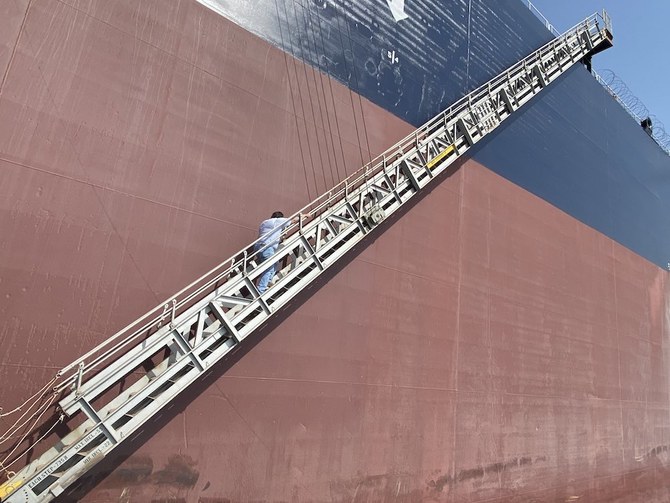
Ship enroute to Yemen to transfer oil from decaying Safer tanker

1 / 3
The vessel Nautica is sailing from to Yemen’s Red Sea coast to take on 1 million barrels of oil from the decaying Safer supertanker. (Twitter: @DavidGressly)
2 / 3
The vessel Nautica is sailing from to Yemen’s Red Sea coast to take on 1 million barrels of oil from the decaying Safer supertanker. (Twitter: @DavidGressly)
3 / 3
The vessel Nautica is sailing from to Yemen’s Red Sea coast to take on 1 million barrels of oil from the decaying Safer supertanker. (Twitter: @DavidGressly)
Short Url
Updated 15 July 2023
Follow

Ship enroute to Yemen to transfer oil from decaying Safer tanker

  • Houthis earlier allowed experts to board and inspect the deteriorating Safer tanker
  • The 47-year-old Safer has had little or no maintenance since the war in Yemen began in 2015

DUBAI: A ship is enroute to Yemen to pump oil from the decaying Safer tanker, the UN’s official coordinator for Yemen said on Saturday.

“The replacement vessel Nautica set sail from #Djibouti today at 09:45 en route to Yemen’s Red Sea coast to take on 1 million barrels of oil from the decaying #FSOSafer supertanker. I am excited to be aboard and for the start of the oil transfer next week!,” David Gressly, the UN resident coordinator for Yemen, posted on Twitter.


The Iran-backed Houthis finally allowed international engineers to board and inspect the deteriorating Safer tanker, moored off Hodeidah in western Yemen, after years of resistance against any operation to salvage the ship.

The 47-year-old Safer has had little or no maintenance since the war in Yemen began in 2015 and has deteriorated to such an extent that experts fear it is in imminent danger of springing a leak, catching fire, or exploding.

Environmentalists and officials have warned of large-scale environmental disaster if the ship’s cargo leaked into the ocean. Images of seawater flowing into the tanker’s rooms as rust eats away at the walls have grabbed international attention during the past three years.

Experts estimate a major leak from the Safer could severely damage Red Sea ecosystems upon which around 30 million people depend for a living, including 1.6 million Yemenis, according to the UN.


Ankara city hall says water cuts due to ‘record drought’

Updated 10 January 2026
Follow

Ankara city hall says water cuts due to ‘record drought’

  • Dam reservoir levels have dropped to 1.12 percent and taps are being shut off for several hours a day in certain districts on a rotating schedule in Ankara

ANKARA: Water cuts for the past several weeks in Turkiye’s capital were due to the worst drought in 50 years and an exploding population, a municipal official told AFP, rejecting accusations of mismanagement.
Dam reservoir levels have dropped to 1.12 percent and taps are being shut off for several hours a day in certain districts on a rotating schedule in Ankara, forcing many residents to line up at public fountains to fill pitchers.
“2025 was a record year in terms of drought. The amount of water feeding the dams fell to historically low levels, to 182 million cubic meters in 2025, compared with 400 to 600 million cubic meters in previous years. This is the driest period in the last 50 years,” said Memduh Akcay, director general of the Ankara municipal water authority.
Turkish President Recep Tayyip Erdogan has called the Ankara municipal authorities, led by the main opposition party, “incompetent.”
Rejecting this criticism, the city hall says Ankara is suffering from the effects of climate change and a growing population, which has doubled since the 1990s to nearly six million inhabitants.
“In addition to reduced precipitation, the irregularity of rainfall patterns, the decline in snowfall, and the rapid conversion of precipitation into runoff (due to urbanization) prevent the dams from refilling effectively,” Akcay said.
A new pumping system drawing water from below the required level in dams will ensure no water cuts this weekend, Ankara’s city hall said, but added that the problem would persist in the absence of sufficient rainfall.
Much of Turkiye experienced a historic drought in 2025. The municipality of Izmir, the country’s third-largest city on the Aegean coast, has imposed daily water cuts since last summer.