

At UN, Pakistan urges boosting rescue mechanisms for distressed people at sea after Greece shipwreck

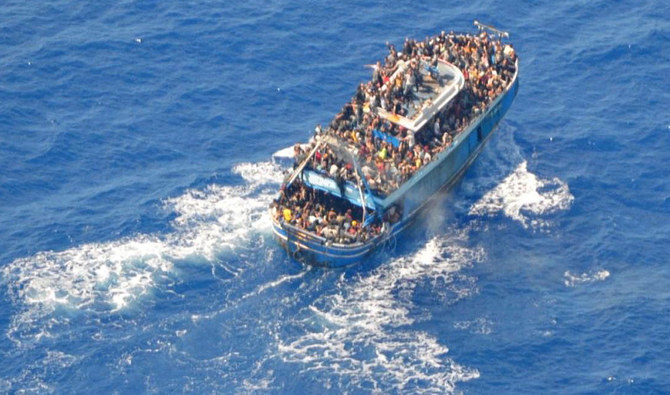
A undated handout photo provided by the Hellenic Coast Guard shows migrants onboard a boat during a rescue operation, before their boat capsized on the open sea, off Greece, June 14, 2023. (Photo courtesy: Hellenic Coast Guard via REUTERS)
Short Url
Updated 15 July 2023
Follow

At UN, Pakistan urges boosting rescue mechanisms for distressed people at sea after Greece shipwreck

  • The meeting was convened by Russia under the format of Arria formula, which affords the UNSC opportunity to hear persons in informal setting
  • The vessel, which sank on June 14, was carrying up to 750 people, including more than 300 Pakistanis, with 104 men rescued, 82 bodies found 

ISLAMABAD: Pakistan’s deputy permanent representative to the United Nations has urged the world to scale up rescue mechanisms for distressed people at sea, the Pakistani state media reported on Friday, a month after a fishing trawler capsized off the coast of Greece. 

A total of 104 men were rescued and 82 bodies were found, but survivor accounts suggested as many as 750 people, including more than 300 Pakistanis, were on board the vessel, with families calling on authorities to raise the wreck from the seabed and recover the bodies. 

Pakistan’s deputy permanent representative to the UN, Ambassador Aamir Khan, addressed a meeting of the UN Security Council on refugees and asylum-seekers, where he said Mediterranean Sea crossings had become “increasingly treacherous” and stressed the need to develop mechanisms for people in distress at sea.

“As responsible members of the international community, it is incumbent on us all to ensure the safety and security of migrants, refugees and asylum seekers, uphold international law including maritime law, and enforce the prompt rescue of individuals in distress at sea, regardless of their nationality or circumstances,” Ambassador Khan was quoted as saying by the state-run APP news agency. 

“As civilized nations, it is our responsibility to ensure that no life is lost at anytime, anywhere and under all circumstances. We must undertake all efforts including by developing a transparent, safe and predictable disembarkation mechanisms for people in distress at sea, while complying with international obligations and without obstructing humanitarian efforts.” 

The 15-member council meeting was convened by Russia under the format of Arria formula, which affords the council an opportunity to hear persons in a confidential, informal setting. 

Referring to the deepening humanitarian crisis, the Pakistani envoy said the Global Compact on Refugees (GCR) provided a good framework by outlining key objectives to ease pressure on hosting countries, enhance refugee self-reliance, expand third-country solutions, and support safe and dignified returns. 

“This is unfair and unequal and cannot be rectified by a business-as-usual approach,” Ambassador Khan said. “We will have to do more … if we want to prevent already desperate situations from becoming catastrophic.” 

The rusty trawler was carrying Pakistanis who were fleeing adverse economic conditions at home in search of a better life in Europe. Young men, primarily from eastern Punjab and northwestern Khyber Pakhtunkhwa province, often use a route through Iran, Libya, Turkiye, and Greece to enter Europe. 

Pakistan’s Interior Minister Rana Sanaullah last month said that around 350 Pakistani citizens were aboard the vessel. 


Pakistan warns India-Canada uranium deal could widen nuclear imbalance in South Asia

Updated 5 sec ago
Follow

Pakistan warns India-Canada uranium deal could widen nuclear imbalance in South Asia

  • Islamabad says assured uranium supplies could free India’s domestic reserves for military use
  • Foreign office calls for non-discriminatory nuclear cooperation framework for non-NPT states

ISLAMABAD: Pakistan on Thursday voiced concern over a uranium supply agreement and nuclear technology cooperation between India and Canada, warning the arrangement could expand India’s nuclear arsenal and undermine the global non-proliferation framework.

The statement came after Ottawa and New Delhi concluded a long-term deal covering uranium supplies and potential cooperation in advanced nuclear technologies, including small modular reactors.

The agreement was announced earlier this week as part of efforts by the two countries to deepen energy and economic ties. Canada has previously supplied uranium to India under a civilian nuclear cooperation framework first agreed in 2010 and implemented in 2013, with commercial supply contracts signed in subsequent years.

“Assured external uranium supplies effectively release India’s domestic reserves for military use, enabling the expansion of its fissile material stockpiles, accelerating the growth of its nuclear arsenal, and deepening existing asymmetries in South Asia’s strategic balance,” foreign office spokesperson Tahir Andrabi said in a statement while responding to media queries.

“The arrangement also undermines Canada’s commitment to the international non-proliferation regime and its corresponding obligations under that framework,” he added.

Andrabi said the agreement represents another country-specific exception in civilian nuclear cooperation, noting that India’s 1974 nuclear test — conducted using plutonium produced in a Canadian-supplied research reactor — led to the creation of the Nuclear Suppliers Group (NSG).

“A state whose actions necessitated the establishment of global export controls is now being granted preferential access under selective arrangements,” he added.

The foreign office spokesperson said India has not placed all of its civilian nuclear facilities under International Atomic Energy Agency safeguards and has not made binding commitments under the new arrangement to do so.

He also pointed out it was unclear what concrete non-proliferation assurances accompanied the agreement.

“Pakistan reiterates that civil nuclear cooperation must be governed by a non-discriminatory, criteria-based approach applicable equally to states that are not parties to the Nuclear Non-Proliferation Treaty (NPT),” Andrabi said.

“Selective exceptions diminish the credibility of the global non-proliferation framework and risk further destabilizing regional and global peace & security.”