

At UN, Pakistan urges boosting rescue mechanisms for distressed people at sea after Greece shipwreck

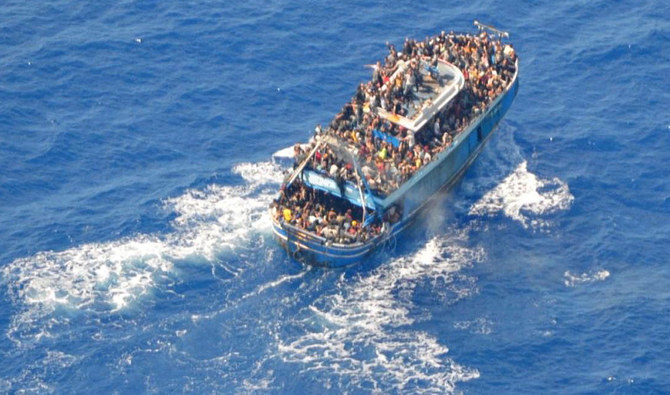
A undated handout photo provided by the Hellenic Coast Guard shows migrants onboard a boat during a rescue operation, before their boat capsized on the open sea, off Greece, June 14, 2023. (Photo courtesy: Hellenic Coast Guard via REUTERS)
Short Url
Updated 15 July 2023
Follow

At UN, Pakistan urges boosting rescue mechanisms for distressed people at sea after Greece shipwreck

  • The meeting was convened by Russia under the format of Arria formula, which affords the UNSC opportunity to hear persons in informal setting
  • The vessel, which sank on June 14, was carrying up to 750 people, including more than 300 Pakistanis, with 104 men rescued, 82 bodies found 

ISLAMABAD: Pakistan’s deputy permanent representative to the United Nations has urged the world to scale up rescue mechanisms for distressed people at sea, the Pakistani state media reported on Friday, a month after a fishing trawler capsized off the coast of Greece. 

A total of 104 men were rescued and 82 bodies were found, but survivor accounts suggested as many as 750 people, including more than 300 Pakistanis, were on board the vessel, with families calling on authorities to raise the wreck from the seabed and recover the bodies. 

Pakistan’s deputy permanent representative to the UN, Ambassador Aamir Khan, addressed a meeting of the UN Security Council on refugees and asylum-seekers, where he said Mediterranean Sea crossings had become “increasingly treacherous” and stressed the need to develop mechanisms for people in distress at sea.

“As responsible members of the international community, it is incumbent on us all to ensure the safety and security of migrants, refugees and asylum seekers, uphold international law including maritime law, and enforce the prompt rescue of individuals in distress at sea, regardless of their nationality or circumstances,” Ambassador Khan was quoted as saying by the state-run APP news agency. 

“As civilized nations, it is our responsibility to ensure that no life is lost at anytime, anywhere and under all circumstances. We must undertake all efforts including by developing a transparent, safe and predictable disembarkation mechanisms for people in distress at sea, while complying with international obligations and without obstructing humanitarian efforts.” 

The 15-member council meeting was convened by Russia under the format of Arria formula, which affords the council an opportunity to hear persons in a confidential, informal setting. 

Referring to the deepening humanitarian crisis, the Pakistani envoy said the Global Compact on Refugees (GCR) provided a good framework by outlining key objectives to ease pressure on hosting countries, enhance refugee self-reliance, expand third-country solutions, and support safe and dignified returns. 

“This is unfair and unequal and cannot be rectified by a business-as-usual approach,” Ambassador Khan said. “We will have to do more … if we want to prevent already desperate situations from becoming catastrophic.” 

The rusty trawler was carrying Pakistanis who were fleeing adverse economic conditions at home in search of a better life in Europe. Young men, primarily from eastern Punjab and northwestern Khyber Pakhtunkhwa province, often use a route through Iran, Libya, Turkiye, and Greece to enter Europe. 

Pakistan’s Interior Minister Rana Sanaullah last month said that around 350 Pakistani citizens were aboard the vessel. 


Pakistan raises India's suspension of water-sharing treaty with UNGA president, seeks action

Updated 7 sec ago
Follow

Pakistan raises India's suspension of water-sharing treaty with UNGA president, seeks action

  • New Delhi said in April last year it was holding the treaty in abeyance after a gun attack in Indian-administered Kashmir
  • Official says such actions threaten lives of 240 million Pakistanis, particularly at a time of climate stress, water scarcity

ISLAMABAD: Pakistan has taken up India’s suspension of a decades-old water-sharing treaty with the president of the United Nations General Assembly (UNGA), urging action over the move that Islamabad said sets "dangerous precedents."

The Indus Waters Treaty (IWT) divides control of the Indus basin rivers between the two nuclear-armed neighbors. India said in April last year it would hold the treaty “in abeyance” after a gun attack in Indian-administered Kashmir killed more than 26 tourists. New Delhi blamed the assault on Pakistan, Islamabad denied it.

The attack led to a four-day military conflict between the neighbors last May that say them attack each other with fighter jets, missiles, drones and artillery before the United States-brokered a ceasefire. Tensions have remained high between the nuclear-armed neighbors.

During a meeting on the sidelines of the Inter-Parliamentary Union (IPU) annual hearing, Pakistan Senate Chairman Yusuf Raza Gilani told UNGA President Annalena Baerbock that India's unlawful action constituted a blatant violation of the treaty’s provisions and principles of customary international law.

"Such actions threaten the lives and livelihoods of over 240 million Pakistanis and set dangerous precedents, particularly at a time when climate stress and water scarcity demand cooperation and strict respect for international agreements," he was quoted as saying by the Pakistani information ministry.

The treaty, mediated by the World Bank, grants Pakistan rights to the Indus basin’s western rivers — Indus, Jhelum, and Chenab — for irrigation, drinking, and non-consumptive uses like hydropower, while India controls the eastern rivers — Ravi, Beas, and Sutlej — for unrestricted use but must not significantly alter their flow.

Highlighting the adverse impacts of climate change, Gilani said countries like Pakistan remain among the most severely affected and underscored the urgency of collective action, climate justice and strengthened international cooperation.

"The United Nations provides an indispensable platform for addressing these interconnected challenges," he said at the meeting.

Gilani, who was leading a six-member parliamentary delegation, this week delivered the national statement at the IPU annual hearing at the UN headquarters, calling for democratic, transparent, and accountable decision-making in order to enhance the UN’s credibility, according to the Senate of Pakistan.

“Parliaments are indispensable partners in ensuring national ownership of international commitments,” he was quoted as saying by the Senate. “Reform is essential. But it must be ‘Reform for All, Privilege for None’.”

The Senate chairman highlighted the continuing importance of the United Nations as the cornerstone of multilateral cooperation, stressing that the organization’s universal membership and Charter-based mandate remain central to promoting global peace and security.