Death Valley visitors drawn to the hottest spot on Earth during ongoing US heat wave

1 / 5
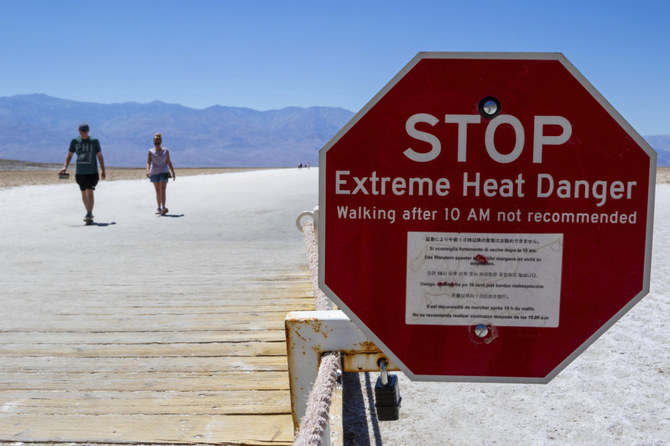
A sign stands warning of extreme heat on July 11, 2023, in Death Valley National Park, California. (AP)
2 / 5
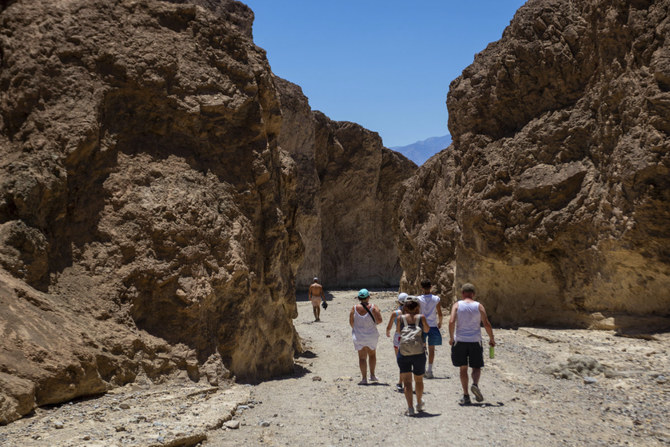
Hikers turn back to their vehicles in Golden Canyon on July 11, 2023, in Death Valley National Park, California. July is the hottest month at the park with an average high of 116 degrees (46.5 Celsius). (AP Photo/Ty ONeil)
3 / 5
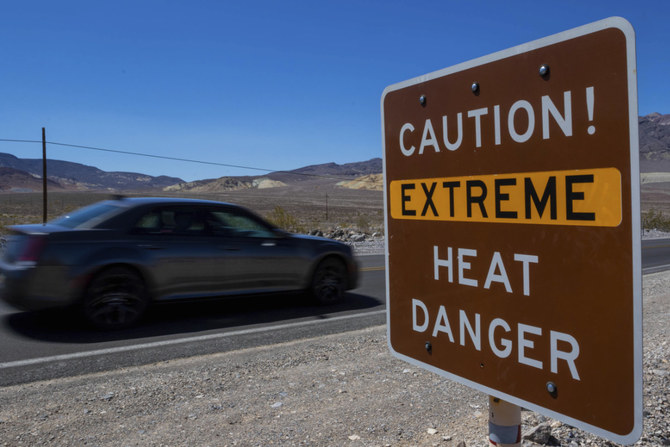
A sign stands warning of extreme heat on July 11, 2023, in Death Valley National Park, California. (AP)
4 / 5
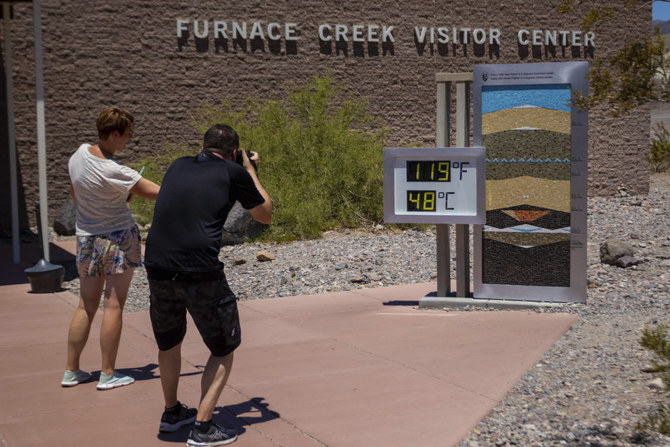
People stop to take photos of a thermostat reading 119° Fahrenheit (48° Celsius) at the Furnace Creek visitor center on July 11, 2023, in Death Valley National Park, California. (AP)
5 / 5
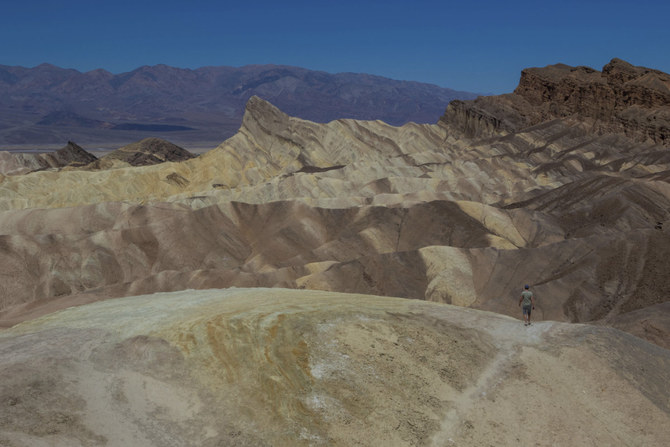
A man walks on a pathway on July 11, 2023, in Death Valley National Park, California. (AP)
Short Url
Updated 15 July 2023
Follow

Death Valley visitors drawn to the hottest spot on Earth during ongoing US heat wave

  • More than 1.1 million people annually visit the desert park, which sits over a portion of the California-Nevada border west of Las Vegas
  • Death Valley is a narrow, 282-foot (86-meter) basin that is below sea level but situated among high, steep mountain ranges

DEATH VALLEY NATIONAL PARK, California: As uninviting as it sounds, Death Valley National Park beckons.
Even as the already extreme temperatures are forecast to climb even higher, potentially topping records amid a major US heat wave, tourists are arriving at this infamous desert landscape on the California-Nevada border.
Daniel Jusehus snapped a photo earlier this week of a famed thermometer outside the aptly named Furnace Creek Visitor Center after challenging himself to a run in the sweltering heat.
“I was really noticing, you know, I didn’t feel so hot, but my body was working really hard to cool myself,” said Jusehus, an active runner who was visiting from Germany. His photo showed the thermometer reading at 120 degrees Fahrenheit (48.8 degrees Celsius).
Most visitors at this time of year make it only a short distance to any site in the park — which bills itself as the lowest, hottest and driest place on Earth — before returning to the sanctuary of an air-conditioned vehicle.
This weekend, the temperatures could climb past 130 F (54.4 C), but that likely won’t deter some willing to brave the heat. Signs at hiking trails advise against venturing out after 10 a.m., though nighttime temperatures are still expected to be over 90 F (32.2 C). The hottest temperature recorded at Death Valley was 134 F (56.6 C) in July 1913, according to the National Park Service.
Other parks have long-standing warnings for hikers. At Grand Canyon National Park in Arizona, officials are cautioning people to stay off the trails for most of the day in the inner canyon, where temperatures can be 20 degrees hotter than the rim.
In west Texas, Big Bend National Park near the Rio Grande is expected to be at least 110 F (43.3 C). The National Weather Service has said it’s best to just stay off the trails in the afternoon.
The precautions vary across parks and landscapes, said Cynthia Hernandez, a park service spokesperson. Certain trails might be closed if conditions are too dangerous. Alerts and restrictions are posted on websites for individual parks, Hernandez said.
Preliminary information form the park service shows at least four people have died this year from heat-related causes across the 424 national park sites. That includes a 65-year-old man from San Diego who was found dead in his vehicle at Death Valley earlier this month, according to a news release.
Death Valley National Park emphasizes self-reliance over expectations of rescue. While rangers patrol park roads and can assist motorists in distress, there’s no guarantee lost tourists will get aid in time.
More than 1.1 million people annually visit the desert park, which sits over a portion of the California-Nevada border west of Las Vegas. At 5,346 square miles (13,848 square kilometers), it’s the largest national park in the Lower 48. About one-fifth of the visitors come in June, July and August.
Many are tempted to explore, even after the suggested cutoff times. Physical activity can make the heat even more unbearable and leave people feeling exhausted. Sunbaked rocks, sand and soil still radiate after sunset.
“It does feel like the sun has gone through your skin and is getting into your bones,” said park Ranger Nichole Andler.
Others mentioned feeling their eyes drying out from the hot wind sweeping through the valley.
“It’s very hot. I mean, especially when there’s a breeze, you would think that maybe that would give you some slight relief from the heat, but it just really does feel like an air blow dryer just going back in your face,” said Alessia Dempster, who was visiting from Edinburgh, Scotland.
Death Valley is a narrow, 282-foot (86-meter) basin that is below sea level but situated among high, steep mountain ranges, according to the park service’s website. The bone-dry air and meager plant coverage allows sunlight to heat up the desert surface. The rocks and the soil emit all that heat in turn, which then becomes trapped in the depths of the valley.
The park’s brownish hills feature signage saying “heat kills” and other messaging, such as a Stovepipe Wells sign warning travelers of the “Savage Summer Sun.”
Still, there are several awe-inspiring sites that draw tourists. Badwater Basin, made up of salt flats, is considered the lowest point in all of North America. The eye-opening 600-foot (183-meter) Ubehebe Crater dates back over 2,000 years. And Zabriskie Point is a prime sunrise viewing spot.
Eugen Chen from Taiwan called the park “beautiful” and an “iconic ... very special place.”
Josh Miller, a visitor from Indianapolis who has been to 20 national parks so far, shared that sentiment.
“It’s hot, but the scenery is awesome,” he said. 


With Iran war exit elusive, Trump aides vie to affect outcome

Updated 13 March 2026
Follow

With Iran war exit elusive, Trump aides vie to affect outcome

  • Aides debate when and how to declare victory even as the conflict spreads across the Middle East
  • In taking America to war, US President Donald Trump offered little explanation

WASHINGTON: A complex tug-of-war inside the White House is driving US President Donald Trump’s shifting public statements on the course of the Iran war, as aides debate when and how to declare victory even as the conflict spreads across the Middle East.

Some officials and advisers are warning Trump that surging gasoline prices could exact a political cost from the US-Israeli attacks on Iran, while some hawks are pressing the president to maintain the offensive against the Islamic Republic, according to interviews with a Trump adviser and others close to the deliberations.

Their observations to Reuters offer a previously unreported glimpse inside White House decision-making as it adjusts its approach to the biggest US military operation since the 2003 Iraq war.

Shifting messages, various internal viewpoints

The behind-the-scenes maneuvering underscores the high stakes Trump, who returned to office last year promising to avoid “stupid” military interventions, faces nearly two weeks after plunging the nation into a war that has rattled global financial markets and disrupted the international oil trade.

The jockeying for Trump’s ear is a feature of his presidency, but this time the consequences are a matter of war and peace in one of the world’s most volatile and economically critical regions.

Shifting from the sweeping goals he framed in launching the war on February 28, Trump in recent days has emphasized that he views the conflict as a limited campaign whose objectives have mostly been met.

But the message remains unclear to many, including the energy markets, which have lurched in both directions in response to Trump’s statements.

He told a campaign-style rally in Kentucky on Wednesday that “we won” the war, then abruptly pivoted: “We don’t want to leave early, do we? We’ve got to finish the job.”

Economic advisers and officials, including from the Treasury Department and the National Economic Council, have warned Trump that an oil shock and rising gasoline prices could quickly erode domestic support for the war, said the adviser and two others close to the deliberations, speaking on the condition of anonymity to disclose internal discussions.

Political advisers, including Chief of Staff Susie Wiles and deputy chief James Blair, are making similar arguments, focusing on the political fallout from higher gas prices and urging Trump to define victory narrowly and signal the operation is limited and nearly finished, the sources said.

Pushing in the other direction are hawkish voices urging Trump to sustain military pressure on Iran, including Republican lawmakers such as US Senators Lindsey Graham and Tom Cotton, and media commentators such as Mark Levin, according to people familiar with the matter.

They argue the US must prevent Iran from obtaining a nuclear weapon and respond forcefully to attacks on American troops and shipping.

A third force comes from Trump’s populist base and figures such as strategist Steve Bannon and right-wing television personality Tucker Carlson, who have been pressing him and his top aides to avoid getting dragged into another prolonged Middle East conflict.

“He is allowing the hawks to believe the campaign continues, wants markets to believe the war might end soon and his base to believe escalation will be limited,” the Trump adviser said.

Asked for comment, White House press secretary Karoline Leavitt said in a statement: “This story is based on gossip and speculation from anonymous sources who aren’t even in the room for any discussions with President Trump.

“The President is known for being a good listener and seeking the opinions of many people, but ultimately everyone knows he’s the final decision maker and his own best messenger,” she said. “The President’s entire team is focused on ensuring the objectives of Operation Epic Fury are fully achieved.”

Other people named for their roles in the deliberations did not immediately respond to Reuters’ questions.

Looking for an exit

In taking America to war, Trump offered little explanation, and the administration’s stated war aims have ranged from thwarting an imminent attack by Iran to crippling its nuclear program to replacing its government.

As he seeks an exit from an unpopular conflict, Trump is trying to juggle competing narratives that some critics say have complicated an already difficult situation, with Iran defiant despite the devastating US-Israeli air assault.

Top political aides and economic advisers, whose warnings before the war of the potential economic shock were largely ignored, appear to have played a major role in pushing Trump’s efforts this week to reassure skittish markets and contain rising oil and gas prices.

His public shift to downplaying the war’s impact, describing it as a “short-term excursion,” and his insistence that gas price hikes would be short-lived appeared aimed at calming fears of an open-ended conflict.

Some top aides have advised him to work toward a conclusion to the conflict that he can call a triumph, at least militarily, the sources said, even if much of the Iranian leadership survives, along with remnants of a nuclear program that the campaign was meant to target.

Wave after wave of US and Israeli air strikes have killed a number of top Iranian leaders among some 2,000 people overall – some as far away as Lebanon – devastated its ballistic missile arsenal, sunk much of its navy and degraded its ability to support armed proxies around the Middle East.

But the military achievements have been seriously undercut by Iran’s stepped-up attacks on oil tankers and transport facilities in the Gulf, driving up oil prices.

Trump has said he will decide when to end the campaign. He and his aides say they are far ahead of the four- to six-week timeframe Trump initially announced.

The shifting reasons for launching the conflict, which has spilled over into more than half a dozen other countries, have only made it more difficult to predict what comes next.

For their part, Iran’s rulers will claim victory, analysts say, for simply surviving the US-Israeli onslaught, especially after demonstrating their ability to fight back and inflict damage on Israel, the US and its allies.

Venezuela miscalculation

Critical to the war’s final trajectory will be the Strait of Hormuz. A fifth of the world’s oil shipments, which normally traverses the narrow waterway, has come to a near-standstill. Iran in recent days has struck tankers in Iraqi waters and other ships near the strait, and the new Supreme Leader Mojtaba Khamenei has vowed to keep it shut.

If Iran’s stranglehold on the waterway pushes US gas prices high enough, that could increase political pressure on Trump to end the military campaign to help his Republican Party, which is defending narrow majorities in Congress in November’s midterm elections.

Trump has recently refrained from pushing the idea that the war seeks to topple the government in Tehran. US intelligence indicates that Iran’s leadership is not at risk of collapse anytime soon, Reuters reported on Wednesday.

At least some of the confusion over the war’s trajectory appears rooted in the quick US military success in Venezuela.

Since the start of the war, some aides have struggled to convince Trump that the Iran campaign was unlikely to unfold in the same way as the January 3 Venezuela raid that captured President Nicolas Maduro, according to another source familiar with the administration’s thinking.

That operation opened the way for Trump to coerce former Maduro loyalists into giving him considerable sway over the country’s vast oil reserves – without requiring extended US military action.

Iran, by contrast, has proved a much tougher, better-armed foe with an entrenched clerical and security establishment.

Experts have rejected claims by Trump aides that Iran had been within weeks of being able to produce a nuclear weapon, despite the president’s insistence in June that US-Israeli bombing had “obliterated” its nuclear program.

Most of Iran’s stockpile of highly enriched uranium is believed to have been buried by the June strikes, meaning the material potentially could be retrieved and purified to bomb grade. Iran has always denied seeking nuclear weapons.

If the war drags on, American casualties mount and the economic costs multiply, some analysts say it could erode backing from Trump’s political base. But despite criticism from some supporters opposed to military interventions, members of his “Make America Great Again” movement have so far largely stayed with him on Iran.

“The MAGA base is going to give the president wiggle room,” said Republican strategist Ford O’Connell.