Saudi customs thwarts Captagon smuggling bid

1 / 2
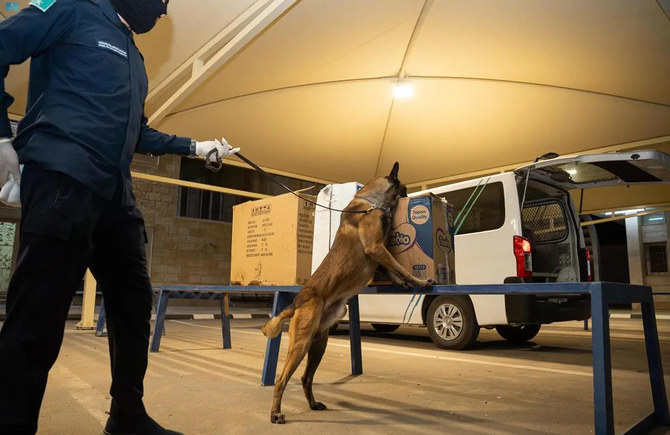
Saudi authorities continue to work to improve customs procedures for imports and exports to thwart such smuggling attempts. (SPA)
2 / 2
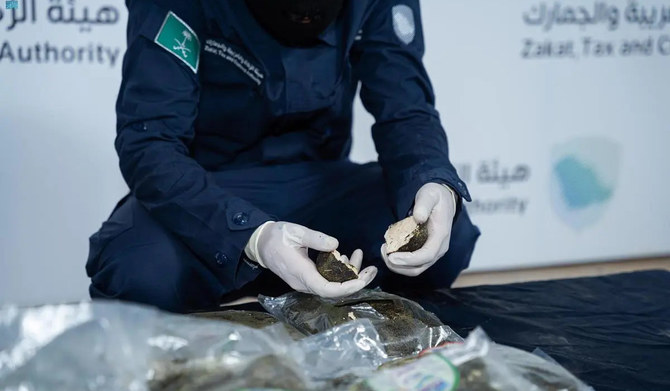
Saudi authorities continue to work to improve customs procedures for imports and exports to thwart such smuggling attempts. (SPA)
Short Url
Updated 31 August 2023
Follow

Saudi customs thwarts Captagon smuggling bid

  • The authority said that it would continue to apply strict customs control over the Kingdom’s imports and exports

RIYADH: The Saudi Zakat, Tax and Customs Authority has thwarted an attempt to smuggle 130,635 Captagon pills at Al-Hadithah Port. The pills were found hidden in a shipment that arrived in the Kingdom through the port.

The authority said that the Captagon pills were found after an inspection was conducted on one of the shipments arriving in the Kingdom. The pills were hidden inside pieces of cheese that were covered with thyme and put in boxes.

After the seizure, the authority coordinated with the General Directorate for Narcotics Control to ensure that the two persons who were supposed to receive the drugs in the Kingdom were arrested.

The authority said that it would continue to apply strict customs control over the Kingdom’s imports and exports. It would also be blocking smugglers to achieve society’s security and protect it from this type of harm.

Meanwhile, the General Directorate for Narcotics Control arrested two Sudanese residents in Badr Governorate in Madinah, for promoting tablets subject to the regulation of medical circulation.

They were found hidden in a vehicle driven by one of the residents when they were stopped and they have been referred to the Public Prosecution. 

Riyadh police also arrested a citizen for using a house and a den to distribute hashish and tablets, and seized firearms and live ammunition in his possession.

Border Guards in the Jazan region have thwarted an attempt to smuggle 90 kilograms of qat. Legal action was taken, and the confiscated contraband was handed over to the pertinent authority.


Digital authority launches campaign to combat online misinformation

Updated 4 sec ago
Follow

Digital authority launches campaign to combat online misinformation

  • Digital Cooperation Organization warns false information is a national security threat
  • Saudi minister says trust, technology and talent are key to an inclusive digital future

KUWAIT CITY: During its fifth General Assembly meeting in Kuwait City on Wednesday, the Digital Cooperation Organization launched a campaign to tackle online misinformation, which 80 percent of surveyed government experts now rank as a primary threat to national security. 

“Misinformation is not an abstract concern; it puts at risk the social cohesion that holds our communities together,” said Omar Saud Al-Omar, Kuwait’s minister of state for communication affairs and chairperson of the DCO Council for the current term.

He said more than 80 percent of government-identified misinformation is considered a top risk to national security. 

Al-Omar emphasized the pivotal importance of joint efforts in combating misinformation. “We prioritized online content integrity as our flagship initiative.”

“During our presidency, the DCO activated the Ministerial Committee on Online Misinformation, which Kuwait has the honor to chair,” said Al-Omar. 

“Today marks an exciting milestone: the launch of the DCO campaign to combat online misinformation, creating a platform for countries and partners to step forward with concrete pledges and shared commitments.” 

He also highlighted the campaign’s importance for advancing the multilateral digital agenda. 

Saudi Arabia’s Communications and Information Technology Minister Abdullah Al-Swaha highlighted the importance of combating misinformation, stating that “the top five risks for the global workforce is misinformation.” 

He emphasized the need to strengthen international cooperation to build an inclusive digital future based on trust, talent empowerment, and the effective use of advanced technologies, foremost among them artificial intelligence.

Al-Swaha commended Kuwait for its leadership during its presidency of the DCO.

He cited several impactful initiatives, including efforts to combat misinformation, promote trusted cross-border data flows, and launch a responsible AI framework — collectively enhancing global trust in the digital ecosystem. 

He also noted the growing impact of the DCO, whose member states represent about 10 percent of the world’s population and contribute nearly $3.6 trillion to the planet’s economy, while achieving growth rates exceeding the global average. 

The minister also highlighted advances in digital talent across DCO member states, which collectively include more than 2 million technology professionals and, in recent years, have contributed to the emergence of 16 unicorn companies and a range of successful entrepreneurial models.

Addressing national achievements, Al-Swaha said the Kingdom has achieved significant milestones in the digital economy in recent years. 

He said this includes the region’s first Nobel Prize awarded for an AI-enabled breakthrough in chemistry, as well as the participation of the first Arab-Muslim woman in a mission to the International Space Station to conduct advanced medical research.

He concluded by underscoring the importance of continued investment in infrastructure in the intelligent age, and of strengthening international partnerships to achieve sustainable growth that serves humanity and the global economy.

Bridging the digital divide and the use of AI were discussed in detail during the meeting with the DCO’s Secretary-General Deemah Al-Yahya underlining the organization’s core mission and its evolution over the past five years. 

Al-Yahya said: “Five years ago, the DCO was born from a simple but powerful conviction: that the digital economy is too important to be shaped by a few, and too critical to be left to chance.”

She called for “urgency and coordination” to bridge the digital divide.

“Today, the gains from digital transformation remain uneven. Infrastructure is concentrated, capital flows to the few, skills are scarce only for a few, and where it’s needed the most. If we do not act with urgency and coordination, the divide will not close … it will deepen.” 

Al-Yahya added: “This is the challenge that defines us. Let us make this general assembly a turning point, not only in the history of this organization, but in the lives of the people we serve.

“And it must be built deliberately and inclusively. At a time when multilateralism itself is being tested, the DCO stands as a platform of trust and dialogue, offering a practical model for how countries can work together to shape a more balanced, resilient, and inclusive future.” 

She underlined that through the general assembly, the “founding conviction has become a coalition.”

There were now 16 member states, more than 60 observers “and a growing ecosystem of governments, institutions, and innovators working side by side. But more important than numbers is what we have built together: trust.”

“We convene this fifth general assembly under the theme: ‘Digital Prosperity in the Age of AI.’ Never has this theme been more urgent,” Al-Yahya said. 

She highlighted that AI was already reshaping industries, redefining labor markets, and transforming how governments serve their citizens. 

Al-Yahya said the question at hand was not whether AI would change societies — “it’s already changing it.” 

“The real question is: who will benefit?”

Also participating in the event was Shaza Fatima Khawaj, Pakistan’s minister of information and technology and telecommunications, who shared her mission to bridge the digital divide. 

She commended the DCO’s efforts in this regard, and praised its role in “promoting trust, innovation and inclusion,” while underlining Pakistan’s readiness to assume the presidency of the general assembly in 2027.

The annual assembly is a major gathering for the DCO, bringing together the full digital ecosystem — including ministers from member states, observers, partners, policymakers, CEOs, innovators, and representatives from more than 60 countries — to help shape the global digital agenda.