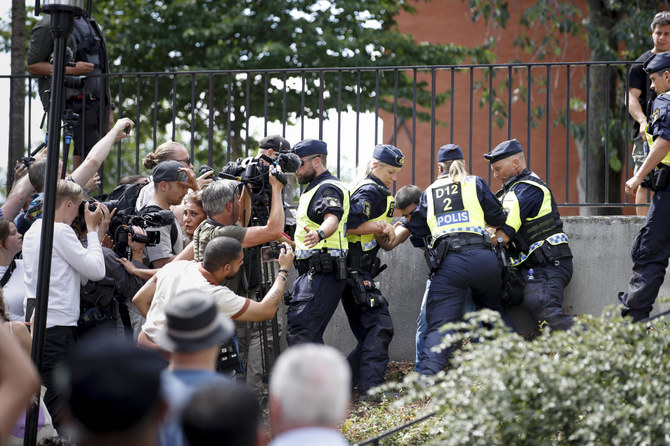
STOCKHOLM: Swedish police on Friday said they had granted a permit for a protest which would include burning holy texts outside the Israeli embassy in Stockholm, sparking condemnation from Israel and Jewish organizations.
The controversial protest, scheduled for Saturday, comes weeks after a man set fire to pages of the Qur'an outside Stockholm’s main mosque — leading to widespread outrage and condemnations around the world.
The demonstration would include a burning of the Torah and the Bible, was in response to the Qur'an burning protest and would be an expression in support of freedom of speech, according to the application to police.
In a comment to AFP, Stockholm police stressed that in line with Swedish legislation they granted permits for people to hold public gatherings and not for the activities conducted during them.
“The police does not issue permits to burn various religious texts — the police issues permits to hold a public gathering and express an opinion,” said Carina Skagerlind, press officer for Stockholm police.
“An important distinction,” she added.
Israel’s President Isaac Herzog was one of several Israeli representatives and Jewish organizations to immediately condemn the decision.
“I unequivocally condemn the permission granted in Sweden to burn holy books,” Herzog said in a statement.
“I condemned the burning of the Qur'an, sacred to Muslims world over, and I am now heartbroken that the same fate awaits a Jewish Bible, the eternal book of the Jewish people,” the head of state added.
Yaakov Hagoel, chairman of the World Zionist Organization, said in a statement that granting the permit was “not freedom of expression but Antisemitism.”
In June, Swedish police had granted a permit for 37-year-old Salwan Momika’s protest where he stomped on the Qur'an and set several pages alight.
The permit was granted in line with free speech protections, but authorities later said they had opened an investigation over “agitation against an ethnic group,” noting that Momika had burnt pages from the Islamic holy book very close to the mosque.
Countries including Iraq, Kuwait, the United Arab Emirates and Morocco summoned Swedish ambassadors in protest at the Qur'an burning incident, which led to an emergency meeting of the 57-member Organization of Islamic Cooperation.
Sweden’s government also condemned the burning as “Islamophobic,” while noting that the country had a “constitutionally protected right to freedom of assembly, expression and demonstration.”


![]()


Sweden condemned as police greenlight Torah burning protest
Short Url
https://arab.news/zhejw
Sweden condemned as police greenlight Torah burning protest
- The controversial protest, scheduled for Saturday, comes weeks after a man set fire to pages of the Qur'an outside Stockholm’s main mosque
- The demonstration would include a burning of the Torah and the Bible, was in response to the Qur'an burning protest


Russia’s war footing may remain after Ukraine war, Latvia spy chief warns
MUNICH: Russia will not end the militarization of its economy after fighting in Ukraine ends, the head of Latvia’s intelligence agency told AFP on the sidelines of the Munich Security Conference which ends Sunday.
“The potential aggressiveness of Russia when the Ukraine war stops will depend of many factors: How the war ends, if it’s frozen or not, and if the sanctions remain,” Egils Zviedris, director of the Latvian intelligence service SAB, told AFP.
Some observers believe that Russia has so thoroughly embraced a war economy and full military mobilization that it will be difficult for it to reverse course, and that this could push Moscow to launch further offensives against European territories.
Zviedris said that lifting current sanctions “would allow Russia to develop its military capacities” more quickly.
He acknowledged that Russia has drawn up military plans to potentially attack Latvia and its Baltic neighbors, but also said that “Russia does not pose a military threat to Latvia at the moment.”
“The fact that Russia has made plans to invade the Baltics, as they have plans for many things, does not mean Russia is going to attack,” Zviedris told AFP.
However, the country is subject to other types of threats from Moscow, particularly cyberattacks, according to the agency he leads.
The SAB recently wrote in its 2025 annual report that Russia poses the main cyber threat to Latvia, because of broader strategic goals as well as Latvia’s staunch support of Ukraine.
The threat has “considerably increased” since Moscow’s full-scale invasion of Ukraine in 2022, it said.
The agency has also warned that Russia is seeking to exploit alleged grievances of Russian-speaking minorities in the Baltics — and in Latvia in particular.
Russia’s Ministry of Foreign Affairs has repeatedly claimed to be preparing cases against Latvia, Lithuania and Estonia at the UN International Court of Justice over the rights of their Russian-speaking minorities.
“The aim of litigation: to discredit Latvia on an international level and ensure long-term international pressure on Latvia to change its policy toward Russia and the Russian-speaking population,” the report said.
In 2025, approximately 23 percent of Latvia’s 1.8 million residents identified as being of Russian ethnicity, according to the national statistics office.
Following the Russian invasion of Ukraine in 2022, Latvian authorities decided to require Russian speakers residing in the country to take an exam to assess their knowledge of the Latvian language — with those failing at potential risk of deportation.
“The potential aggressiveness of Russia when the Ukraine war stops will depend of many factors: How the war ends, if it’s frozen or not, and if the sanctions remain,” Egils Zviedris, director of the Latvian intelligence service SAB, told AFP.
Some observers believe that Russia has so thoroughly embraced a war economy and full military mobilization that it will be difficult for it to reverse course, and that this could push Moscow to launch further offensives against European territories.
Zviedris said that lifting current sanctions “would allow Russia to develop its military capacities” more quickly.
He acknowledged that Russia has drawn up military plans to potentially attack Latvia and its Baltic neighbors, but also said that “Russia does not pose a military threat to Latvia at the moment.”
“The fact that Russia has made plans to invade the Baltics, as they have plans for many things, does not mean Russia is going to attack,” Zviedris told AFP.
However, the country is subject to other types of threats from Moscow, particularly cyberattacks, according to the agency he leads.
The SAB recently wrote in its 2025 annual report that Russia poses the main cyber threat to Latvia, because of broader strategic goals as well as Latvia’s staunch support of Ukraine.
The threat has “considerably increased” since Moscow’s full-scale invasion of Ukraine in 2022, it said.
The agency has also warned that Russia is seeking to exploit alleged grievances of Russian-speaking minorities in the Baltics — and in Latvia in particular.
Russia’s Ministry of Foreign Affairs has repeatedly claimed to be preparing cases against Latvia, Lithuania and Estonia at the UN International Court of Justice over the rights of their Russian-speaking minorities.
“The aim of litigation: to discredit Latvia on an international level and ensure long-term international pressure on Latvia to change its policy toward Russia and the Russian-speaking population,” the report said.
In 2025, approximately 23 percent of Latvia’s 1.8 million residents identified as being of Russian ethnicity, according to the national statistics office.
Following the Russian invasion of Ukraine in 2022, Latvian authorities decided to require Russian speakers residing in the country to take an exam to assess their knowledge of the Latvian language — with those failing at potential risk of deportation.
Latest updates


Recommended


© 2026 SAUDI RESEARCH & PUBLISHING COMPANY, All Rights Reserved And subject to Terms of Use Agreement.