

Steadfast implementation of policies ‘critical’ for Pakistan to reduce financing gaps — IMF 

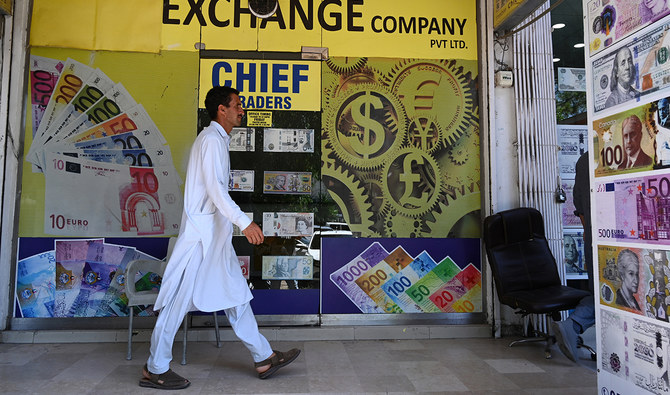
A man walks past foreign currency exchange market in Islamabad on July 11, 2023. (AFP/File)
Short Url
Updated 14 July 2023
Follow

Steadfast implementation of policies ‘critical’ for Pakistan to reduce financing gaps — IMF 

  • The South Asian country has been witnessing an economic meltdown for more than a year 
  • The $4.2 billion inflows from IMF, Gulf states this week provided Pakistan much-needed relief 

ISLAMABAD: The International Monetary Fund (IMF) said on Friday that steadfast implementation of policies was “critical” for Pakistan to stabilize its economy and balance of payments needs, days after the South Asian country negotiated a $3 billion deal with the global lender to avoid a default on its loan obligations. 

Pakistan on Thursday received $1.2 billion from the IMF after the lender approved the crucial bailout that had been stalled since November last year. 

The recent approval of the agreement by the IMF executive board came as a sigh of relief for the cash-strapped South Asian nation, amid concerns that it might default on its external financial obligations. 

But IMF spokesperson Julie Kozack said the stand-by arrangement (SBA) between Pakistan and the IMF came at a challenging juncture and required steadfast implementation of fiscal policies. 

“It (SBA) aims to stabilize the economy & address the needs of the Pakistani people,” she said on Twitter. “Steadfast implementation is critical to address its large financing needs & support the most vulnerable.” 


Along with the IMF funds, Pakistan this week received $2 billion deposits from Saudi Arabia and $1 billion from the UAE on Tuesday and Wednesday, respectively. 

After the latest inflows, Pakistan’s overall foreign exchange reserves are expected to hit the $13-14 billion mark from the $9.8 billion figure recorded on July 7. Pakistan’s official reserves are expected to increase to $8-9 billion. 

Kozack said the relatively shorter program provided time for Pakistan to implement the policies to strengthen its domestic and external economic situation, while supporting sustainability. 

“Of course, resolving Pakistan’s structural challenges will likely require continued reforms over the medium term, underpin the needed economic transformations to strengthen inclusive growth prospects, and to create an environment conducive to renewed private capital inflows,” 

“We, at the IMF, we always stand ready to work with Pakistan and the Pakistani government on these efforts to restore sustainability and economic stability.” 

The South Asian country has been witnessing an economic meltdown for more than a year, with its currency depreciating to record lows against the dollar owing to the low forex reserves. 

Pakistan last year banned imports to prevent the outflow of dollars in a bid to keep the frail economy afloat. 

However, Pakistan’s currency, bonds and stocks rallied on Thursday after the South Asian country managed to secure the much-needed $4.2 billion in funds from the IMF and Gulf states, reflecting a boost in local and international investors’ confidence in Pakistan. 


Pakistan’s JF-17 fighter jet draws ‘strong interest’ at Riyadh defense exhibition

Updated 29 min 30 sec ago
Follow

Pakistan’s JF-17 fighter jet draws ‘strong interest’ at Riyadh defense exhibition

  • Jets showcased as Pakistan seeks to expand defense exports
  • Interest in JF-17 has heightened after May 2025 conflict with India 

ISLAMABAD: Pakistan’s JF-17 Thunder fighter jet has drawn “strong interest” at the World Defense Exhibition in Riyadh, Pakistan’s state broadcaster said on Sunday, as Islamabad promotes the aircraft to international buyers at one of the region’s largest defense industry events.

The exhibition brings together defense officials, manufacturers and military delegations from dozens of countries, offering a platform for arms exporters to showcase equipment and pursue new contracts amid heightened global and regional security concerns.

Saudi Arabia has sought to position Riyadh as a regional hub for defense and aerospace exhibitions, using such events to foster partnerships and attract international manufacturers as part of broader diversification efforts. 

Last year Islamabad signed a mutual defense pact with Riyadh and is reportedly discussing another defense agreement involving Saudi Arabia and Turkiye, although details have not been made public.

“At the World Defense Exhibition in Riyadh, the Pakistan Air Force’s JF-17 Thunder has attracted strong interest from visitors and defense experts, standing out among fighter jets displayed by the US, Saudi Arabia and other countries,” state broadcaster Pakistan Television reported.

Islamabad is attending the exhibition in the backdrop of talks with at least 13 countries, six to eight of which are in an advanced stage, for deals involving JF-17 jets made jointly with China as well as training aircraft, drones, and weapons systems, according to recent media reports. 

Interest in the JF-17 jets has been bolstered by its operational visibility following the Pakistan-India military confrontation in May 2025, which Pakistani officials and defense analysts have cited as reinforcing the aircraft’s combat credibility.

Islamabad has increasingly positioned the JF-17 as a cost-effective multirole combat aircraft for countries seeking alternatives to high-end Western fighter jets. The aircraft is already in service with several foreign air forces and remains central to Islamabad’s defense export strategy.

Countries engaged in talks include Sudan, Saudi Arabia, Indonesia, Morocco, Ethiopia, and Nigeria as well as the government in eastern Libya led by Khalifa Haftar. Discussions on JF-17s and other weapons with Bangladesh and Iraq have been publicly acknowledged by Pakistan’s military, although more details have not been made public.

Almost all the potential buyers are Muslim-majority nations, like Pakistan. Many are from the predominantly Muslim Middle East, where Pakistan has historically been a security provider.

Separately, Pakistan’s Defense Minister Khawaja Asif met his Saudi counterpart, Khalid bin Salman bin Abdulaziz Al Saud, at the sidelines of the event. 

Asif congratulated the Saudi leadership and the defense minister on the “successful and splendid” organization of the World Defense Show, state broadcaster Radio Pakistan reported. 

“He described this global defense event as an important milestone in promoting defense cooperation in the region,” Radio Pakistan said.