

Pakistan gets $77.8 million, largest investment to date, to ‘recharge’ flood and water resources management

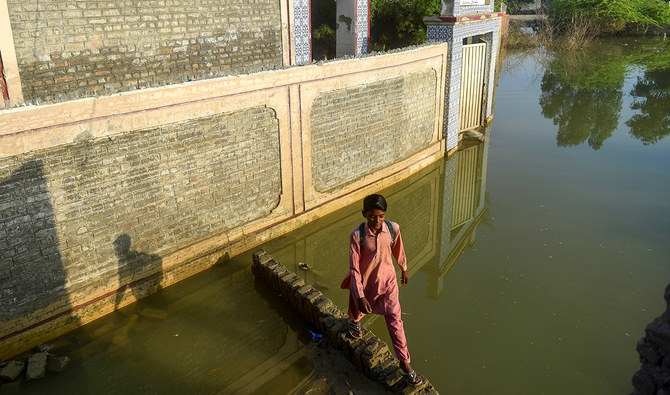
In this picture taken on October 28, 2022, a flood-affected student walks past a deluged government primary school in Chandan Mori, in Dadu district of Sindh province. (AFP/File)
Short Url
Updated 14 July 2023
Follow

Pakistan gets $77.8 million, largest investment to date, to ‘recharge’ flood and water resources management

  • Recharge Pakistan project, to be implemented over seven years, will bolster country’s ability to withstand climate challenges
  • Funding includes $66 million from Green Climate Fund, $5 million from USAID, $5 million from Coca-Cola, $2 million from WWF

ISLAMABAD: Pakistani Climate Change Minister Sherry Rehman said on Friday funding of $77.8 million, the largest such investment to date, for the Recharge Pakistan Project would help reduce flood risks and enhance water recharge in targeted catchments of the Indus Basin, bolstering the resilience of over seven million people and safeguarding vulnerable ecosystems by 2030.

The Recharge Pakistan project aims to enhance Pakistan’s resilience to climate change by reducing flood and drought risks in the Indus Basin, the largest basin in Asia drained by the Indus river and its tributaries. The project is set to be implemented over a period of seven years, focusing on bolstering the country’s ability to withstand climate challenges. Funding of $77.8 million for the project includes a $ 66 million grant from the Green Climate Fund, $5 million from USAID, $5 million from the Coca-Cola Foundation, and $2 million from the World Wide Fund for Nature (WWF) Pakistan.

“This transformative initiative, spanning over the next 7 years, has received funding of a total $77.8 million,” Rehman told Arab News, saying the initiative would fortify Pakistan’s resilience against climate change impacts, particularly in regions severely affected by the devastating floods of 2022, which claimed 1,700 lives, affected 33 million individuals, and caused damages worth $30 billion to the economy, according to government estimates.

“As the largest investment at the national level to date in ecosystem-based approaches to flood and water resources management, the project will accelerate climate innovation in Pakistan through green infrastructure interventions and water recharge in the target catchments of the Indus basin for flood and drought risks reduction and sustainable development,” Rehman said.

Deborah Hong, an official from GCF’s communication team, said the project would “catalyze transformational change” in Pakistan by investing in ecosystem-based and green infrastructure interventions at four project sites in the Indus Basin.

“It will reduce the impacts of increasingly severe floods and droughts on vulnerable communities and ecosystems,” Hong told Arab News in a statement, adding that the project would directly benefit a total of 687,336 people and indirectly benefit 7,024,361 people living around Pakistan’s Indus Basin.

“The project aims to restore 14,215 hectares of degraded watersheds in Dera Ismail Khan, 34 kilometers of flow paths, as well as desilting and restoring channels in Ramak Watershed and Manchar Lake,” she said.

An additional 127 green infrastructure interventions, including recharge basins and retention areas, would be implemented at specific locations in D.I. Khan, Ramak, Manchar, and Chakar Lehri to maximize the flood reduction benefits to vulnerable communities.

“The project is strongly aligned with GCF’s priorities of creating enabling environments for climate action, accelerating climate innovation, and funding scalable and replicable adaptation interventions,” Hong added.

Hammad Naqi Khan, the CEO of WWF Pakistan, an implementation agency for the project in Pakistan, said a majority of activities, especially those conducted in the field, would be carried out by the provincial irrigation, forest, and wildlife departments.

“That is the reason that when we were developing the project, we had a very good partnership with the federal and provincial flood commissions, provincial irrigation departments, especially in the selection of the sites,” he told Arab News.

To ensure smooth implementation, a project steering committee was established under the ministry of climate change, which included members from the ministry of water resources and other relevant departments and would approve budgets and activities. The seven-year-long project would begin to show effects after two years, Khan added. 


Pakistani man convicted in US in political assassination plot tied to Iranian paramilitary

Updated 4 sec ago
Follow

Pakistani man convicted in US in political assassination plot tied to Iranian paramilitary

  • Asif Merchant, 47, worked for Pakistani banks for decades before going into clothing and other businesses
  • He testified he met a Revolutionary Guard operative who gave him countersurveillance training, assignments

NEW YORK: A Pakistani business owner who tried to hire hit men to kill a US politician was convicted Friday in a trial that showcased allegations of Iran-backed plotting on American soil.

As the Iran war unfolded in the Mideast, Asif Merchant acknowledged in a US court that he sought to put an assassination in motion during the 2024 presidential campaign — a plot that was quickly disrupted by American investigators before it had a chance to proceed.

A jury in Brooklyn convicted Merchant on terrorism and murder for hire charges.

The verdict after only a couple hours of deliberations followed a weeklong trial that included remarkable testimony from Merchant himself.

Merchant told the jury he was carrying out instructions from a contact in the Islamic Republic’s powerful paramilitary Revolutionary Guard. According to Merchant, the handler never specified a target but broached names including then-candidate Donald Trump, then-President Joe Biden and Nikki Haley, the former UN ambassador who was also in the race for a time.

The Iranian government has denied trying to kill US officials.

The nascent plot fell apart after Merchant showed an acquaintance what he had in mind by using objects on a napkin to depict a shooting at a rally. He asked the man to help him hire assassins. Instead, he was introduced to undercover FBI agents who were secretly recording him, as had the acquaintance.

Merchant told the supposed hit men he needed services that could include killing “some political person” and paid them $5,000 in cash in a parked car in Manhattan.

“This man landed on American soil hoping to kill President Trump — instead, he was met with the might of American law enforcement,” US Attorney General Pam Bondi said in a statement released after the conviction.

Merchant’s attorney, Avraham Moskowitz, didn’t immediately reply to a message seeking comment.

Merchant, 47, worked for Pakistani banks for decades before going into clothing and other businesses. He has two families, in Pakistan and Iran, and he sometimes visited the US for his garment business.

Merchant testified that he met a Revolutionary Guard intelligence operative about three years ago. The contact gave him countersurveillance training and assignments including the assassination scheme, Merchant said.

He maintained that he had to do his handler’s bidding to protect loved ones in Iran. The defendant said he reluctantly went through the motions but thought he’d be arrested and explain his situation to authorities before anyone was killed.

“I was going along with it,” he said, speaking in Urdu through a court interpreter.

Prosecutors emphasized that Merchant admitted taking steps to enact the plan on behalf of the Revolutionary Guard, which the US considers a foreign terrorist organization, and he didn’t proactively go to authorities.

Instead, he was packing for a flight to Pakistan when he was arrested on July 12, 2024, a day before an unrelated attempt on Trump’s life in Butler, Pennsylvania. Officials said it appeared the Butler gunman acted alone but that they had been tracking a threat on Trump’s life from Iran, a claim that the Islamic Republic called “unsubstantiated and malicious.”

When Merchant subsequently spoke to FBI agents to explore the possibility of a cooperation agreement, he didn’t say he had acted out of fear for his family.

Prosecutors argued that he didn’t back up a defense of acting under duress. Merchant sought to persuade jurors he simply didn’t think the agents would believe him because they seemed to “think that I am some type of super-spy,” which he said he was “absolutely not.”