

PIF, ENGIE sign MoU to develop green hydrogen projects in Saudi Arabia 

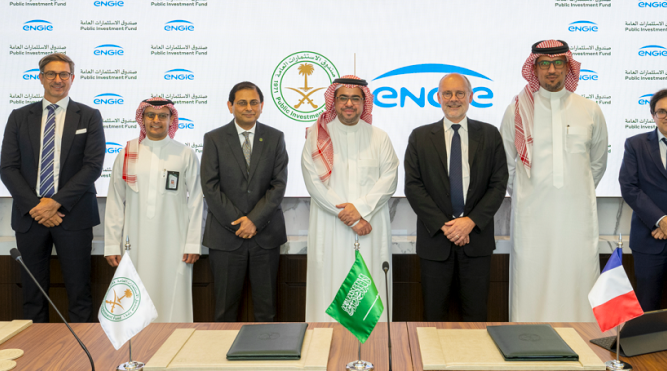
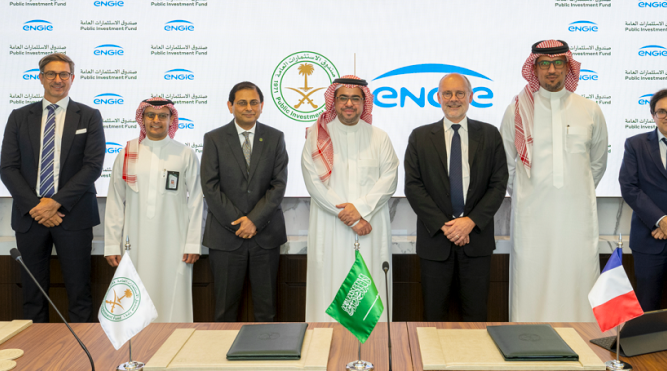
Both PIF and ENGIE will work to formulate a strategy for the global market in an attempt to secure off-take arrangements (Supplied)
Short Url
Updated 13 July 2023
Follow

PIF, ENGIE sign MoU to develop green hydrogen projects in Saudi Arabia 

RIYADH: In a push to stay ahead of the curve in developing future energy, Saudi Arabia’s Public Investment Fund has signed a deal with the French low-carbon energy provider ENGIE to jointly develop green hydrogen projects and derivatives in the Kingdom for export purposes. 

This move will see ENGIE working closely with PIF to help the Kingdom in strengthening its international competitiveness in producing and supplying hydrogen and derivatives. 

The deal also falls in line with the goals outlined in Vision 2030 where Saudi Arabia aims to increase domestic generation capacity from renewable energy to 50 percent by the end of this decade to achieve net-zero emissions by 2060. 

“We, at ENGIE, are proud to contribute to driving the energy transition in the Kingdom and achieving its aspirations and goals in the green hydrogen sector,” Managing Director at ENGIE Frederic Claux said. 

“Our partnership with PIF will contribute to laying robust foundations for the green hydrogen industry, enabling the Kingdom to be one of the top exporters of green hydrogen worldwide,” Claux added. 

Under the MoU, both parties will work on assessing the feasibility of the co-development opportunities that could potentially contribute to enhancing the energy transition in the Kingdom 

Moreover, as part of the collaboration, both PIF and ENGIE will work to formulate a strategy for the global market in an attempt to secure off-take arrangements. 

This comes after PIF signed a memorandum of understanding in January with Korea’s Posco and Samsung C&T to develop a new green hydrogen production plant.  

The MoU’s main objective was to complete project feasibility for an export-oriented green hydrogen project, PIF said in a statement at the time.

The cooperation between the three entities was set to take a giant leap in the reduction of carbon emissions, as well as the transfer of knowledge and expertise between the Kingdom and South Korea. 

Meanwhile, the world’s largest green hydrogen development in the Kingdom’s $500 billion giga-project NEOM formally entered the construction stage earlier this month. 

In a statement to Tadawul in the first week of July, ACWA Power said that its affiliate NEOM Green Hydrogen Co. issued a full award notice to proceed with the engineering, procurement and construction, which has been approved. 

In May, NGHC signed financial documents with 23 local, regional and international banks and investment firms to construct a green hydrogen facility at a total investment value of $8.4 billion. 


US pump prices surge as Iran war upends global energy supply

Updated 07 March 2026
Follow

US pump prices surge as Iran war upends global energy supply

  • Fuel prices jump over 10 percent as oil prices surge
  • Analysts predict further price rises due to market conditions

MARIETTA/NEW YORK : US retail gasoline and diesel prices are soaring as the US-Israel war with Iran constrains oil and fuel exports, which could be a political test for President Donald Trump’s Republican Party ahead of midterm ​elections in November.
Fuel prices jumped more than 10 percent this week as oil rose above $90 a barrel, its highest in years, adding pain at the pump for consumers already strained by inflation.
Trump on Thursday shrugged off higher gasoline prices in an interview with Reuters, saying “if they rise, they rise.”
The president had vowed to lower energy prices and unleash US oil and gas drilling during his second term, but much of his tenure has been marked by volatility and uncertainty amid shifts in policies like tariffs and geopolitical turmoil.
The US is the world’s largest oil producer. It is a major exporter but also imports millions of barrels a day since it is the world’s largest oil consumer.
As of Friday, the national average prices for regular gasoline stood at $3.32 a gallon, up 11 percent from a ‌week ago and ‌the highest since September 2024, according to data from the motorists association AAA. Diesel was at $4.33, ​up ‌15 percent ⁠from a week ​ago, ⁠surging to the highest since November 2023.

Midwest, south feel the pinch
US motorists in parts of the Midwest and the South, including states that supported Trump, have seen some of the steepest increases in fuel costs since the conflict in Iran started.
In Georgia, a swing state, average retail gasoline prices rose 40.1 cents a gallon over the past week, according to fuel tracking site GasBuddy.
Andrenna McDaniel, a health care insurance worker in South Fulton, Georgia, said she was surprised to see prices skyrocket overnight.
“They jumped up so quickly,” she said on Friday, adding that she does not agree with the war at all.
McDaniel, a Democrat, said that for now she is only driving for the most important things, ⁠and feels lucky that she works from home so she does not have to drive as ‌much as other people do. Georgia voted for Donald Trump in the 2024 election.
Trump voter ‌Richard Soule, 69, a US Air Force veteran and a retired firefighter, said ​a little pain at the pump is worth Trump’s efforts to ‌protect America.
“When President Trump went in there and bombed out their nuclear, and they just thumbed their nose at it, ‌I believe he did the right thing at the right time,” Soule said on Friday as he filled up his Ford F-150 truck in Marietta, Georgia.
Other states, including Indiana and West Virginia have seen prices rise by 44.3 cents and 43.9 cents, respectively.

Prices may rise further
More pain may be on the way, analysts said, as oil prices continue to trend upward. On Friday, US oil futures settled at $90.90 a barrel, up nearly $10 and ‌the biggest single-day rise since April 2020.
“Given current market conditions, the national average price of gasoline could climb toward $3.50 to $3.70 per gallon in the coming days if oil continues rising and supply ⁠disruptions persist,” GasBuddy analyst Patrick De ⁠Haan said.
The disruptions in the Middle East and the Strait of Hormuz, a key trade conduit, have boosted demand for US oil abroad, which in turn has driven up prices for domestic refiners too.
“The US has weaned itself off of its dependence on Middle Eastern crude, but obviously Asian refineries, and to a lesser extent, European refineries have not,” Denton Cinquegrana, chief oil analyst with OPIS. “That’s what you’re seeing happen in the spot market, because the demand for US exports rise, and so the price rise.”
Seasonal factors could add further pressure. Gasoline prices typically go up in the spring and peak in the summer due to higher gasoline demand and production of summer-blend gasoline, which is more costly to produce. Diesel fuel saw an even more aggressive jump since Iran began retaliating against US and Israeli strikes, significantly disrupting shipping in the Strait of Hormuz.
Global diesel inventories have remained in tight supply due to heavy demand for heating and power generation during a prolonged winter in the US and other parts of the world and a structural tightness of refining ​capacity. Sticker prices of everything from food to furniture go up ​when the cost of diesel goes up, as the fuel is mainly used in freight transportation, manufacturing, agriculture, and global shipping, analysts said.
“In a world where buzzword seems to be ‘affordability’, that is certainly not going to help,” Cinquegrana said.