After Qur’an burnings, UN rights body calls for more action to combat religious hatred

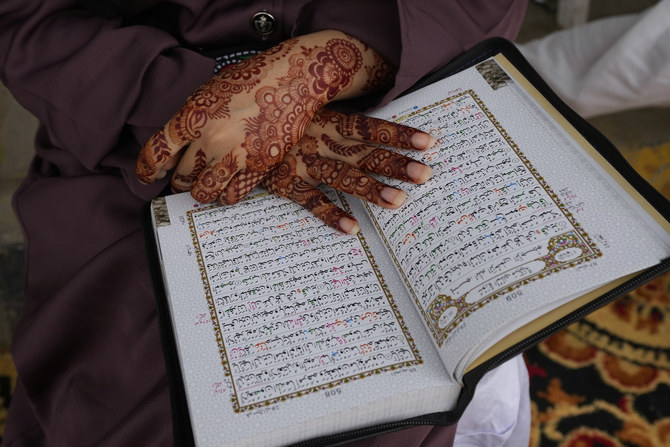
A Muslim woman recites from the Qur’an during a demonstration to denounce the burning of a Qur’an that took place in Sweden, in Karachi, Pakistan. (File/AP)
Short Url
Updated 12 July 2023
Follow

After Qur’an burnings, UN rights body calls for more action to combat religious hatred

  • After the vote, Ambassador Khalil Hashmi of Pakistan insisted the measure “does not seek to curtail the right to free speech”

GENEVA: The UN’s top human rights body overwhelmingly approved a measure calling on countries to do more to prevent religious hatred in the wake of Qur’an burnings in Europe, over the objections of Western countries who fear tougher steps by governments could trample freedom of expression.
Applause broke out in the cavernous chamber of the Human Rights Council on Wednesday after the 28-12 vote, with seven abstentions, on a measure brought by Pakistan and Palestine that was backed by many developing countries in Africa, as well as China and India, and Middle Eastern countries.
The resolution comes in the wake of recent Qur’an burnings in parts of Europe, and among other things, calls on countries to take steps to “prevent and prosecute acts and advocacy of religious hatred that constitute incitement to discrimination, hostility or violence.”
After the vote, Ambassador Khalil Hashmi of Pakistan insisted the measure “does not seek to curtail the right to free speech,” but tries to strike a “prudent balance” between it and “special duties and responsibilities.”
“The opposition of a few in the room has emanated from their unwillingness to condemn the public desecration of the Holy Qur’an or any other religious book,” Hashmi said. “They lack political, legal and moral courage to condemn this act, and it was the minimum that the council could have expected from them.”
A day earlier, however, Michele Taylor, the US ambassador to the council, said that the United States “strongly condemns the acts that have precipitated today’s discussion, including desecration of the Holy Qur’an on June 28” — a reference to an incident in Sweden last month that fanned protest in some Muslim communities.
After the vote, Taylor said she was “truly heartbroken” that the council was unable to reach consensus “in condemning what we all agree are deplorable acts of anti-Muslim hatred, while also respecting freedom of expression.”


Asylum applications drop to 40-year low in Sweden

A picture taken on June 26, 2023, shows migrants receiving food and clothes from an NGO in Athens. (AFP)
Updated 7 sec ago
Follow

Asylum applications drop to 40-year low in Sweden

  • Asylum seekers and their family members accounted for just 6 percent of the total, compared with 31 percent in 2018, when total immigration was 133,000

STOCKHOLM: The number of people applying for asylum in Sweden dropped by 30 percent in 2025 to the lowest level since 1985, with the ​right-of-center government saying it planned to further tighten rules this year ahead of an election in September.
The ruling minority coalition, which is supported by the anti-immigration Sweden Democrats, has made cutting the number of asylum seekers a key policy platform since taking power in 2022. It blames a surge ‌in gang ‌crime on decades of loose ‌asylum laws and ​failed ‌integration measures under previous Social Democrat-led governments.

FASTFACT

The Swedish government has cracked down on asylum seekers, made it more difficult to gain residency and citizenship, and introduced financial incentives for immigrants to leave the country.

“The change is not just about numbers in terms of lower immigration, it’s also about the way that’s made up, who is coming to Sweden with the proportion from asylum at a record low,” said Immigration Minister Johan Forssell.
The number of immigrants, excluding refugees from Ukraine, fell to 79,684 last year from 82,857 in 2024, according to figures from the Migration Board. 
Asylum seekers and their family members accounted for just 6 percent of the total, compared with 31 percent in 2018, when total immigration was 133,000.
The number of people either voluntarily returning to another country or being expelled by authorities was also up.
“This is an area which is a high priority for us,” Forssell said.
The government has cracked down on asylum seekers, made it more difficult to gain residency and citizenship, and introduced financial incentives for immigrants to leave the country since it came to power.
Forssell said the government planned to further tighten regulations in the coming year, including a new law to increase the number of returnees and stricter citizenship rules, among other measures.
Swedes will ‌vote in what is expected to be a tight general election in September.
Meanwhile, Denmark’s strict immigration policies drove asylum admissions to a historic low in 2025, with 839 requests granted by the end of November, the government said.
“It is absolutely critical that as few foreigners as possible come to Denmark and obtain asylum. My main priority is to limit the influx of refugees,” said Immigration Minister Rasmus Stoklund in a press release.
According to the ministry, “there have been very few years when the annual total remained below 1,000 ... 2025 will be a year with a historically low number of residence permits granted on asylum grounds.”
Denmark registered 1,835 asylum requests by November 2025.
The country’s immigration approach has been influenced by far-right parties for more than 20 years, and Prime Minister Mette Frederiksen, leader of the Social Democrats, has pursued a “zero refugee” policy since taking office in 2019.
Copenhagen has, over the years, implemented a slew of initiatives to discourage migrants and make Danish citizenship harder to obtain.
In 2024, the country of 6 million people accepted some 860 of the 2,333 asylum requests lodged that year.