

IMF’s $3 billion bailout program reignites funding hopes for Pakistani startups following 90 percent decline

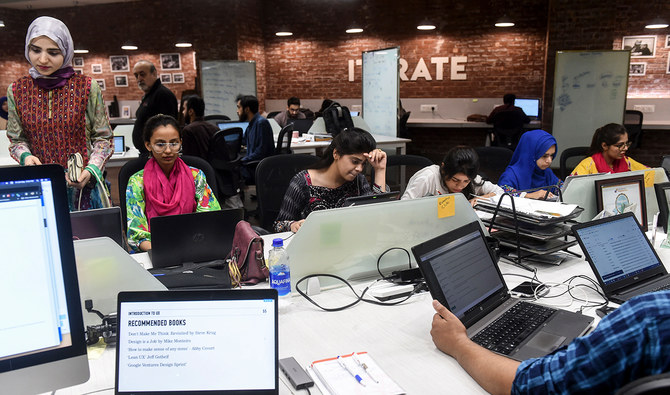
In this photograph taken on May 24, 2019, Pakistani youngsters work at their desks at the National Incubation Centre (NIC), in Lahore, Pakistan. (AFP/File)
Short Url
Updated 12 July 2023
Follow

IMF’s $3 billion bailout program reignites funding hopes for Pakistani startups following 90 percent decline

  • Pakistani startups received about $28 million in the first half of the year as compared to $277 million in 2022
  • Startup monitors say the funding decline was in keeping with global slowdown and macroeconomic crisis at home

KARACHI: After suffering almost 90 percent funding drop in the first half of the current year, Pakistani startups are hoping for the revival of funding rush after the country got positive signals from the International Monetary Fund (IMF) in recent weeks, said startup monitors and advisers on Tuesday.

Pakistani startups raised about $375 million of global funding in 2021 which exceeded the overall financing received by them in the previous six years.

However, they only received around $28 million in the first half of 2023, including $5 million received in the second quarter, depicting a 90 percent decline in their funding, as compared to $277 million raised in the first half of 2022, according to Alpha Beta Core (ABC), a startup funding advisory firm, and Data Darbar, a startup and market tracking firm.

“This funding decline was aligned with the global slowdown coupled with macroeconomic crisis at home,” Khurram Schehzad, ABC’s chief executive officer, told Arab News. “The rupee-dollar parity issue, slow industrial activities, and high inflations created a context where investors chose to remain on the sidelines instead of putting their money in risky startup businesses.”

The number of funding breakthroughs has largely remained stagnant during the second quarter of the 2023. Major deals in this quarter include Fintech startups such as GoldFin securing $2 million and Neem raising $1 million.

In addition, smaller pre-seed and accelerator level deals were struck by Apollo Group, Qist Bazaar, OkayKer, and Pattern App, according to ABC.

Pakistan, which has been grappling with deteriorating economic conditions, finally reached a staff-level agreement (SLA) with the IMF last month over a $3 billion bailout program which rekindled startup funding hopes.

“The recent news of the IMF bailout is a welcome respite though, at least in the short term, in stemming some of the uncertainty,” Kalsoom Lakhani, co-founder and general partner at i2i Ventures, a funding company, said in a statement.

“I also think more startups will raise toward the end of this year (provided our relative respite holds and elections go as planned as well),” she continued, adding: “We definitely won’t reach our 2022 numbers, but here’s hoping 2H2023 finishes out better than the first half of this year.”

Schehzad agreed with Lakhani, saying the recovery would be gradual since “the IMF deal would improve investors’ confidence and help improve liquidity situation in the market.”

However, he noted the investors would adopt “pick and choose” strategy, instead of funding across the board.

“Now the investors are betting on smart startups or entrepreneurs – they will now pick and choose only smart startups which have shown resilience.”

Pakistani startup experts said the startup operating in ecommerce, fintech healthtech, agritech and education have substantial potential to attract funding from investors in the future.

However, Pakistani startups will have to go the extra mile, as a global slowdown combined with a tough national macroeconomic situation is definitely an uphill climb, according to i2i Insight, the research arm of i2i Venture.

Pakistani startups have raised approximately $953 million through 329 deals since 2015, according to i2i Insight.


Sindh assembly passes resolution rejecting move to separate Karachi

Updated 21 February 2026
Follow

Sindh assembly passes resolution rejecting move to separate Karachi

  • Chief Minister Shah cites constitutional safeguards against altering provincial boundaries
  • Calls to separate Karachi intensified amid governance concerns after a mall fire last month

ISLAMABAD: The provincial assembly of Pakistan’s southern Sindh province on Saturday passed a resolution rejecting any move to separate Karachi, declaring its territorial integrity “non-negotiable” amid political calls to carve the city out as a separate administrative unit.

The resolution comes after fresh demands by the Muttahida Qaumi Movement (MQM) and other voices to grant Karachi provincial or federal status following governance challenges highlighted by the deadly Gul Plaza fire earlier this year that killed 80 people.

Karachi, Pakistan’s largest and most densely populated city, is the country’s main commercial hub and contributes a significant share to the national economy.

Chief Minister Syed Murad Ali Shah tabled the resolution in the assembly, condemning what he described as “divisive statements” about breaking up Sindh or detaching Karachi.

“The province that played a foundational role in the creation of Pakistan cannot allow the fragmentation of its own historic homeland,” Shah told lawmakers, adding that any attempt to divide Sindh or separate Karachi was contrary to the constitution and democratic norms.

Citing Article 239 of Pakistan’s 1973 Constitution, which requires the consent of not less than two-thirds of a provincial assembly to alter provincial boundaries, Shah said any such move could not proceed without the assembly’s approval.

“If any such move is attempted, it is this Assembly — by a two-thirds majority — that will decide,” he said.

The resolution reaffirmed that Karachi would “forever remain” an integral part of Sindh and directed the provincial government to forward the motion to the president, prime minister and parliamentary leadership for record.

Shah said the resolution was not aimed at anyone but referred to the shifting stance of MQM in the debate while warning that opposing the resolution would amount to supporting the division of Sindh.

The party has been a major political force in Karachi with a significant vote bank in the city and has frequently criticized Shah’s provincial administration over its governance of Pakistan’s largest metropolis.

Taha Ahmed Khan, a senior MQM leader, acknowledged that his party had “presented its demand openly on television channels with clear and logical arguments” to separate Karachi from Sindh.

“It is a purely constitutional debate,” he told Arab News by phone. “We are aware that the Pakistan Peoples Party, which rules the province, holds a two-thirds majority and that a new province cannot be created at this stage. But that does not mean new provinces can never be formed.”

Calls to alter Karachi’s status have periodically surfaced amid longstanding complaints over governance, infrastructure and administrative control in the megacity, though no formal proposal to redraw provincial boundaries has been introduced at the federal level.