VILNIUS: US President Joe Biden thanked his Turkish counterpart Recep Tayyip Erdogan on Tuesday for his “courage” in dropping opposition to Sweden’s entry to NATO.
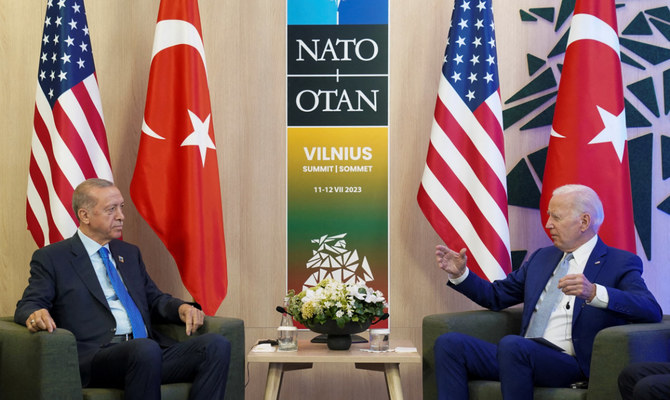
At a meeting during the NATO summit in Vilnius, Biden celebrated the conclusion of a major diplomatic push to get Erdogan to stop blocking Sweden’s application.
“I want to thank you for your diplomacy and your courage to take that on. And I want to thank you for your leadership,” Biden told Erdogan.
Frustration had been mounting in Western capitals at Erdogan’s obstruction of Sweden, which required unanimous approval from NATO members in order to complete its entry bid into the alliance, launched, along with Finland, in response to the Russian invasion of Ukraine last year.
Biden spoke with Erdogan from Air Force One for nearly an hour on Sunday in a bid to break the impasse and avoid an embarrassing failure at the Vilnius summit. Erdogan abruptly dropped his opposition late Monday on the eve of the NATO get-together.
For months, Erdogan insisted on a crackdown in Sweden against members of Kurdish movements outlawed in Turkiye, something the Swedish government says it has now done.
But speculation mounted over what other concessions Turkiye extracted to give its green light.
Erdogan had demanded at the last minute that approval for Sweden in NATO would depend on Turkiye being able to renew stalled membership talks with the European Union.
Another long-standing demand from Turkiye for the purchase of modern US F-16 fighter jets seemed to get a boost in the wake of the decision on Sweden.
Biden’s national security adviser, Jake Sullivan, stressed Tuesday that the US president has “been clear and unequivocal for months that he’s supported the transfer of F-16s,” seeing this as in the interests of NATO.
“He has placed no caveats or conditions on that in his public and private comments over the past few months. And he intends to move forward with that transfer in consultation with Congress.”
A US official told AFP that the White House is now “actively engaging” with Congress, where there has been significant opposition to allowing the sale.
Sullivan said “we will work with the Congress on the appropriate timing for getting” the warplanes to Turkiye. But he could not “speculate on the precise day it’s going to happen.”
Although NATO Secretary General Jens Stoltenberg and Sweden’s Prime Minister Ulf Kristersson were heavily engaged in the negotiations with Erdogan, Sullivan stressed “significant recent” US involvement.
As for the effort by Erdogan to link Turkiye’s EU aspirations with the Swedish-NATO question, Sullivan said Biden has “long” supported Turkiye entering the European Union.
However, that would take “discussions of the necessary reforms and steps relative to democratic resilience that every prospective applicant to the European Union goes through.”
“So, as far as we’re concerned, these issues are not connected,” he said.


![]()

Biden thanks Erdogan for Sweden decision, backs F-16s sale
Short Url
https://arab.news/wj6qz
Biden thanks Erdogan for Sweden decision, backs F-16s sale
- Another long-standing demand from Turkiye for the purchase of modern US F-16 fighter jets seemed to get a boost in the wake of the decision on Sweden


Latest updates


© 2026 SAUDI RESEARCH & PUBLISHING COMPANY, All Rights Reserved And subject to Terms of Use Agreement.