

Pakistan’s foreign minister urges global unity against desecration of Holy Qur’an

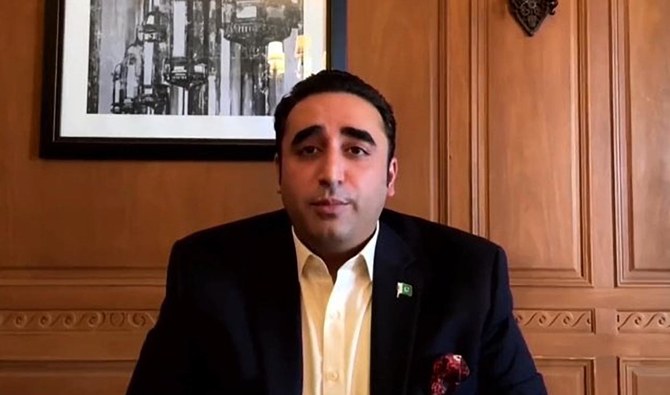
Pakistan Foreign Minister Bilawal Bhutto-Zardari addresses the UN Human Rights Council via video link on July 11, 2023. (Photo courtesy: @UN_HRC/Twitter)
Short Url
Updated 11 July 2023
Follow

Pakistan’s foreign minister urges global unity against desecration of Holy Qur’an

  • Bhutto-Zardari tells the world last month’s Qur’an burning in Stockholm was an attempt to provoke religious violence
  • He says the vigor to protect free speech should not make the world lose sight of the imperative to reject hate speech

ISLAMABAD: Pakistan’s foreign minister Bilawal Bhutto-Zardari on Tuesday urged the world to unite against hatred, discrimination and intolerance, calling upon the international community to join hands in condemning the desecration of the Holy Qur’an while seeking to isolate those who trying to stoke hatred by committing such acts.

Bhutto-Zardari virtually addressed the United Nations Human Rights Council to participate in a global conversation on incidents of religious hatred, with specific focus on the recent Qur’an burning in Stockholm.

An Iraqi immigrant to Sweden burned the Islamic scripture outside a mosque in the European state last month, leading to protests across the Muslim world.

In a draft resolution presented by Pakistan on behalf of the 57-nation Organization of Islamic Cooperation (OIC), the group described the incident as “offensive, disrespectful and a clear act of provocation.”

“Let’s unite against hatred, discrimination, intolerance and forge pathways for mutual respect, understanding and tolerance,” said the Pakistani minister in his virtual address.

“We must join hands in condemning [such incidents], must isolate those who stoke hatred as the Holy Qur’an is a spiritual anchor for two billion Muslims,” he added.

Bhutto-Zardari maintained it was unfortunate that such deliberate acts of desecration of the Holy Qur’an had continued under “government sanction and with a sense of impunity” in Europe.

“Increasingly, these acts are designed to maximize provocation,” he said, adding the world must see such incidents clearly as incitement to religious hatred, discrimination and attempts to provoke violence.

“It is in the same spirit I resolutely stand alongside those who are calling for prevention, legal deterrence and accountability of actions that constitute incitement to hostility against people of faith,” he continued.

The Pakistani minister noted the world had observed the first international day to combat Islamophobia only three months ago, pointing out that everyone had spoken with a single voice in condemnation of such hatred back then.

He maintained it was important to understand the emotional injury that a public and premeditated act of the Qur’an’s desecration caused Muslims.

“It is an attack on their faith,” he said, adding the draft text before the council called for the prevention of such incidents and accountability of those guilty of perpetrating it.

“In making this call, I am not losing sight of the fundamental right of free speech, it is as indispensable as hate speech should be indefensible,” the minister continued.

However, he emphasized that the vigor to protect free speech must not make the world lose sight of the imperative to reject hate speech.

“There is not a single Muslim country on the planet that allows for the desecration of the holy texts of other religions as such an act is unthinkable to any Muslim and is forbidden by faith, by culture and by law,” he added.


On Qatar’s National Day, Pakistan hails Doha as global ‘emissary of peace’

Updated 53 min 20 sec ago
Follow

On Qatar’s National Day, Pakistan hails Doha as global ‘emissary of peace’

  • PM says Pakistan stood with Qatar after Israeli airstrike, notes Doha backed Islamabad during May conflict with India
  • Doha has recently facilitated de-escalation talks between Pakistan and Afghanistan after border clashes this year

ISLAMABAD: Prime Minister Shehbaz Sharif on Tuesday praised Qatar as one of the region’s most active diplomatic mediators, calling Doha an “emissary of peace” during an address at a ceremony to mark Qatar’s National Day in Islamabad.

Sharif’s remarks come after Qatar led negotiations aimed at easing the Gaza conflict, working with nations like the United States to reach a ceasefire and secure humanitarian pauses and prisoner exchanges. Doha also facilitated de-escalation talks between Pakistan and Afghanistan after border clashes earlier this year, underscoring its growing role as a crisis mediator across the region.

Pakistan has also aligned closely with Qatar in recent months. Sharif visited Doha in a show of solidarity after Israel’s airstrikes on the country in September, while Qatar publicly supported Pakistan during a brief military conflict with India in May, which Islamabad has highlighted as evidence of a deepening two-way partnership.

“Pakistan deeply appreciates Qatar’s distinguished and long-standing role as the emissary of peace, a nation that has repeatedly opened doors for dialogue, helped defuse tensions, and encouraged reconciliation with the noble aim of fostering peace and stability in the region and beyond,” Sharif said during his National Day address. 

He described Qatar as a “brotherly country of Pakistan” with “very strong fraternal and friendly relations,” noting that bilateral engagement spans energy security, defense cooperation, trade and investment. More than 150,000 Pakistanis live and work in Qatar, contributing to its economy and remitting income back home, while Qatari investments in Pakistan’s real estate, infrastructure and renewable energy sectors have expanded.

Sharif said he had traveled to Doha twice this year, first to convey Pakistan’s solidarity after the Israeli airstrike on Doha on September 9, 2025, and again for the Arab-Islamic Summit, and stressed that Islamabad stands “shoulder-to-shoulder” with Doha in pursuit of regional stability.