

Pakistan invites Chinese companies to become part of ‘National Solar Energy Initiative’

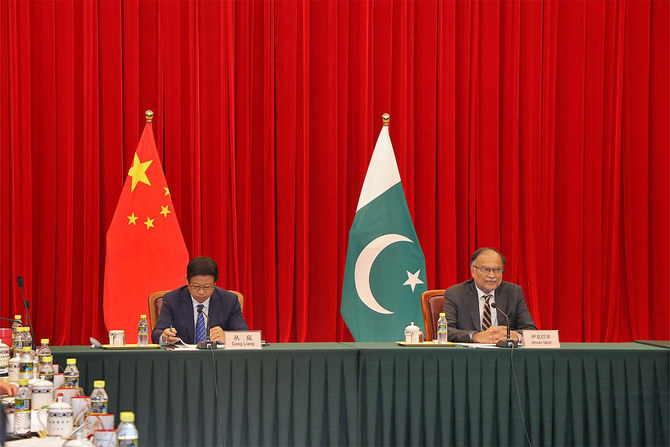
Pakistan's Planning Minister Ahsan Iqbal and Vice Chairman, National Development & Reform Commission (NDRC), China Mr, Cong Liang are pictured during 12th (Special) Joint Cooperation Committee (JCC) of the China-Pakistan Economic Corridor (CPEC) in Islamabad, Pakistan, on July 12, 2023. (@PakinChina_/Twitter)
Short Url
Updated 11 July 2023
Follow

Pakistan invites Chinese companies to become part of ‘National Solar Energy Initiative’

  • Program to help generate 10,000 MW solar power, “substitute costly energy with cheap solar power”
  • Pakistan has vowed to produce 60 percent of its electricity from renewable energy sources by 2030

ISLAMABAD: Minister for Planning Ahsan Iqbal on Tuesday met senior Chinese business officials and invited them to become part of a new ‘National Solar Energy Initiative,’ state media reported.

Pakistani Prime Minister Shehbaz Sharif announced the initiative in September last year, saying the program would help generate 10,000 MW solar power and “substitute costly energy with cheap solar power, which will provide massive relief to people and save precious foreign exchange.” 

The solar initiative aims to start off by switching government buildings and tube wells from diesel to solar power, while power plants operating on diesel, coal and furnace oil will also be partially replaced.

“Iqbal briefed the Chinese companies about Prime Minister’ ‘solar energy initiative’ for which foreign investors were offered special incentives,” the APP news agency reported about the planning minister’s meeting with Chen Diming, chairman of the China Apollo Holding Group, and Xu Hao, a senior representative of the China Ocean Engineering Construction Company.

“The minister invited the Chinese companies to benefit from this new policy.”

“He underscored the importance of energy projects which have enabled Pakistan to overcome its energy shortages and urged them to invest in solar power generation and establishment of solar manufacturing plants in Pakistan to achieve better efficiency and wider distribution of cheaper electricity,” APP added.

Pakistan’s current energy mix is about 58 percent fossil fuels, 30 percent hydropower and 10 percent renewables and nuclear power. Pakistan has vowed to produce 60 percent of its electricity from renewable sources by 2030.

Last month, Pakistan and China signed a $4.8 billion deal to build a 1,200-megawatt nuclear power plant, the Chashma 5 project.

Pakistan's total nuclear energy production capacity rose to 1,400 MW when the country's sixth nuclear power plant opened two years ago. Located in the southern port city of Karachi, that 1,100 mw plant was also constructed with Chinese assistance.

Since 2015, Beijing has pledged $65 billion in infrastructure and energy projects for Pakistan under its Belt and Road Initiative.


Four people, including two policemen, killed in twin blasts in northwest Pakistan

Updated 3 sec ago
Follow

Four people, including two policemen, killed in twin blasts in northwest Pakistan

  • Attack on police van in South Waziristan and motorbike-mounted IED in Lakki Marwat hits KP province
  • Violence comes amid a surge in militancy and cross-border clashes between Pakistan and Afghanistan

ISLAMABAD: At least four people, including two policemen, were killed and about 20 others wounded in two separate blasts in Pakistan’s northwestern Khyber Pakhtunkhwa province on Saturday, officials said, the latest violence in a region grappling with militant violence.

One explosion targeted a police patrol van in Wana, the main town of South Waziristan district near the Afghan border, while another blast caused by explosives mounted on a motorbike struck a market area in Lakki Marwat district, according to police officials and preliminary reports.

The incidents come amid rising militant violence in Pakistan’s northwest, where authorities say armed groups operate from across the border in Afghanistan, straining relations between Islamabad and the Taliban administration in Kabul, with both sides engaged in a military conflict since last month.

“The control room received information in the evening about a bomb blast targeting a police van in Wana Bazaar,” a police official in the area, who did not want to be named, confirmed while speaking to Arab News over the phone.

He confirmed two deaths in the incident while saying more than 25 people had been injured.

The official said rescue teams responded promptly and shifted three seriously injured people to a nearby hospital in Wana.

In another incident during the day in Lakki Marwat, an improvised explosive device attached to a motorbike exploded near shops.

“Two people have been killed and about 10 have been injured in an IED blast in Lakki Marwat,” Raza Khan, Deputy Superintendent of Police in Bannu, told Arab News.

“The deceased are identified as Shoaib Ur Rehman and Furqan Ullah,” he added. “Shoaib, the owner of the shop, was the brother of the Lakki peace committee head.”

Peace committees in the region are informal, community-based groups that work with security forces to report militant activity and maintain order, making their members frequent targets of attacks.

Pakistan’s Interior Minister Mohsin Naqvi condemned the attacks and expressed grief over the incidents.

“I strongly condemn the blast near a police patrolling vehicle in Wana Bazaar,” Naqvi said in a statement, confirming the killing of four people, including two police personnel.

“Khyber Pakhtunkhwa police are on the front line in the war against terrorism,” he said, noting the force had made “unforgettable sacrifices” in the fight against militant groups.

Militant violence has surged in Pakistan’s border regions in recent months, particularly in Khyber Pakhtunkhwa and Balochistan provinces.
Islamabad has repeatedly accused the Afghan Taliban government of allowing militant groups, including the Tehreek-e-Taliban Pakistan (TTP), to operate from Afghan territory — a charge Kabul denies — as cross-border tensions between the two neighbors have escalated.