

UN rights body set to debate Pakistan’s proposal on religious hatred after Qur’an burning

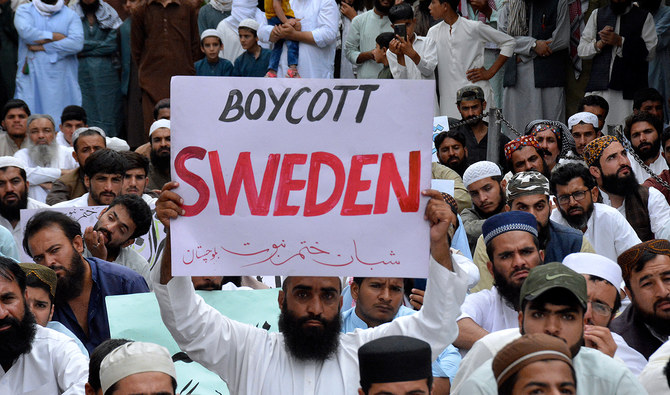
Muslim protestors take part in a rally to denounce burning of Islam's holy book 'Qur'an' in Quetta on July 7, 2023. (AP/File)
Short Url
Updated 10 July 2023
Follow

UN rights body set to debate Pakistan’s proposal on religious hatred after Qur’an burning

  • Draft resolution presented by Pakistan on behalf of 57-nation Organization of Islamic Cooperation
  • It remains to be seen whether Pakistan will succeed in rallying all OIC countries behind it

GENEVA: The Human Rights Council is set to debate a draft proposal on religious hatred in the wake of a Qur’an burning in Sweden, an initiative that has highlighted rifts in the UN body and challenged practices in human rights protection.

In a draft resolution presented by Pakistan on behalf of the 57-nation Organization of Islamic Cooperation (OIC), the group described the burning of the Qur’an in Stockholm last month as “offensive, disrespectful and a clear act of provocation” that incites hatred and constitutes a human rights violation.

The draft — which condemned “recurring acts of public burning of the Holy Qur’an in some European and other countries” — has stoked opposition from Western diplomats who argue it aims to safeguard religious symbols rather than human rights.

“We don’t like the text,” one Western diplomat said of the draft, which will be presented to the Human Rights Council in Geneva on Tuesday. “Human rights are supposed to be attached to individuals, not to religions.”

The OIC initiative also stokes tensions between Western states and the Islamic organization at a time when the group has unprecedented clout in the council, the only body made up of governments to protect human rights worldwide.

Nineteen OIC countries are voting members of the 47-member council, and other states such as China have aligned with their draft resolution.

It remains to be seen whether Pakistan will succeed in rallying all OIC countries behind it.

“If the resolution passes, as seems likely, it will strengthen the impression the council is flipping and the West is losing ground on key debates such as the boundary between free speech and hate speech, and whether religions have rights,” said Marc Limon, director of the Geneva-based Universal Rights Group.

“This could make the council explode in acrimony.”

The European Union has urged parties to reach a consensus on the issue.

“Defamation of religions has been a difficult topic for decades within the UN,” an EU diplomat said in negotiations last week.

“The question where to draw the line between freedom of expression and incitement to hatred is indeed a very complicated one.”


Pakistan urges developed nations, global institutions to expand role in climate financing

Updated 07 December 2025
Follow

Pakistan urges developed nations, global institutions to expand role in climate financing

  • Pakistan is recognized among countries worldwide most affected by climate-induced disasters
  • Planning minister stresses redesigning global financial system on principles of responsibility, equity

ISLAMABAD: Pakistan’s Planning Minister Ahsan Iqbal this week called on developed nations and international financial institutions to play a greater role in helping developing countries adopt green technologies at lower costs, state-run media reported. 

Pakistan has suffered frequent climate change-induced disasters over the past couple of years, ranging from floods, droughts, heatwaves, cyclones and other irregular weather patterns. 

This year the South Asian country reported over 1,000 deaths from floods and landslides triggered by heavy rains and the melting of glaciers. 

“He [Iqbal] said Pakistan has urged developed countries and international financial institutions to expand their role in climate financing to enable developing nations to adopt green technologies at lower costs,” state-run Associated Press of Pakistan (APP) reported on Saturday. 

The minister was speaking at the Second Asia Energy Transition Summit held at Pakistani university LUMS on Saturday. 

Iqbal warned that climate change is intensifying emergencies and increasing economic burdens on vulnerable countries, adding that financial incentives and concessional financing have become indispensable for sustainable climate action.

“He further emphasized the need to redesign the global financial system based on the principles of collective responsibility and equity,” APP said. 

The minister noted that Pakistan has been introducing comprehensive reforms in its development agenda to promote renewable energy, solar power and green technological solutions. 

The country, he said, possesses “strong solar potential,” a robust renewable energy market, a wide talent pool in engineering and science and an enabling environment for green innovation.

Pakistan has regularly urged developed countries to fulfill past pledges and provide easy access to climate funding without attaching conditions, especially at Conference of Parties (COP30) climate summits. 

Islamabad was instrumental in getting the Fund for Responding to Loss and Damage (FRLD) established at the COP27 climate summit in Egypt in 2022. The Loss and Damage Fund aims to help developing and least developed countries cope with both economic and non-economic impacts of climate change, such as extreme weather events and slow-onset crises like sea-level rise and droughts.