

North Korea denounces US move to bring ballistic missile submarine to peninsula

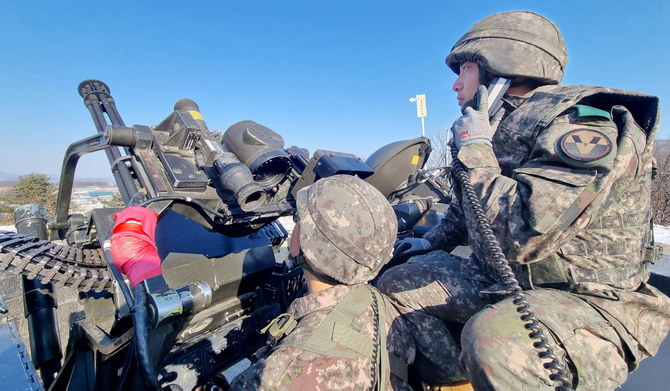
South Korean soldiers with 20mm vulcan cannon take part in an anti-drone drill in Yangju, South Korea, in this handout picture provided by the South Korean Defence Ministry on December 29, 2022. (REUTERS)
Short Url
Updated 10 July 2023
Follow

North Korea denounces US move to bring ballistic missile submarine to peninsula

  • A US nuclear-powered cruise missile submarine arrived at the port of Busan in South Korea last month

SEOUL: North Korea denounced on Monday what it called a move by the United States to introduce a nuclear missile submarine to waters near the Korean peninsula, saying it creates a situation that brings a nuclear conflict closer to reality.
North Korea also claimed US reconnaissance planes recently violated its air space near the east coast, quoting an unnamed spokesperson of its Ministry of National Defense in a statement carried by the official KCNA news agency.
“There is no guarantee that a shocking incident where a US air force strategic reconnaissance plane is shot down over the East Sea will not happen,” the spokesperson said.
The statement cited past incidents of the North shooting down or intercepting US aircraft at the border with South Korea and off the coast. North Korea has often complained about US surveillance flights near the peninsula.
The moves by the United States to introduce strategic nuclear assets to the Korean peninsula is a blatant nuclear blackmail against North Korea and regional countries and presents a grave threat to peace, KCNA said.
“It is up to future US actions whether an extreme situation arises in the Korean peninsula region that nobody wants, and the United States will be held fully responsible if any unexpected situation occurs,” it said.
A US nuclear-powered cruise missile submarine arrived at the port of Busan in South Korea last month.
In April, the leaders of South Korea and the United States agreed a US Navy nuclear-armed ballistic missile submarine will visit South Korea for the first time since the 1980s but no timetable has been given for such a visit.
It was part of a plan to boost the deployment of American strategic assets aimed at a more effective response to North Korea’s threats and weapons tests in defense of its ally South Korea, as agreed by the two leaders.
The move to sail nuclear submarines has created a “very dangerous situation that makes it impossible for us not to realistically accept the worst-case scenario of a nuclear confrontation,” the North Korean statement said.
In June, a US B-52 strategic bomber took part in air military drills with South Korea in a show of force following North Korea’s failed launch of a spy satellite at the end of May.


Russia’s war footing may remain after Ukraine war, Latvia spy chief warns

Updated 7 sec ago
Follow

Russia’s war footing may remain after Ukraine war, Latvia spy chief warns

MUNICH: Russia will not end the militarization of its economy after fighting in Ukraine ends, the head of Latvia’s intelligence agency told AFP on the sidelines of the Munich Security Conference which ends Sunday.
“The potential aggressiveness of Russia when the Ukraine war stops will depend of many factors: How the war ends, if it’s frozen or not, and if the sanctions remain,” Egils Zviedris, director of the Latvian intelligence service SAB, told AFP.
Some observers believe that Russia has so thoroughly embraced a war economy and full military mobilization that it will be difficult for it to reverse course, and that this could push Moscow to launch further offensives against European territories.
Zviedris said that lifting current sanctions “would allow Russia to develop its military capacities” more quickly.
He acknowledged that Russia has drawn up military plans to potentially attack Latvia and its Baltic neighbors, but also said that “Russia does not pose a military threat to Latvia at the moment.”
“The fact that Russia has made plans to invade the Baltics, as they have plans for many things, does not mean Russia is going to attack,” Zviedris told AFP.
However, the country is subject to other types of threats from Moscow, particularly cyberattacks, according to the agency he leads.
The SAB recently wrote in its 2025 annual report that Russia poses the main cyber threat to Latvia, because of broader strategic goals as well as Latvia’s staunch support of Ukraine.
The threat has “considerably increased” since Moscow’s full-scale invasion of Ukraine in 2022, it said.
The agency has also warned that Russia is seeking to exploit alleged grievances of Russian-speaking minorities in the Baltics — and in Latvia in particular.
Russia’s Ministry of Foreign Affairs has repeatedly claimed to be preparing cases against Latvia, Lithuania and Estonia at the UN International Court of Justice over the rights of their Russian-speaking minorities.
“The aim of litigation: to discredit Latvia on an international level and ensure long-term international pressure on Latvia to change its policy toward Russia and the Russian-speaking population,” the report said.
In 2025, approximately 23 percent of Latvia’s 1.8 million residents identified as being of Russian ethnicity, according to the national statistics office.
Following the Russian invasion of Ukraine in 2022, Latvian authorities decided to require Russian speakers residing in the country to take an exam to assess their knowledge of the Latvian language — with those failing at potential risk of deportation.