

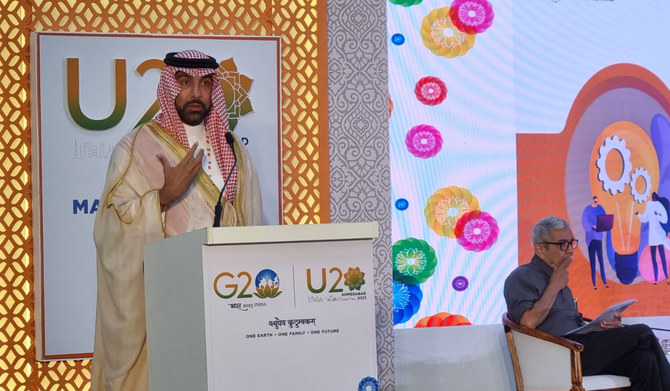


AHMEDABAD: Saudi Arabia’s G20 representative Fahd Al-Rasheed’s appearance at the Urban 20 Mayoral Summit in Ahmedabad, India, this week, in which he focused on the importance of engaging with citizens for development projects, has inspired a number of urban planners to try and emulate Riyadh and to seek cooperation with the Kingdom.
Al-Rasheed, adviser to the Saudi Council of Ministers, previously served as CEO of the Royal Commission for Riyadh and helped transform the Saudi capital into one of the world’s top smart cities. He shared the city’s success story with the summit’s participants on Friday.
One of the main issues he focused on was citizen engagement, stressing that good governance was ultimately about serving “every person that lives in the city.”
HIGHLIGHTS
• Fahd Al-Rasheed, adviser to the Saudi Council of Ministers, helped transform the Saudi capital into one of the world’s top smart cities.
• One of the main issues he focused on was citizen engagement, stressing that good governance was ultimately about serving ‘every person that lives in the city.’
• This view of urban development as a multi-level effort provided Indian planners and top municipal officials with new insights.
This view of urban development as a multi-level effort — from the economy through lifestyle to infrastructure — provided Indian planners and top municipal officials with new insights.
“I was quite impressed with the fact that he envisions cities as multi-dimensional living organisms which have to evolve with time, which have various facets, various functions and various roles,” Junaid Azim Mattu, mayor of Srinagar, told Arab News.
“He spoke about the retail economy, about the infrastructure and the relationship it has with human behavior, and about how human behavior and indices of human prosperity and human activity have to be at the core of infrastructure development. I found that very interesting and fascinating.”
The development of Riyadh was “definitely a success story” for Mattu, one from which Indian cities could learn.
“I am sure there are lots of things from Riyadh that should and can be emulated,” he said. “I spoke to my team and asked them to initiate some sort of knowledge-sharing mechanism with the city of Riyadh.”
For Somya Gurjar, mayor of Jaipur, the most important takeaway from Al-Rasheed’s speech was the significance of citizens’ wellbeing.
“The health of citizens should be the priority. Healthy citizens will definitely contribute a lot to the development of a city,” she told Arab News, adding that she also related to the Riyadh planner’s focus on skill development to give the city a sound economy — something that she, too, is trying to pursue in Jaipur, she said.
Dr. Chetan Vaidya, senior urban planner and educator, said that Al-Rasheed’s experience in both private and government sectors meant his ideas resonated with his audience.
“We need a strong technical team, as well as appropriate financing — linking public-sector financing and private-sector financing. This is one lesson we should learn from Riyadh,” Vaidya told Arab News.
Another lesson was to engage with the city’s inhabitants and find out what kind of place they want to live in.
“Unless we get the lifestyles correct, which is a lesson from his presentation, I think we will get our new cities wrong,” Vaidya said.


