Pakistan expresses condemnation as two killed in militant attack on police station in Iran

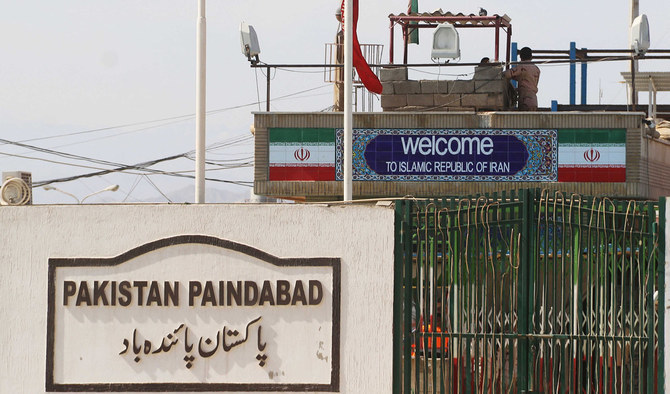
General view of a closed gate at Pakistan and Iran's border posts in Taftan, Pakistan on February 25, 2020. (REUTERS/File)
Short Url
Updated 08 July 2023
Follow

Pakistan expresses condemnation as two killed in militant attack on police station in Iran

  • Armed group attacked police station in Zahedan, city in Iran’s Sistan and Baluchistan province
  • Iran’s Revolutionary Guard said in a statement that the four militants were killed

ISLAMABAD: Pakistan on Saturday “strongly” condemned a militant attack in Iran’s Zahedan city in which two Iranian security forces were killed.
Four militants attacked a police station in Zahedan in Iran’s Sistan and Baluchistan province, about 30 kilometers from the border with Pakistan, triggering a shootout. Two security forces were killed, Iranian state TV said.
“We express our deepest condolences to the bereaved families and pray for the swift recovery of those injured,” the Pakistani foreign office said.
“Pakistan stands in complete solidarity with the government and people of Iran in this common fight against the scourge of terrorism.”
Iran’s Revolutionary Guard said in a statement that the four militants were killed.
The report quoted Alireza Marhamati, the province’s deputy governor, as saying the militants were trying to gain access to the police station and were equipped with grenades, but did not elaborate further.


Pakistan says Indian minister initiated handshake in Dhaka, first contact since May conflict

Updated 5 sec ago
Follow

Pakistan says Indian minister initiated handshake in Dhaka, first contact since May conflict

  • Pakistan’s Ayaz Sadiq and India’s Subrahmanyam Jaishankar met on the sidelines of Khaleda Zia’s funeral
  • The National Assembly of Pakistan says Islamabad has consistently emphasized dialogue with New Delhi

ISLAMABAD: Pakistan said on Wednesday Indian External Affairs Minister Subrahmanyam Jaishankar initiated a brief handshake with Speaker of the National Assembly Sardar Ayaz Sadiq in Dhaka, marking the first high-level contact between the two nuclear-armed rivals since their military conflict in May.

The encounter took place on the sidelines of the funeral of former Bangladeshi prime minister Khaleda Zia, attended by senior officials and diplomats from multiple countries.

Ties between India and Pakistan have remained frozen since a four-day military confrontation in May, during which both sides exchanged missile, drone and air strikes before a ceasefire brokered by Washington.

“During Speaker NA Sardar Ayaz Sadiq’s visit to the Parliament of Bangladesh ... the Indian External Minister Dr. S. Jaishankar approached the Speaker National Assembly and [shook] hands,” Pakistan’s National Assembly said in a post on social media platform X.

It added that Jaishankar introduced himself to Sadiq during the brief interaction. India has not commented publicly on the exchange.

“It is noteworthy that Pakistan has consistently emphasized dialogue, restraint, and cooperative measures, including proposals for peace talks,” the post continued.

Tensions between the two neighbors escalated in April after a militant attack in Indian-administered Kashmir killed more than 20 tourists. New Delhi blamed Pakistan for supporting the attack, an allegation Islamabad denied, calling instead for an independent and transparent investigation.

Officials from both countries have largely avoided public interactions since the conflict, with senior figures refraining from handshakes or exchanges at international gatherings.

Sadiq was in Dhaka to attend Zia’s funeral and to convey condolences from Pakistan’s leadership and people. He also met Zia’s son Tarique Rahman, the acting chairman of the Bangladesh Nationalist Party, according to Pakistan’s high commission in Bangladesh.

Speaking to Pakistan’s Geo TV, Sadiq confirmed that Jaishankar approached him in full media glare and exchanged pleasantries.

Responding to a question about being photographed with the Indian minister, he said: “Cameras arrived with them. Our people took the photographs later.”