

Pakistan seeking early warning system from Switzerland to prevent disasters — PM Sharif

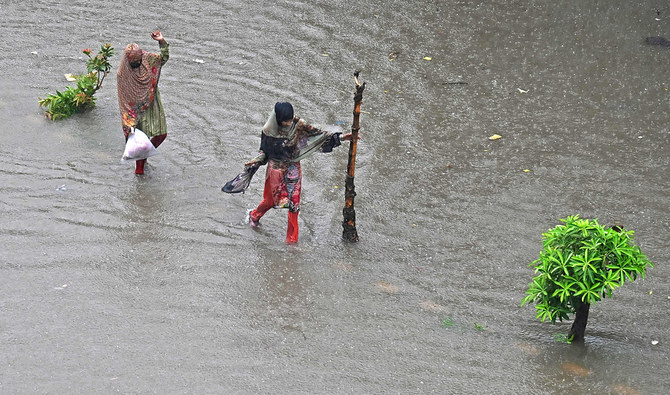
Women make their way through a waterlogged street after heavy rainfall in Lahore on July 5, 2023. (AFP)
Short Url
Updated 08 July 2023
Follow

Pakistan seeking early warning system from Switzerland to prevent disasters — PM Sharif

  • Sharif said this at a meeting with Swiss Foreign Minister Ignazio Cassis in Bhurban
  • The development comes as death toll from two weeks of monsoon rains rises to 55

ISLAMABAD: Pakistan Prime Minister Shehbaz Sharif said on Saturday his country was looking forward to getting an early warning system from Switzerland that could help Islamabad mitigate losses from natural disasters, Pakistani state media reported, as fresh monsoon rains in the country claimed more than 50 lives.
The statement by the Pakistan prime minister came at a meeting with Swiss Foreign Minister Ignazio Cassis in Bhurban hill station, wherein the two sides signed a memorandum of understanding (MoU) for the promotion of cooperation in the field of disaster management.
The development came a day after Pakistani authorities said the death toll from two weeks of monsoon rains had risen to at least 55, following the death of 12 people, including eight children, in weather-related incidents amid fears of flash floods.
The rains have returned to Pakistan a year after the climate-induced downpour swelled rivers and inundated at one point one-third of Pakistan, killing 1,739 people. The floods also caused $30 billion in damage in cash-strapped Pakistan in 2022.
“Pakistan looks forward to cooperation from Switzerland in getting advance warning system and other facets which secure Pakistan as much as possible from the natural disasters,” Sharif was quoted as saying by the state-run Radio Pakistan broadcaster.
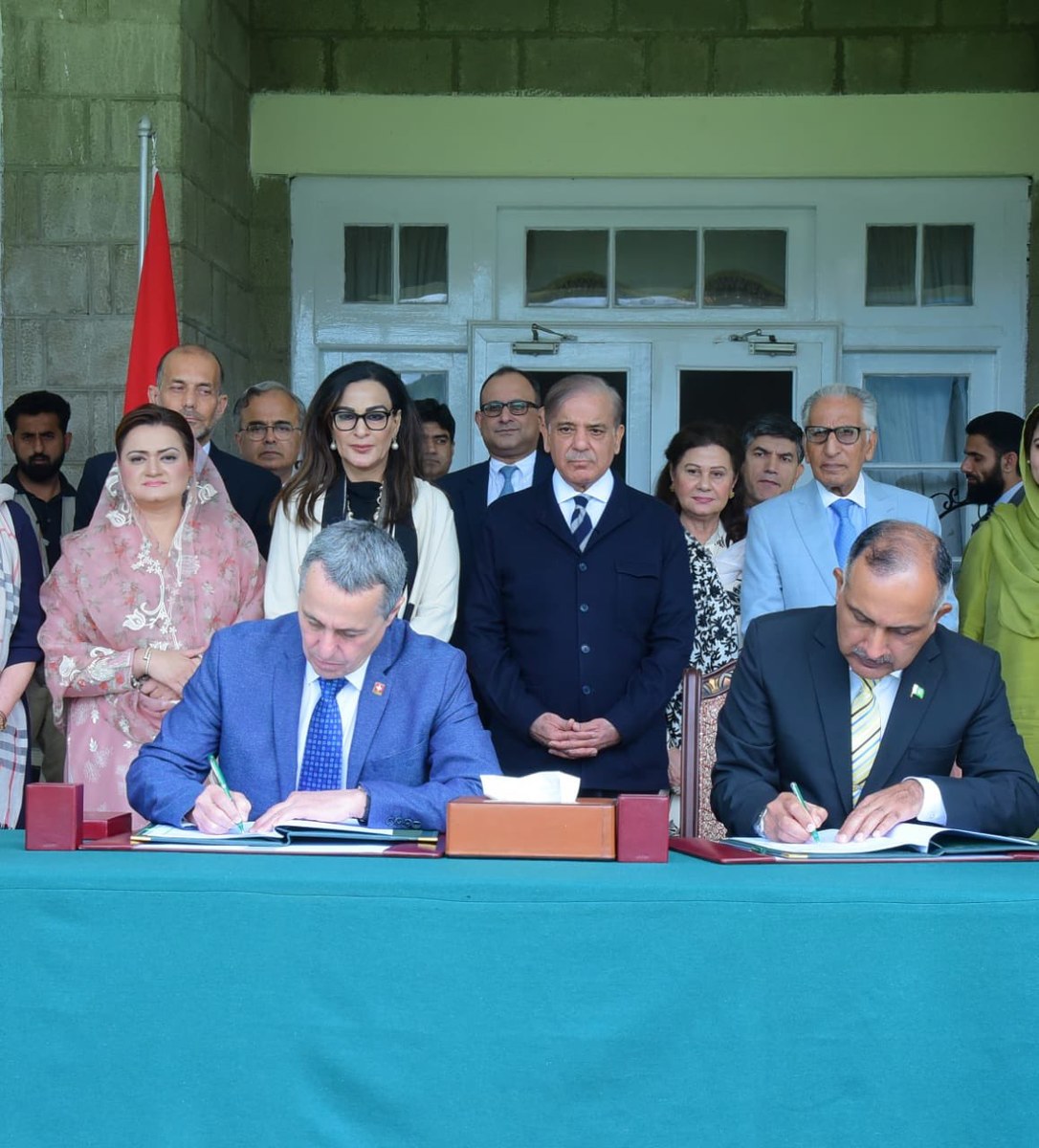


In this photo visiting Swiss Foreign Minister Ignazio Cassis (left) and head of Pakistan's disaster management authority, Lieutenant General Inam Haider Malik (right) signs Memorandum of Understanding, at the Nathia Gali resort, located some 85 kilometers from Islamabad on June 8, 2023. (Photo courtesy: Twitter/sherryrehman)

The prime minister pointed out that Pakistan had almost no contribution to the climate change. Pakistan is among the top 10 countries most affected by climate change, experts say, while the country’s contribution to global greenhouse gas emissions is less than 1 percent.
In his remarks, Foreign Minister Cassis said disaster risk management goes beyond borders and nationalities.
“It is a global responsibility that requires unity and collective action,” he said. “Pakistan and Switzerland will work hand in hand to raise awareness and protect the lives and livelihoods of our peoples.”
Cassis said the MoU signed by the two sides was a vital step in strengthening collaborative efforts against climate change.
“Pakistan is a country with rich cultural heritage and beautiful landscape but unfortunately it has been grappling with the devastating effects of natural disasters,” he said.
“It is a stark reminder of the urgent need for international cooperation to mitigate and manage the risks associated with catastrophes.”
The Swiss foreign minister said his country was ready to support Pakistan in this regard. 


Pakistan rice exports slump 40% as India’s return hits pricing power

Updated 24 February 2026
Follow

Pakistan rice exports slump 40% as India’s return hits pricing power

  • Statistics show non-Basmati shipments have fallen over 50 percent in July-January period
  • Government offers 9 percent tax drawback on premium Basmati exports to support sector

ISLAMABAD: Pakistan’s rice exports fell 40.5 percent to $1.31 billion in the first seven months of the fiscal year, official data showed on Tuesday, as India’s return to the global market squeezed Islamabad’s market share and pricing power.

According to the Pakistan Bureau of Statistics (PBS), non-Basmati exports dropped 50.8 percent to $827.8 million, with volumes falling to 2.0 million tons from 3.15 million tons a year ago. Basmati exports declined 6.62 percent to $477.7 million, with volumes easing to 436,484 tons from 487,278 tons.

The Ministry of National Food Security told a parliamentary committee in two separate meetings in December and January that India’s re-entry into the global rice market was a key factor behind the decline, saying increased Indian supplies had made Pakistani rice less competitive.

Officials told lawmakers that India benefits from free trade agreements and provides substantial support to its rice sector, putting additional pressure on Pakistani exporters.

In response, the Ministry of Commerce last month issued a notification under the “Drawback of Local Taxes and Levies for Rice Order, 2026,” allowing a rebate of 9 percent of the free-on-board (FOB) value for Basmati exports priced above $750 per metric ton.

The government said the measure, announced on January 23, aims to ease liquidity pressures on exporters and improve competitiveness.

While PBS data for July-January shows a 40.5 percent decline, figures from the Federal Board of Revenue (FBR) for July-December show an even steeper 47 percent drop to $973 million from $1.82 billion in the same period last year, reflecting a deficit of over $800 million.

Industry representatives say they are now focusing on market diversification to counter the slowdown.

“Currently Basmati is mainly exported to Middle East and EU. Non-Basmati is exported to Philippines, Indonesia, Malaysia and African countries,” Malik Faisal Jahangir, chairman of the Pakistan Rice Exporters Association, told Arab News last week.

“For the new markets for our non-basmati rice exports, we are looking to increase our volumes to China, Philippines, Indonesia and Bangladesh,” he added.