

Pakistan seeking early warning system from Switzerland to prevent disasters — PM Sharif

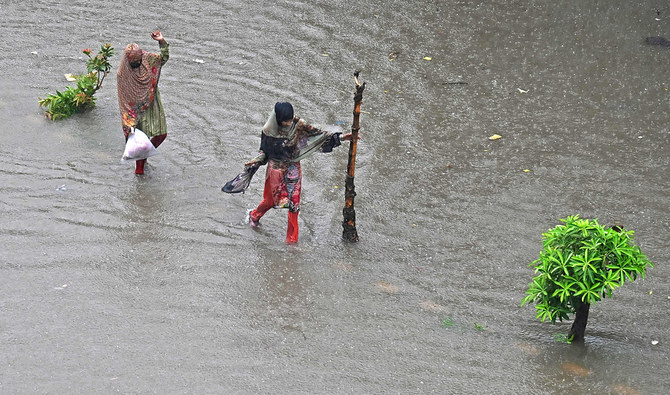
Women make their way through a waterlogged street after heavy rainfall in Lahore on July 5, 2023. (AFP)
Short Url
Updated 08 July 2023
Follow

Pakistan seeking early warning system from Switzerland to prevent disasters — PM Sharif

  • Sharif said this at a meeting with Swiss Foreign Minister Ignazio Cassis in Bhurban
  • The development comes as death toll from two weeks of monsoon rains rises to 55

ISLAMABAD: Pakistan Prime Minister Shehbaz Sharif said on Saturday his country was looking forward to getting an early warning system from Switzerland that could help Islamabad mitigate losses from natural disasters, Pakistani state media reported, as fresh monsoon rains in the country claimed more than 50 lives.
The statement by the Pakistan prime minister came at a meeting with Swiss Foreign Minister Ignazio Cassis in Bhurban hill station, wherein the two sides signed a memorandum of understanding (MoU) for the promotion of cooperation in the field of disaster management.
The development came a day after Pakistani authorities said the death toll from two weeks of monsoon rains had risen to at least 55, following the death of 12 people, including eight children, in weather-related incidents amid fears of flash floods.
The rains have returned to Pakistan a year after the climate-induced downpour swelled rivers and inundated at one point one-third of Pakistan, killing 1,739 people. The floods also caused $30 billion in damage in cash-strapped Pakistan in 2022.
“Pakistan looks forward to cooperation from Switzerland in getting advance warning system and other facets which secure Pakistan as much as possible from the natural disasters,” Sharif was quoted as saying by the state-run Radio Pakistan broadcaster.
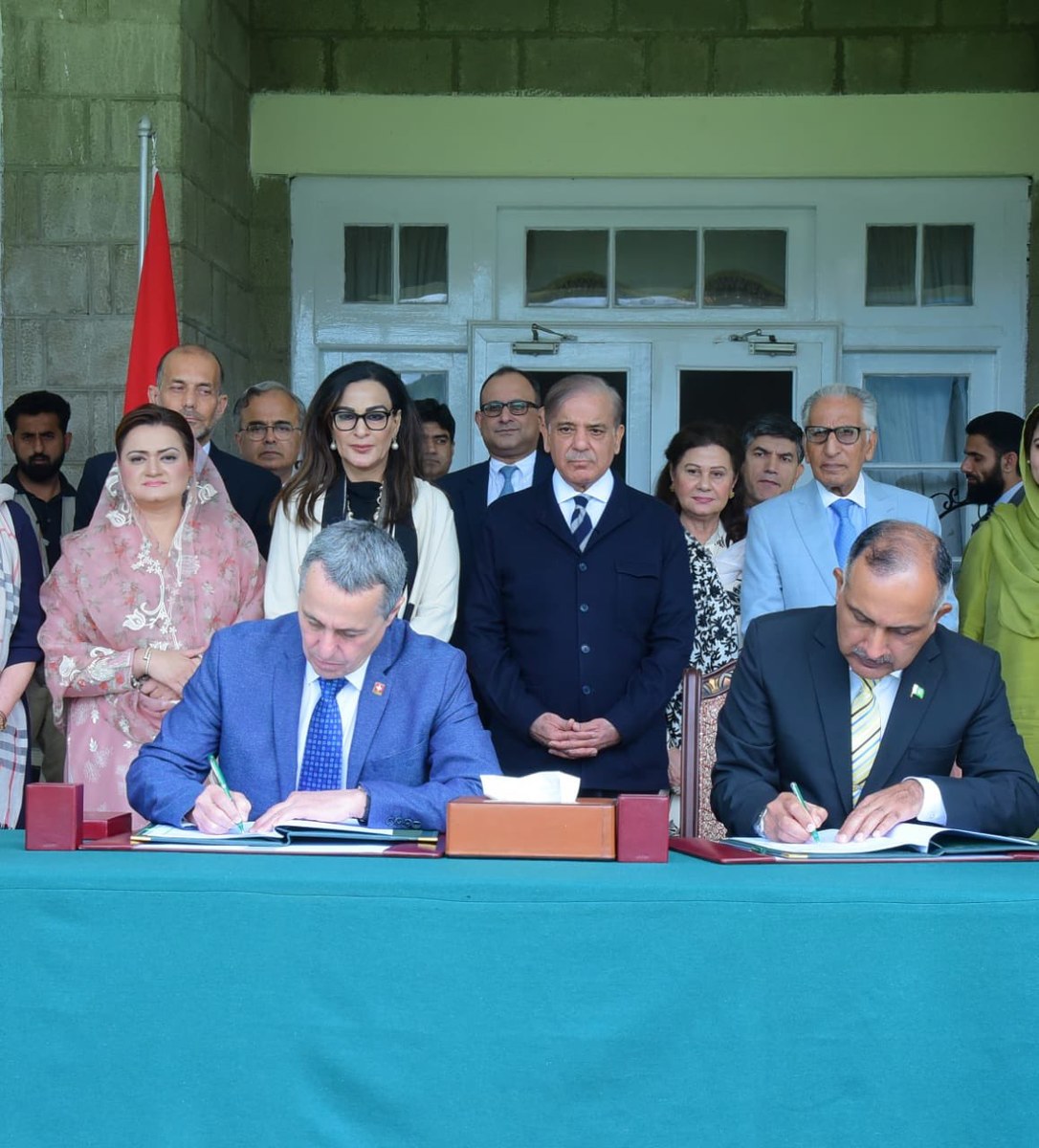


In this photo visiting Swiss Foreign Minister Ignazio Cassis (left) and head of Pakistan's disaster management authority, Lieutenant General Inam Haider Malik (right) signs Memorandum of Understanding, at the Nathia Gali resort, located some 85 kilometers from Islamabad on June 8, 2023. (Photo courtesy: Twitter/sherryrehman)

The prime minister pointed out that Pakistan had almost no contribution to the climate change. Pakistan is among the top 10 countries most affected by climate change, experts say, while the country’s contribution to global greenhouse gas emissions is less than 1 percent.
In his remarks, Foreign Minister Cassis said disaster risk management goes beyond borders and nationalities.
“It is a global responsibility that requires unity and collective action,” he said. “Pakistan and Switzerland will work hand in hand to raise awareness and protect the lives and livelihoods of our peoples.”
Cassis said the MoU signed by the two sides was a vital step in strengthening collaborative efforts against climate change.
“Pakistan is a country with rich cultural heritage and beautiful landscape but unfortunately it has been grappling with the devastating effects of natural disasters,” he said.
“It is a stark reminder of the urgent need for international cooperation to mitigate and manage the risks associated with catastrophes.”
The Swiss foreign minister said his country was ready to support Pakistan in this regard. 


Pakistan reports current account surplus in Jan. owing to improved trade, remittances

Updated 17 February 2026
Follow

Pakistan reports current account surplus in Jan. owing to improved trade, remittances

  • Pakistan’s exports crossed the $3 billion mark in Jan. as the country received $3.5 billion in remittances
  • Last month, IMF urged Pakistan to accelerate pace of structural reforms to strengthen economic growth

ISLAMABAD: Pakistan recorded a current account surplus of more than $120 million in January, the country’s finance adviser said on Tuesday, attributing it to improved trade balance and remittance inflows.

Pakistan’s exports rebounded in January 2026 after five months of weak performance, rising 3.73 percent year on year and surging 34.96 percent month on month, according to data released by the country’s statistics bureau.

Exports crossed the $3 billion mark for the first time in January to reach $3.061 billion, compared to $2.27 billion in Dec. 2025. The country received $3.5 billion in foreign remittances in Jan. 2026.

Khurram Schehzad, an adviser to the finance minister, said Pakistan reported a current account surplus of $121 million in Jan., compared to a current account deficit of $393 million in the same month last year.

“Improved trade balance in January 2026, strong remittance inflows, and sustained momentum in services exports (IT/Tech) continue to reinforce the country’s external account position,” he said on X.

Pakistan has undergone a difficult period of stabilization, marked by inflation, currency depreciation and financing gaps, and international rating agencies have acknowledged improvements after Islamabad began implementing reforms such as privatizing loss-making, state-owned enterprises (SOEs) and ending subsidies as part of a $7 billion International Monetary Fund (IMF) loan program.

Late last month, the IMF urged Pakistan to accelerate the pace of these structural reforms to strengthen economic growth.

Responding to questions from Arab News at a virtual media roundtable on emerging markets’ resilience, IMF’s director of the Middle East and Central Asia Jihad Azour said Islamabad’s implementation of the IMF requirements had been “strong” despite devastating floods that killed more than 1,000 people and devastated farmland, forcing the government to revise its 4.2 percent growth target to 3.9 percent.

“What is important going forward in order to strengthen growth and to maintain the level of macroeconomic stability is to accelerate the structural reforms,” he said at the meeting.

Azour underlined Pakistan’s plans to privatize some of the SOEs and improve financial management of important public entities, particularly power companies, as an important way for the country to boost its capacity to cater to the economy for additional exports.

“This comes in addition to the effort that the authorities have made in order to reform their tariffs, which will allow the private sector of Pakistan to become more competitive,” the IMF official said.