

India arrests three railway officials over train crash that killed more than 290 people 

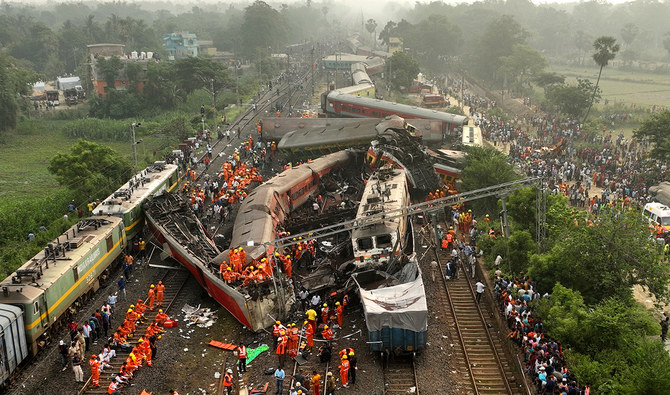
A drone shot of rescuers work at the site of passenger trains accident, in Balasore district, in the eastern Indian state of Orissa, Saturday, June 3, 2023. (AP/File)
Short Url
Updated 08 July 2023
Follow

India arrests three railway officials over train crash that killed more than 290 people 

  • The arrested men have been charged with culpable homicide without murder and destruction of evidence 
  • The June crash was India’s deadliest since 1995, when two trains collided near New Delhi, killing 358 people 

NEW DELHI: India’s federal crime agency said Friday it has arrested three railway officials in connection with one of the country’s deadliest train accidents, which killed more than 290 people last month. 

The arrested men have been charged with culpable homicide without murder and destruction of evidence, the Central Bureau of Investigation said in a statement. It identified them as two signal engineers and one technician, and said the investigation is ongoing. 

June’s train crash in eastern Odisha state occurred when a packed passenger train was mistakenly diverted onto an adjacent loop line where it rammed into a stationary freight train loaded with iron ore. The collision derailed the passenger train’s coaches onto another track where they struck a passing train that was running in the opposite direction. 

The two passenger trains were carrying more than 2,290 people when the collision took place. Nearly 1,000 people were injured. 

After the accident, India’s Railway Minister Ashwini Vaishnaw said the cause of the crash was related to the signaling system. 

India, a country of 1.42 billion people, has one of the world’s most extensive and complicated railways built during the British colonial era: more than 40,000 miles (64,000 kilometers) of tracks, 14,000 passenger trains and 8,000 stations. Spread across the country from the Himalayas in the north to the beaches in the south, it is also a system that is weakened by decades of mismanagement and neglect. 

Despite efforts to improve safety, several hundred accidents happen every year, and most such crashes are blamed on human error or outdated signaling equipment. 

The June crash was India’s deadliest since 1995, when two trains collided near New Delhi, killing 358 people. In 2016, a passenger train slid off the tracks between the cities of Indore and Patna, killing 146 people. 


Afghan clerics ban use of nation’s territory for attacks, declare national defense obligatory

Updated 9 sec ago
Follow

Afghan clerics ban use of nation’s territory for attacks, declare national defense obligatory

  • Scholars’ gathering attended by Taliban leaders, Supreme Judge Sheikh Abdul Hakim Haqqani
  • Decree says citizens must not allow Afghan soil ‘to be used against any other country’

KABUL: Afghan scholars have issued a fatwa, or religious decree, banning the use of Afghan soil for attacks on other countries and declaring national defense a sacred religious duty, less than a week after deadly border clashes erupted again between Afghanistan and Pakistan following a fragile ceasefire.

The decree was issued on Wednesday following a grand assembly in Kabul that was attended by around a thousand clerics, religious leaders and officials.

They held discussions in the presence of several Taliban leaders, including Supreme Judge Sheikh Abdul Hakim Haqqani, Minister of Virtue and Prevention of Vice Khalid Hanafi, and Minister of Higher Education Sheikh Neda Mohammad Nadeem.

In a five-article decree seen by Arab News, the scholars said that defending national interests is “necessary and obligatory” for every Muslim.

“Whenever anyone from outside Afghanistan attempts to invade or harm the country, defense becomes a religious obligation. Muslims, without hesitation, must consider defending the system, the land, and their own values as an obligation. This defense is called ‘sacred jihad,’” one article reads.

It also said the people of Afghanistan must “not allow anyone to use the Afghan soil for destructive purposes,” and that “no one has the right to give foreign countries permission to operate or interfere” in the country under any name.

“The Islamic Emirate must prevent such actions and take necessary measures to stop those attempting it,” another article reads.

The Kabul gathering was aimed at uniting religious opinion behind the Taliban’s stance, said one Taliban official, who spoke with Arab News on condition of anonymity because he was not authorized to speak to the media.

“The message is clear. If we are attacked, we must respond — this is now an obligation,” another Taliban official, who was also not authorized to speak to the media, told Arab News.

Deadly border clashes broke out last week between Afghan and Pakistani forces, marking violations of a ceasefire that was in place since October.

After the ceasefire agreement, subsequent talks for a long-term truce have so far yielded little progress. The latest deadly exchange of fire comes amid reports of back-channel negotiations between Afghan and Pakistani officials, which neither governments have openly confirmed.

Wednesday’s fatwa was seen by some as a calibrated signal to Pakistan, which has repeatedly accused Afghanistan’s Taliban government of tolerating cross-border militancy.

“The above resolution reflects the collective wisdom of the Afghan Ulema and is clearly intended to convey a message to Pakistan regarding reconciliation between the two Muslim countries,” Asif Durrani, Pakistan’s former special envoy to Afghanistan, wrote on X.

“The government of Pakistan should welcome the resolution and offer the resumption of dialogue with the Taliban regime.”

Relations between Afghanistan and Pakistan have been deteriorating since the Taliban took control of Afghanistan in 2021, with clashes intensifying along the Durand Line — their 2,640-km border.

Dozens of people died during the violence in October, making it the deadliest confrontation in years between the neighbors.

Islamabad accuses the Afghan Taliban of sheltering fighters from the banned Tehreek-e-Taliban Pakistan and allowing them to stage cross-border attacks — a charge Afghanistan denies, saying it does not allow its territory to be used against other countries.

Wasi Baheer, an Afghan political analyst, said the decree did not signify a new move from the Taliban government.

“This is not big news for either country. The leadership of the Taliban had announced this earlier — this is a repeated decree calling jihad abroad impermissible,” he told Arab News.

“The TTP problem is not new for Pakistan,” Baheer said. “I think Kabul cannot do more to help Pakistan. The fatwa will not have a huge effect on things, as the Afghan Taliban are not involved, and the TTP is too strong now to listen.”