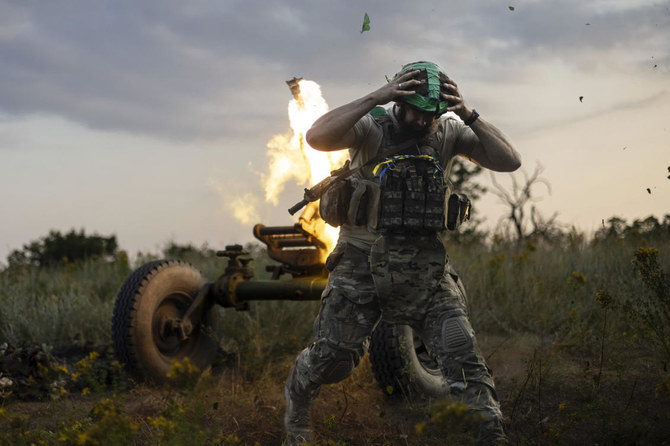
BRUSSELS: EU negotiators on Friday sealed a plan to boost ammunition production in the bloc, as part of a push to arm Ukraine and restock depleted arsenals.
The $545 million (500 million euros) Act in Support of Ammunition Production — or ASAP — is aimed at ramping up the manufacture of artillery shells and missiles.
“This is yet another proof of the EU’s unwavering commitment to supporting Ukraine,” said Margarita Robles, the defense minister of Spain, which currently holds the EU’s rotating presidency.
Brussels says it hopes to boost production capacity in the bloc to a million shells a year within the next 12 months as European allies struggle to keep up supplies for Ukraine’s fight against Russia.
Negotiations between EU member states and lawmakers were pushed through at express speed to put the plan in place.
It now needs final approval from the European Parliament and capitals.
The program will provide money to firms looking to bolster their production capacity.
EU states have also implemented another two-billion-euro plan to send a million shells to Ukraine from their stocks over this year and purchase ammunition together for Kyiv.
So far the bloc is still far off its target of sending a million howitzer shells to Kyiv.
Ukrainian forces complain they are facing a shortage of ammunition as they seek to dislodge Moscow’s troops from occupied territories in a grueling counter-offensive.
The EU says that overall it has already supplied weaponry worth around 15 billion euros to Kyiv since Russia’s all-out invasion last February.

EU seals ammunition production plan in rush to arm Ukraine
https://arab.news/9rdkq
EU seals ammunition production plan in rush to arm Ukraine
- The $545 million Act in Support of Ammunition Production aimed at ramping up the manufacture of artillery shells and missiles
Rohingya rue Myanmar’s election from exile
COX’S BAZAR, Bangladesh: Myanmar’s military portrays its general election as a path to democracy and peace, but the vote offers neither to a million Rohingya exiles, robbed of citizenship rights and evicted from their homeland by force.
“How can you call this an election when the inhabitants are gone and a war is raging?” said 51-year-old Kabir Ahmed in Bangladesh’s Kutupalong, the world’s largest refugee camp complex.
Heavily restricted polls are due to start Sunday in areas of Myanmar governed by the military, which snatched power in a 2021 coup that triggered civil war.
SPEEDREAD
• Heavily restricted polls are due to start Sunday in areas of Myanmar governed by the military, which snatched power in a 2021 coup that triggered civil war.
• In 2017, a military crackdown sent legions of the mostly Muslim group fleeing Myanmar’s Rakhine state to neighboring Bangladesh.
But for the Rohingya minority, violence began well before that, with a military crackdown in 2017 sending legions of the mostly Muslim group fleeing Myanmar’s Rakhine state to neighboring Muslim-majority Bangladesh.
The month-long election will be the third national poll since they were stripped of their voting rights a decade ago, but comes amid a fresh exodus fueled by the all-out war. Ahmed once served as chairman of a village of more than 8,000 Rohingya in Myanmar’s Maungdaw township, just over the border from Cox’s Bazar in Bangladesh.
After their eviction, the area is now a “wasteland,” he told AFP.
“Who will appear on the ballot?” he asked. “Who is going to vote?“
Today 1.17 million Rohingya live crammed in dilapidated camps spread over 8,000 acres in Cox’s Bazar.
The majority came in the 2017 crackdown, which is now the subject of a UN genocide court case, with allegations of rampant rape, executions and arson.
Civil war has brought fresh violence, with the Rohingya caught between the warring military and separatist group the Arakan Army, one of the many factions challenging the junta’s rule.
Both forces have committed atrocities against the Rohingya, monitors say.
Some 150,000 people fled the persecution to Bangladesh in the 18 months to July, according to UN analysis.
The UN refugee agency said it was the largest surge in arrivals since 2017.
Aged 18, Mohammad Rahim would have been eligible to vote this year — if he was back home, if his country acknowledged his citizenship, and if polling went ahead despite the war.
“I just want the war to end and for steps to be taken to send us back to Myanmar,” said Rahim, the eldest of four siblings who have all grown up in the squalid camps.
The Arakan Army controls all but three of Rakhine’s 17 townships, according to conflict monitors, meaning the military’s long-promised polls are likely to be extremely limited there.
The military has blockaded the coastal western state, driving a stark hunger and humanitarian crisis.
Rahim still craves a homecoming. “If I were a citizen, I would negotiate for my rights. I could vote,” he said.
“I would have the right to education, vote for whoever I wanted, and work toward a better future.”


