- Iraqi refugee claims to be liberal, but he fought in the Imam Ali Brigades and praised firebrand cleric Muqtada Al-Sadr
- Swedish political writer Jerry Maher says Momika’s motives appears to be asylum related, presenting himself as a victim
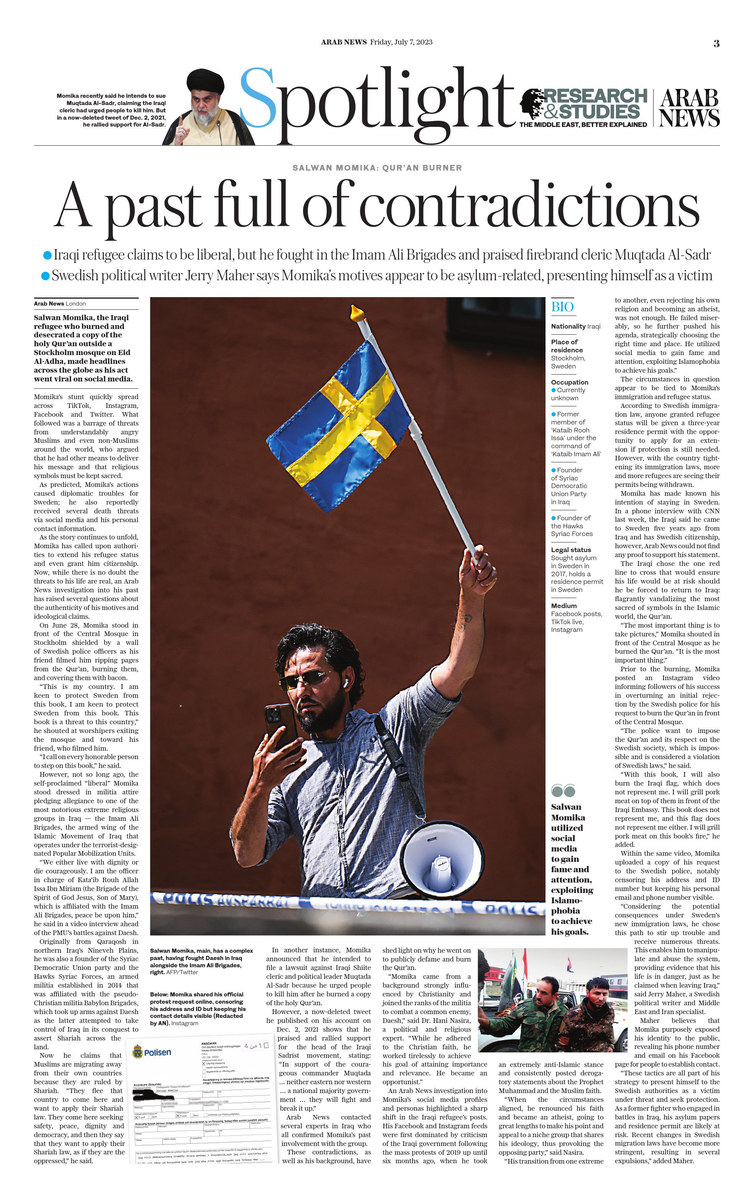
LONDON: Salwan Momika, the Iraqi refugee who burned and desecrated a copy of the holy Qur’an outside a Stockholm mosque on Eid Al-Adha, made headlines across the globe as his act went viral on social media.
Momika’s stunt quickly spread across TikTok, Instagram, Facebook and Twitter. What followed was a barrage of threats from understandably angry Muslims and even non-Muslims around the world, who argued that he had other means to deliver his message and that religious symbols must be kept sacred.
As predicted, Momika’s actions caused diplomatic troubles for Sweden; he also reportedly received several death threats via social media and his personal contact information.
As the story continues to unfold, Momika has called upon authorities to extend his refugee status and even grant him citizenship. Now, while there is no doubt the threats to his life are real, an Arab News investigation into his past has raised several questions about the authenticity of his motives and ideological claims.
On June 28, Momika stood in front of the Central Mosque in Stockholm shielded by a wall of Swedish police officers as his friend filmed him ripping pages from the Qur’an, burning them, and covering them with bacon.
“This is my country. I am keen to protect Sweden from this book, I am keen to protect Sweden from this book. This book is a threat to this country,” he shouted at worshipers exiting the mosque and toward his friend, who filmed him.
“I call on every honorable person to step on this book,” he said.
However, not so long ago, the self-proclaimed “liberal” Momika stood dressed in militia attire pledging allegiance to one of the most notorious extreme religious groups in Iraq — the Imam Ali Brigades, the armed wing of the Islamic Movement of Iraq that operates under the terrorist-designated Popular Mobilization Units.
“We either live with dignity or die courageously. I am the officer in charge of Kata’ib Rouh Allah Issa Ibn Miriam (the Brigade of the Spirit of God Jesus, Son of Mary), which is affiliated with the Imam Ali Brigades, peace be upon him,” he said in a video interview ahead of the PMU’s battles against Daesh.
Originally from Qaraqosh in northern Iraq’s Nineveh Plains, he was also a founder of the Syriac Democratic Union party and the Hawks Syriac Forces, an armed militia established in 2014 that was affiliated with the pseudo-Christian militia Babylon Brigades, which took up arms against Daesh as the latter attempted to take control of Iraq in its conquest to assert Shariah across the land.
Now he claims that Muslims are migrating away from their own countries because they are ruled by Shariah. “They flee that country to come here and want to apply their Shariah law. They come here seeking safety, peace, dignity and democracy, and then they say that they want to apply their Shariah law, as if they are the oppressed,” he said.
In another instance, Momika announced that he intended to file a lawsuit against Iraqi Shiite cleric and political leader Muqtada Al-Sadr because he urged people to kill him after he burned a copy of the holy Qur’an.
However, a now-deleted tweet he published on his account on Dec. 2, 2021 shows that he praised and rallied support for the head of the Iraqi Sadrist movement, stating: “In support of the courageous commander Muqtada … neither eastern nor western … a national majority government … they will fight and break it up.”

Arab News contacted several experts in Iraq who all confirmed Momika’s past involvement with the group.
These contradictions, as well as his background, have shed light on why he went on to publicly defame and burn the Qur’an.
“Momika came from a background strongly influenced by Christianity and joined the ranks of the militia to combat a common enemy, Daesh,” said Dr. Hani Nasira, a political and religious expert. “While he adhered to the Christian faith, he worked tirelessly to achieve his goal of attaining importance and relevance. He became an opportunist.”
An Arab News investigation into Momika’s social media profiles and personas highlighted a sharp shift in the Iraqi refugee’s posts. His Facebook and Instagram feed was first dominated by criticism of the Iraqi government following the mass protests of 2019 up until six months ago, when he took an extremely anti-Islamic stance and consistently posted derogatory statements about the Prophet Muhammad and the Muslim faith.
“When the circumstances aligned, he renounced his faith and became an atheist, going to great lengths to make his point and appeal to a niche group that shares his ideology, thus provoking the opposing party,” said Nasira.
“His transition from one extreme to another, even rejecting his own religion and becoming an atheist, was not enough. He failed miserably, so he further pushed his agenda, strategically choosing the right time and place. He utilized social media to gain fame and attention, exploiting Islamophobia to achieve his goals.”
The circumstances in question appear to be tied to Momika’s immigration and refugee status.
According to Swedish immigration law, anyone granted refugee status will be given a three-year residence permit with the opportunity to apply for an extension if protection is still needed. However, with the country tightening its immigration laws, more and more refugees are seeing their permits being withdrawn.
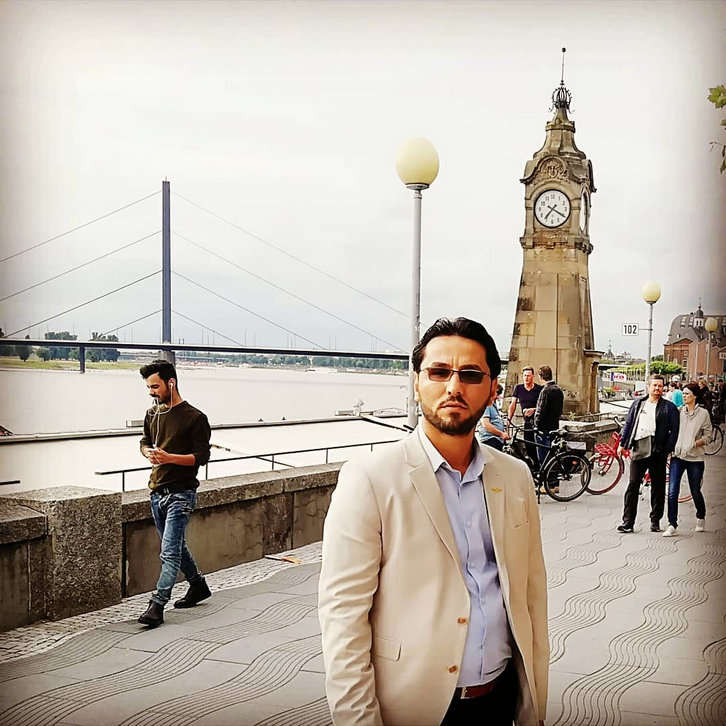
Momika has made known his intention of staying in Sweden. In a phone interview with CNN last week, the Iraqi said he came to Sweden five years ago from Iraq and has Swedish citizenship, however, Arab News could not find any proof to support his statement.
The Iraqi chose the one red line to cross that would ensure his life would be at risk should he be forced to return to Iraq: flagrantly vandalizing the most sacred of symbols in the Islamic world, the Qur’an.
“The most important thing is to take pictures,” Momika shouted in front of the Central Mosque as he burned the Qur’an. “It is the most important thing.”
Prior to the burning, Momika posted an Instagram video informing followers of his success in overturning an initial rejection by the Swedish police for his request to burn the Qur’an in front of the Central Mosque.
“The police want to impose the Qur’an and its respect on the Swedish society, which is impossible and is considered a violation of Swedish laws,” he said.
“With this book, I will also burn the Iraqi flag, which does not represent me. I will grill pork meat on top of them in front of the Iraqi Embassy. This book does not represent me, and this flag does not represent me either. I will grill pork meat on this book’s fire,” he added.
Within the same video, Momika uploaded a copy of his request to the Swedish police, notably censoring his address and ID number but keeping his personal email and phone number visible.
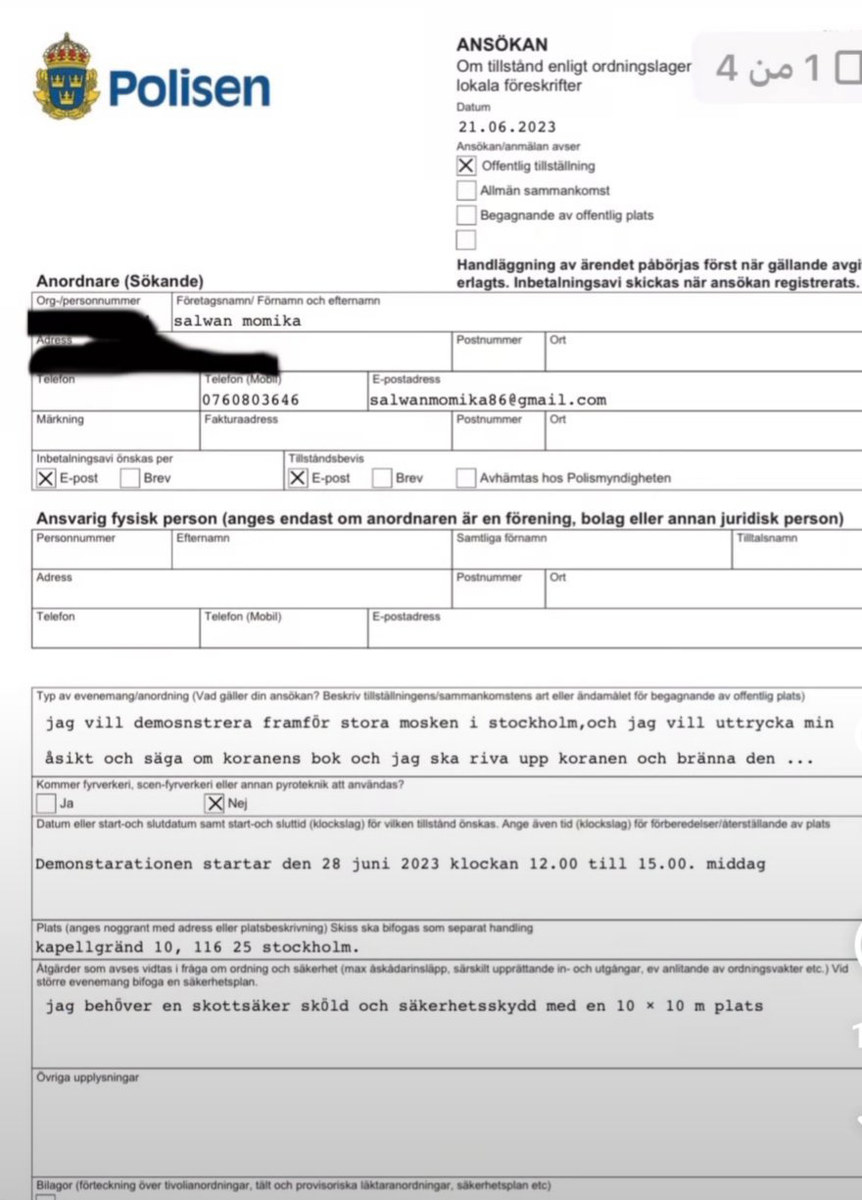
“Considering the potential consequences under Sweden’s new immigration laws, he chose this path to stir up trouble and receive numerous threats. This enables him to manipulate and abuse the system, providing evidence that his life is in danger, just as he claimed when leaving Iraq,” said Jerry Maher, a Swedish political writer and Middle East and Iran specialist.
Maher believes that Momika purposely exposed his identity to the public, revealing his phone number and email on his Facebook page for people to establish contact.
“These tactics are all part of his strategy to present himself to the Swedish authorities as a victim under threat and seek protection. As a former fighter who engaged in battles in Iraq, his asylum papers and residence permit are likely at risk. Recent changes in Swedish migration laws have become more stringent, resulting in several expulsions,” added Maher.