

EU lawmakers urge international probe of Greece migrant tragedy

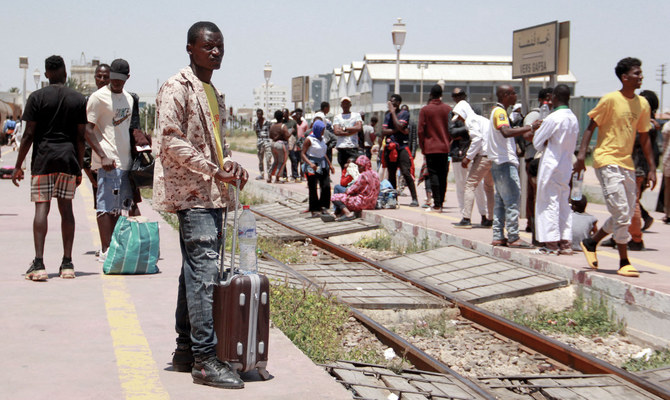
African migrants wait for a train as they flee to Tunis amid unrest in the coastal city of Sfax. Racial tension in Sfax has flared into violence targeting migrants. (File/AFP)
Short Url
Updated 06 July 2023
Follow

EU lawmakers urge international probe of Greece migrant tragedy

  • Some survivors allege that the Greek coast guard caused the tragedy by tying a rope to their drifting vessel and then driving off at high power

BRUSSELS: EU lawmakers have pushed for an independent probe into a migrant boat tragedy off Greece in which hundreds of people are believed to have died, calling an internal investigation by Athens inadequate.

That stance, also backed by the EU’s Fundamental Rights Agency, seeks to shine a light on the June capsizing of an overcrowded vessel headed from North Africa to Europe.

“Maybe 600 people” drowned and “around” 110 people were rescued, EU home affairs commissioner Ylva Johansson told MEPs, based on information from Greek authorities.

She said the fishing trawler had apparently been used by Egyptian smugglers who sailed it empty from Egypt to pick up to 750 people in Libya for the Mediterranean crossing to Europe.

She said the migrants were packed into the “very, very overcrowded boat” according to how much they paid: Pakistani men “stacked” on the bottom, women and children in the middle, and those with “high status” on top.

A plane with limited fuel and then a drone used by the EU’s border patrol agency Frontex were diverted to overfly the boat, Frontex chief Hans Leijtens told the same European Parliament committee.

The drone, which pulled away to observe another migrant boat two hours distant, returned to find “it already had sunk,” he said.

“We offered to help, but there was no response from Greek authorities,” Leijtens said.

Some survivors allege that the Greek coast guard caused the tragedy by tying a rope to their drifting vessel and then driving off at high power.

The Greek government denies that. It has opened two investigations, one into smugglers it blames for the event, and the other into the actions of its coast guard.

The “seriousness” of the tragedy required an “independent and transparent international investigation,” the MEP chairing the European Parliament hearing, Birgit Sippel, said.

The committee called on Greece and the European Commission to set up a probe “as a matter of urgency” to examine what actions the Greek coast guard and Frontex took in relation with international obligations for search and rescue, she said.

Another MEP on the committee, Sophie in ‘t Veld, called it “naive to say ‘but, you know, the Greek authorities are going to take care of this and we can trust them’“

Johansson stressed that the commission had no powers to conduct its own investigation, nor to set up an EU-wide maritime search and rescue body.

While acknowledging that there were “a lot of unanswered questions” about the tragedy, “it’s the responsibility of the member states to investigate these kinds of things.”

She admitted, though, that “we have to realize that we are not doing enough.”

“Unfortunately this will happen again,” she predicted.

The commission’s energy was being directed at curbing migration from source countries, including many in Africa as well as Pakistan, and transit countries including Egypt, Tunisia, Morocco and Libya, she said.

The EU, which is currently looking at speeding up the return of unsuccessful asylum seekers, has been accused by non-governmental organizations and charities such as Oxfam of implementing a “Fortress Europe” policy.

The head of the bloc’s EU Fundamental Rights Agency, Michael O’Flaherty, told the parliamentary committee that a “proper investigation” was needed into the migrant boat tragedy off Greece.

He also said “we’ve seen a problem” with EU countries applying an “overly restrictive understanding” of what conditions are required to trigger their international duty to launch sea rescues.

The agency provides advice to EU institutions and governments on policy matters and raises awareness on rights, including access to justice and discrimination.

On Thursday it presented a new report on preventing and reporting deaths at sea that O’Flaherty said took “close account” of this latest migrant boat capsizing.


UK pays Guantanamo detainee ‘substantial’ compensation over US torture questions

Updated 5 sec ago
Follow

UK pays Guantanamo detainee ‘substantial’ compensation over US torture questions

  • Abu Zubaydah has been held at Guantanamo Bay without charge for 20 years
  • British security services knew he was subjected to ‘enhanced interrogation’ but failed to raise concerns for 4 years

LONDON: A Saudi-born Palestinian being held without trial by the US has received a “substantial” compensation payment from the UK government, the BBC reported.

Abu Zubaydah has been imprisoned at Guantanamo Bay in Cuba for almost 20 years following his capture in Pakistan in 2002, and was subjected to “enhanced interrogation” techniques by the CIA.

He was accused of being a senior member of Al-Qaeda in the aftermath of the Sept. 11 terror attacks on the US. The allegations were later dropped but he remains in detention.

The compensation follows revelations that UK security services submitted questions to the US to be put to Abu Zubaydah by their US counterparts despite knowledge of his mistreatment.

He alleged that MI5 and MI6 had been “complicit” in torture, leading to a legal case and the subsequent compensation.

Dominic Grieve, the UK’s former attorney general, chaired a panel reviewing Abu Zubaydah’s case.

He described the compensation as “very unusual” but said the treatment of Abu Zubaydah had been “plainly” wrong, the BBC reported.

Grieve added that the security services had evidence that the “Americans were behaving in a way that should have given us cause for real concern,” and that “we (UK authorities) should have raised it with the US and, if necessary, closed down co-operation, but we failed to do that for a considerable period of time.”

Abu Zubaydah’s international legal counsel, Prof. Helen Duffy, said: “The compensation is important, it’s significant, but it’s insufficient.”

She added that more needs to be done to secure his release, stating: “These violations of his rights are not historic, they are ongoing.”

Duffy said Abu Zubaydah would continue to fight for his freedom, adding: “I am hopeful that the payment of the substantial sums will enable him to do that and to support himself when he’s in the outside world.”

He is one of 15 people still being held at Guantanamo, many without charge. Following his initial detention, he arrived at the prison camp having been the first person to be taken to a so-called CIA “black site.”

He spent time at six such locations, including in Lithuania and Poland, outside of US legal jurisdiction. 

Internal MI6 messages revealed that the “enhanced interrogation” techniques he was subjected to would have “broken” the resolve of an estimated 98 percent of US special forces members had they been subjected to them.

CIA officers later decided he would be permanently cut off from the outside world, with then-President George W. Bush publicly saying Abu Zubaydah had been “plotting and planning murder.”

However, the US has since withdrawn the allegations and no longer says he was a member of Al-Qaeda.

A report by the US Senate Select Committee on Intelligence said Abu Zubaydah had been waterboarded at least 83 times, was locked in a coffin-like box for extended periods, and had been regularly assaulted. Much of his treatment would be considered torture under UK law.

Despite knowledge of his treatment, it was four years before British security services raised concerns with their American counterparts, and their submission of questions within that period had “created a market” for the torture of detainees, Duffy said.

A 2018 report by the UK Parliament’s Intelligence and Security Committee was deeply critical of the behavior of MI5 and MI6 in relation to Abu Zubaydah. 

It also criticized conduct relating to Guantanamo detainee Khalid Sheikh Mohammed, widely regarded as a key architect of the Sept. 11 attacks, warning that the precedent set by Abu Zubaydah’s legal action could be used by Mohammed to bring a separate case against the UK.

MI5 and MI6 failed to comment on Abu Zubaydah’s case. Neither the UK government nor Mohammed’s legal team would comment on a possible case over his treatment.