

Zuckerberg: 10 million sign up on Threads in first seven hours to rival Twitter

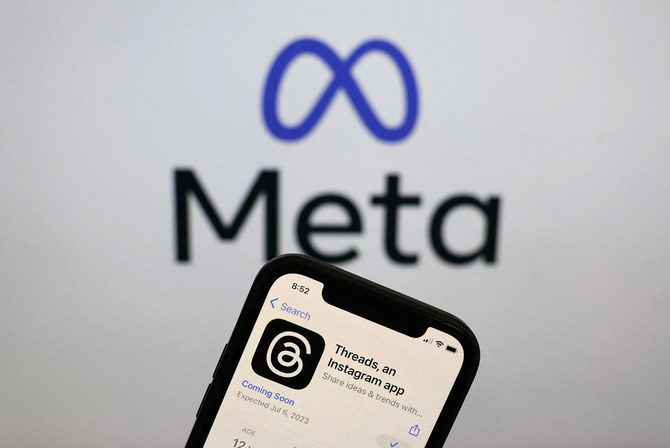
Meta's new app Threads logo is displayed on a cell phone a day ahead of its launch. (Getty Images/AFP)
Short Url
Updated 06 July 2023
Follow

Zuckerberg: 10 million sign up on Threads in first seven hours to rival Twitter

  • Posts can go up to 500 characters, which is more than Twitter’s 280-character threshold, and can include links, photos and videos up to five minutes long
  • Instagram users will be able to log in with their existing user names, while new users will have to set up an Instagram account

WASHINGTON/LONDON: Ten million users have signed up to Threads, Meta’s newly launched social media platform and rival to Twitter, less than a day after its launch, CEO Mark Zuckerberg said Thursday.

“10 million sign ups in seven hours,” Zuckerberg wrote on his official Threads account.

The new offering is billed as a text-based version of Meta’s photo-sharing app Instagram that the company says provides “a new, separate space for real-time updates and public conversations.”

The app is live in Apple and Google Android app stores in more than 100 countries including the US, Britain, Australia, Canada and Japan.

Users will get a Twitter-like microblogging experience, according to screenshots provided to media, suggesting that Meta Platforms has been gearing up to directly challenge the platform after Musk’s tumultuous ownership has resulted in a series of unpopular changes that have turned off users and advertisers.

There are buttons to like, repost, reply to or quote a “thread,” and counters showing the number of likes and replies that a post has received.

“Our vision is that Threads will be a new app more focused on text and dialogue, modeled after what Instagram has done for photo and video,” the company said.

Posts are limited to 500 characters, which is more than Twitter’s 280-character threshold, and can include links, photos and videos up to five minutes long.

Instagram users will be able to log in with their existing user names and follow the same accounts on the new app. New users will have to set up an Instagram account.

Meta emphasized measures to keep users safe, including enforcing Instagram’s community guidelines and providing tools to control who can mention or reply to users.

Meta’s new offering, however, has raised data privacy concerns.

Threads could collect a wide range of personal information, including health, financial, contacts, browsing and search history, location data, purchases and “sensitive info,” according to its data privacy disclosure on the App Store.

Twitter co-founder Jack Dorsey pointed it out in a snarky tweet saying, “All your Threads are belong to us” that included a screenshot of the disclosure. Musk replied “yeah.”

One place Threads won’t be rolled out is in the European Union, which has strict data privacy rules.

Meta has informed Ireland’s Data Privacy Commission that it has no plans yet to launch Threads in the 27-nation bloc, commission spokesman Graham Doyle said. The Irish watchdog is Meta’s main privacy regulator for the EU because the company’s regional headquarters is based in Dublin.

While Meta had teased Threads with a listing on Apple’s UK App Store earlier this week, it could not be found in the French, German or Dutch versions. The company is working on rolling the app out to more countries, but cites regulatory uncertainty for its decision to hold off on a European launch.

Analysts said its success is far from guaranteed, citing Meta’s track record of starting up standalone apps that were later shut down.

Also in question is whether it’s the right move for Meta, which has announced tens of thousands of layoffs over the past year amid a tech industry slowdown.

CEO Mark Zuckerberg also has been focusing on the metaverse, investing tens of billions of dollars in the virtual reality concept.

Meta risks “spreading itself too thin,” said Mike Proulx, a research director at Forrester, a global market research company. “Meta is banking on a moment in time amidst peak Twitter frustration. However, this window of opportunity is already flooded with Twitter alternatives including Bluesky, Mastodon, Spill, Post.News and Hive, which are all competing for Twitter’s market share.”

Even so, Threads could be a fresh headache for Musk, who acquired Twitter last year for $44 billion.

He’s made a series of changes that have triggered backlash, the latest being daily limits on the number of tweets people can view to try to stop unauthorized scraping of potentially valuable data. He also is now requiring paid verification for users to access the online dashboard TweetDeck.

Musk’s rivalry with Zuckerberg could end up spilling over into real life. In an online exchange the two tech billionaires seemingly agreed to a cage match face-off, though it’s unclear if they will actually make it to the ring.


Prince Harry’s war against UK press reaches showdown with Daily Mail case

Updated 7 sec ago
Follow

Prince Harry’s war against UK press reaches showdown with Daily Mail case

  • Prince Harry to give evidence in London court for second time
  • Media accused of phone hacking and other privacy intrusions
LONDON:Prince Harry’s war against the British press heads into a final showdown next week with the start of his
privacy ​lawsuit against the publisher of the powerful Daily Mail newspaper over alleged unlawful action he says contributed to his departure for the US
The 41-year-old Harry, a boy when his mother Princess Diana died in a 1997 car crash with paparazzi in pursuit, has long resented the often aggressive tactics of British media and pledged to bring them to account.
Harry, who is King Charles’ younger son, and six other claimants including singer Elton John are suing Associated Newspapers over years of alleged unlawful behavior, ranging from bugging phone lines to obtaining personal health records.
Associated has rejected any wrongdoing, calling the accusations “preposterous smears” and part of a conspiracy.
Over the course of nine weeks, Harry, John and the other claimants – John’s husband David Furnish, actors Liz Hurley and Sadie ‌Frost, campaigner Doreen ‌Lawrence, and former British lawmaker Simon Hughes – will give evidence to the High Court ‌in London ⁠and be ​grilled by ‌Associated’s lawyers.
The prince is due to appear next Thursday. It will be his second such court appearance in the witness box in three years, having become the first British royal to give evidence in 130 years in 2023 in another lawsuit.
Current and former senior Associated staff, including a number of editors of national newspapers, will likewise be quizzed by the claimants’ legal team. The stakes for both sides are high, with not just the reputation of media and claimants on the line, but because legal costs are set to run into tens of millions of pounds. Critics say Harry, the Duke of Sussex, is bitter over unfavorable coverage, from partying in his youth to quarrelling with his family and leaving ⁠the UK in later years.
But supporters say it is a noble cause against sometimes immoral media.
“He seems to be motivated by a lot more than money,” said Damian Tambini, ‌an expert in media and communications regulation and policy at the London School ‍of Economics.
“He’s actually trying to, along with many of the ‍other complainants, affect change in the newspapers.”
Harry and his American wife Meghan have cited media harassment as one of the main ‍factors that led them to stepping down from royal duties and moving to California in 2020. Elton John, 77, also has history in the courts with the British press, successfully suing newspapers including the Daily Mail for libel. He received 1 million pounds ($1.34 million) from the Sun in a 1988 settlement over a false allegation about sex sessions with male prostitutes.
Having successfully sued Mirror Group Newspapers, and also won damages, an apology ​and some admission of wrongdoing from Rupert Murdoch’s News Group Newspapers (NGN), the case against Associated could be Harry’s most significant. The 130-year-old Daily Mail, renowned for championing traditional, conservative values, for decades has been one of, if not ⁠the most powerful media force within Britain and unlike the Mirror and NGN has not been embroiled in the phone-hacking scandal.
It says it gives voice to millions in “Middle England,” holding the rich, powerful and famous to account.
In 1997, it famously ran a front page denouncing five men accused of the racist killing of Black teenager Stephen Lawrence as murderers and challenging anyone to sue if that was wrong.
The case was a defining moment in race relations in Britain.
Despite that, one of those now suing the Mail is Doreen Lawrence, the mother of murdered Stephen, who says journalists tapped her phones, monitored her bank accounts and phone bills, and paid police for confidential information.
The Associated case will mark one of the final airings in court of accusations of phone-hacking which have dogged the British press for more than 20 years.
The practice of unlawfully accessing voicemails fully burst onto the public agenda in 2011, leading to the closure of Murdoch’s News of the World tabloid, the jailing of its former editor who had later worked as a communications chief for ex-Prime Minister David Cameron, and ‌a public inquiry.
Murdoch’s NGN and the Mirror Group have since both paid out hundreds of millions of pounds to victims of the unlawful activity.
If the claimants lose, Tambini said, “this could be the moment when phone hacking, finally, as a set of issues, went away.”