

Saudi fashion presents huge investment opportunity: Honayda founder

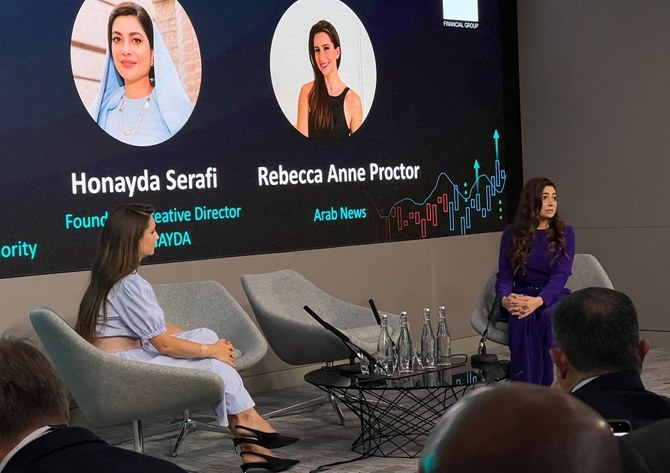
Honayda Serafi, right, at BMG Economic Forum 2023 in the London Stock Exchange. (Supplied)
Short Url
Updated 05 July 2023
Follow

Saudi fashion presents huge investment opportunity: Honayda founder

  • ‘We’re getting a lot of international interest,’ Honayda Serafi tells BMG Economic Forum
  • ‘Fashion is changing the perception of Saudi women and culture’

LONDON: Saudi fashion presents a booming investment opportunity, the founder and creative director of fashion brand Honayda told the BMG Economic Forum at the London Stock Exchange on Wednesday.

Already employing 200,000 people and generating 1.4 percent of gross domestic product, Honayda Serafi said the Kingdom is looking to up the industry’s economic impact to 2 percent by 2030 as she seeks out prospective investors for Saudi fashion.

“Saudi is growing in all sectors and fashion has really strong potential, with investors having an opportunity to invest in not only brands but infrastructure,” she said at the forum that was attended by Arab News.

“Through the Saudi 100 Brands program we’ve received strong interest for brand investment internationally, and in one year we’ve taken this to New York, Milan, and recently we’ve just returned from Paris. Fashion is changing the perception of Saudi women and culture.”

Launched last year by the Saudi Fashion Commission, 100 Brands is a traveling exhibition featuring a curated selection of clothing and accessories from 100 designers from the Kingdom.

It is one of several developments for an industry seen as one of Saudi Arabia’s 2030 “giga-projects,” with the commission and the Prince Mohammed bin Salman Nonprofit City also having signed a memorandum of understanding last September to develop and train young designers from the Kingdom.

“Young Saudis should take advantage of these opportunities to help grow and promote the sector at a moment where we’re getting a lot of international interest,” Serafi said.

“Government is really pushing for the industry to succeed, there are a lot of fashions schools opening up, and there are future programs being lined up by the fashion commission, so as a country Saudi Arabia is really building greater expertise on this front.”

Noting that the Kingdom is responsible for 50 percent of the Gulf Cooperation Council’s total spend on fashion, Serafi said the impetus is really on showcasing Saudi Arabia’s production potential.

She added that international designers are beginning to step up and take notice of this, and that there has been an increase in big brands visiting and liaising with Saudi designers.

“This represents a real opportunity to bring fashion back to the local market, and to change the perception of Saudi women from not only consumers but also producers,” she said.

“With the opening of the Saudi creative world in the past five years, it has helped shed light on who we as a people are — cultural, educated, well-rounded — and we’ve become more confident to show this and to be proud of it.

“There’s a huge opportunity for this creative sector to rise further as a whole industry — this means stylists, photographers, makeup artists and creative designers.”


Saudi Arabia surpasses $400bn in investment volume, minister announces

Updated 26 January 2026
Follow

Saudi Arabia surpasses $400bn in investment volume, minister announces

RIYADH: Saudi Arabia’s total investment volume surpassed SR1.5 trillion ($400 billion) for the first time in 2025, the Kingdom’s minister of investment has announced.

Speaking at the Government Press Conference in Riyadh, Khalid Al-Falih highlighted unprecedented growth across the financial landscape, with foreign capital inflows playing a central role.

The Kingdom is aiming to attract $100 billion in annual foreign direct investment by the end of the decade as part of its Vision 2030 economic diversification plan. 

“We expect foreign investment flows into Saudi Arabia in 2025 to range between SR140 billion and SR150 billion,” Al-Falih said, noting that this projection represents a five-fold increase from the SR28 billion recorded in 2017, a sign of rising global investor confidence.

The surge in international business activity is further reflected in the number of foreign companies operating in the Kingdom. Al-Falih revealed that licensed foreign firms have reached 62,000, a dramatic increase from just 6,000 in 2016.

Furthermore, the nation has attracted more than 700 regional headquarters for leading global corporations, solidifying its position as a premier commercial hub for the Middle East and North Africa.

The investment boom is creating substantial opportunities for Saudis. The minister highlighted that 800,000 new jobs have been created in the Saudi economy, with private sector wages rising by 45 percent. He also noted that women’s labor force participation has doubled, marking a significant societal shift.

The domestic entrepreneurial spirit remains robust, with the number of active commercial registrations held by Saudi investors reaching 1.86 million by the end of 2025.

Al-Falih also stated that 500,000 Saudis have been employed out of 1.5 million workers in foreign companies, and that three major companies have begun automobile manufacturing in the Kingdom.

The economic outcomes cited by Al-Falih are direct results of the nation’s Vision 2030 reform agenda. This transformation is being accelerated by the systematic opening of Saudi Arabia’s capital markets. 

On Feb. 1, the Capital Market Authority will allow all foreign investors direct access to the Main Market, eliminating previous qualification barriers. This follows a period of rapid growth in international participation, with foreign ownership exceeding SR590 billion by the third quarter of 2025. 

On this, the minister said that Tadawul is “prideworthy,” noting that it’s now one of the biggest 10 stock markets worldwide. He stated that the old restrictions on foreign investors were found to limit market access for all international investors. He confirmed that the new rules, which will be announced soon, are designed to be “balanced.”