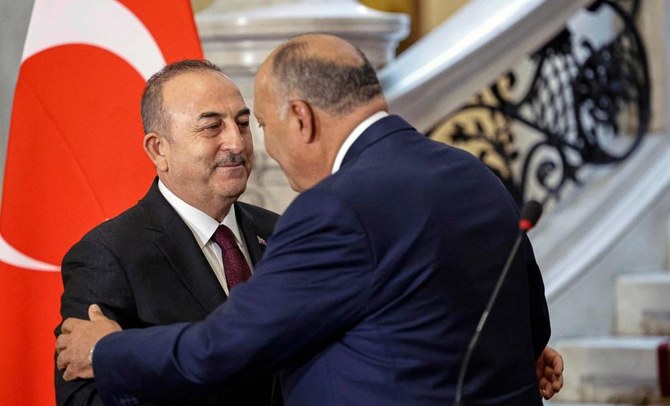

ANKARA: After years of strained relations, Egypt and Turkiye have appointed ambassadors to each other’s capitals for the first time in a decade to restore normal diplomatic relations, their foreign ministries announced on Tuesday.
Turkiye took several measures to repair ties, such as ceasing the broadcast of Egyptian opposition TV channels based in Istanbul and detaining Egyptian dissidents who used social media to support anti-government protests in Egypt.
Additionally, the Muslim Brotherhood-affiliated Egyptian satellite TV channel, Mekameleen TV, relocated its operations from Turkiye last year.
In a joint statement, it was announced that Amr Elhamamy would become Egypt’s ambassador in Ankara, while Turkiye nominated Salih Mutlu Sen as its ambassador in Cairo. Sen previously served as Turkiye’s representative to the Organization of Islamic Cooperation from 2015 to 2020.
Dalia Ziada, director of the Cairo-based MEEM Center for Middle East and Eastern Mediterranean Studies, said that elevating diplomatic missions to the ambassadorial level demonstrates the determination of both presidents to proceed with the reconciliation process and ensure the sustainability of fruitful cooperation in the future.
“The ambassadors were at the forefront of the initial conflict between Turkiye and Egypt. When the political rift began in late 2013, the mutual expulsion of ambassadors was one of the first actions taken. The return of ambassadors today symbolizes an official act of restoring deep friendship and solidarity between Turkiye and Egypt,” Ziada told Arab News.
Ziada said the mutual appointment of ambassadors is crucial for redirecting the Egypt-Turkiye reconciliation process from the hands of security and intelligence officials to diplomats.
“Since the reconciliation process began in May 2021, security and intelligence services have been primarily responsible for the talks, while involvement of diplomatic missions and visiting representatives has been limited. This approach has slowed down the reconciliation process and confined it to short-term compromises,” she said.
According to Ziada, the initial focus of the reconciliation process for both countries was to minimize or avoid problems rather than actively finding long-term solutions. Experienced diplomats can better facilitate reconciliation talks and identify future areas of collaboration between Cairo and Ankara, Ziada added.
The attention now turns to the potential items on the bilateral agenda for the two countries in the coming days. Ziada said that improving the public image of the respective states and presidents will be a priority.
“Unfortunately, the media-led distortion campaigns against both presidents not only misled public perception but also created personal prejudices that need to be addressed through intensive diplomatic efforts in each country,” she said.
Ziada expects the two ambassadors to facilitate in-person meetings between senior government officials, including a presidential summit, to explore and negotiate effective areas of cooperation in the Eastern Mediterranean and North Africa.
The activation of military-to-military cooperation and the emergence of innovative areas of collaboration beyond politics and economics, considering the shared cultural heritage between the two nations, is also expected.
However, the two countries remain at odds over the Libyan conflict, with Cairo opposing Ankara’s interference. Nevertheless, Ziada said that she believes that Egypt and Turkiye can collaborate in Libya to facilitate the political process, support elections, and mediate negotiations between conflicting factions, leveraging their influence on different Libyan politicians.
The Eastern Mediterranean region poses both opportunities for cooperation and potential disagreements.
Ziada said while Egypt will uphold its Exclusive Economic Zone agreement with Greece, this should not prevent Egypt from pursuing similar agreements with Turkiye.
She cited Israel’s balanced relationship with Greece and Cyprus on one hand and Turkiye on the other as a model to follow.
Ziada also proposes considering Turkiye’s admission to the East Med Organization, given its extensive border in the Eastern Mediterranean and the notable improvement in its relationship with Greece since the February earthquake.
Prof. Michael Tanchum, non-resident fellow at the Middle East Institute, said that the Turkish-Egyptian diplomatic reconciliation, although initiated before Russia’s February 2022 invasion of Ukraine, is even more timely and important because of the Russia-Ukraine war.
“As the recent Wagner mutiny demonstrated, Moscow’s capacity to project power along the eastern and southern shores of the Mediterranean may be diminishing. The extent to which the Kremlin leaves a vacuum in Libya, the Eastern Mediterranean, and the wider Red Sea corridor, opportunities arise for both Turkiye and Egypt to increase their geopolitical footprint,” he told Arab News.
Tanchum added: “Communication and coordination between Ankara and Cairo become essential to preventing the escalation of potential conflicts that are in neither’s interest. Libya will be the primary testing ground of this new chapter in Turkish-Egyptian relations.”