

World may be underestimating climate risk to crops – researchers

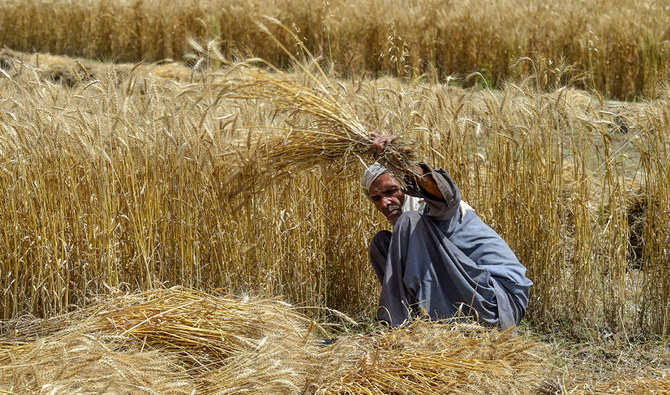
A farmer harvests wheat crops in a field in Peshawar on May 2, 2020. (AFP)
Short Url
Updated 04 July 2023
Follow

World may be underestimating climate risk to crops – researchers

  • The new study looked at likelihood of several major food-producing regions suffering low yields 
  • These events can lead to price spikes, food insecurity and even civil unrest, said the lead author  

Paris: The risks of harvest failures in multiple global breadbaskets have been underestimated, according to a study Tuesday that researchers said should be a "wake up call" about the threat climate change poses to our food systems. 

Food production is both a key source of planet-warming emissions and highly exposed to the effects of climate change, with climate and crop models used to figure out just what the impacts could be as the world warms. 

In the new research published in Nature Communications, researchers in the United States and Germany looked at the likelihood that several major food producing regions could simultaneously suffer low yields. 

These events can lead to price spikes, food insecurity and even civil unrest, said lead author Kai Kornhuber, a researcher at Columbia University and the German Council on Foreign Relations. 

By "increasing the concentration of greenhouse gases, we are entering this uncharted water where we are struggling to really have an accurate idea of what type of extremes we're going to face," he told AFP. 

"We show that these types of concurring events are really largely underestimated." 

The study looked at observational and climate model data between 1960 and 2014, and then at projections for 2045 to 2099. 

Researchers first looked at the impact of the jet stream -- the air currents that drive weather patterns in many of the world's most important crop producing regions. 

They found that a "strong meandering" of the jet stream, flowing in big wave shapes, has particularly significant impacts on key agricultural regions in North America, Eastern Europe and East Asia, with a reduction in harvests of up to seven percent. 

The researchers also found that this had been linked to simultaneous crop failures in the past. 

One example was in 2010, when the fluctuations of the jet stream were linked to both extreme heat in parts of Russia and devastating floods in Pakistan, which both hurt crops, Kornhuber said. 

The study also looked at how well computer models assess these risks and found that while they are good at showing the atmospheric movement of the jet stream, they underestimate the magnitude of the extremes this produces on the ground. 

Kornhuber said the study should be a "a wakeup call in terms of our uncertainties" of the impacts of climate change on the food sector, with more frequent and intense weather extremes and increasingly complicated combinations of extremes. 

"We need to be prepared for these types of complex climate risks in the future and the models at the moment seem to not capture this," he said. 

On Monday, United Nations' human rights chief Volker Turk warned of a "truly terrifying" dystopian future of hunger and suffering as climate change-driven extremes hit crops, livestock and crucial ecosystems. 

He told a UN debate on the right to food that more than 828 million people faced hunger in 2021 and climate change could increase that by 80 million by mid-century, and slammed world leaders for short term thinking.  


US allows oil majors to broadly operate in Venezuela, new energy investments

Updated 14 February 2026
Follow

US allows oil majors to broadly operate in Venezuela, new energy investments

  • Treasury Department issues general license allowing Chevron, BP, Eni, Shell and Repsol to operate oil and gas operations in Venezuela
  • Move is the most significant relaxation of sanctions on Venezuela since US forces captured and removed President Nicolas Maduro

WASHINGTON: The US ​eased sanctions on Venezuela’s energy sector on Friday, issuing two general licenses that allow global energy companies to operate oil and gas projects in the OPEC member and for other companies to negotiate contracts to bring in fresh investments. The move was the most significant relaxation of sanctions on Venezuela since US forces captured and removed President Nicolas Maduro last month.
The Treasury Department’s Office of Foreign Assets Control issued a general license allowing Chevron, BP, Eni, Shell and Repsol to operate oil and gas operations in Venezuela. Those companies still have offices in the country and stakes in projects, and are among the main partners of state-run ‌company PDVSA.
The authorization ‌for the oil majors’ operations requires payments for royalties and Venezuelan ​taxes ‌to ⁠go through ​the US-controlled ⁠Foreign Government Deposit Fund.
The other license allows companies around the world to enter contracts with PDVSA for new investments in Venezuelan oil and gas. The contracts are contingent on separate permits from OFAC.
The authorization does not allow transactions with companies in Russia, Iran, or China or entities owned or controlled by joint ventures with people in those countries.
The licenses “invite American and other aligned companies to play a constructive role in supporting economic recovery and responsible investment, ” the US State Department said in a release. Additional authorizations may be issued “as necessary,” it said.
A spokesperson for Chevron, ⁠the only US oil firm currently operating in Venezuela, said the company welcomed ‌the new licenses.
“The new General Licenses, coupled with recent changes ‌in Venezuela’s Hydrocarbons Law, are important steps toward enabling the further development ​of Venezuela’s resources for its people and for advancing ‌regional energy security,” the spokesperson said in a statement.
Eni said it is assessing the opportunities in ‌Venezuela that the authorization opens up.

Oil law reform

The US licenses follow a sweeping reform of Venezuela’s main oil law approved last month, which grants autonomy for foreign oil and gas producers to operate, export and cash sale proceeds under existing joint ventures with PDVSA or through a new production-sharing contract model.
The US has had sanctions on Venezuela since ‌2019 when President Donald Trump imposed them during his first administration. Trump is now seeking $100 billion in investments by energy companies in Venezuela’s oil and gas sector. ⁠US Energy Secretary Chris Wright ⁠said on Thursday, during his second day of a trip to Venezuela, that oil sales from the country since Maduro’s capture have hit $1 billion and would hit another $5 billion in months.
Wright said the US will control the proceeds from the sales until Venezuela stands up a “representative government.” Since last month, the Treasury issued several other general licenses to facilitate oil exports, storage, imports and sales from Venezuela. It also authorized the provision of US goods, technology, software or services for the exploration, development or production of oil and gas in Venezuela.
The Venezuelan government expropriated assets of Exxon Mobil and ConocoPhillips in 2007 under then-President Hugo Chavez. The Trump administration is trying to get those companies to invest in Venezuela as well. At a meeting at the White House with Trump last month, Exxon Mobil CEO Darren Woods said Venezuela was “uninvestable” at ​the moment.
Wright said on Thursday that Exxon, ​which no longer has an office in Venezuela, is in talks with the government there and gathering data about the oil sector. Exxon did not immediately comment.