

Pakistan’s liquidity risk remains high even with IMF deal — Moody’s

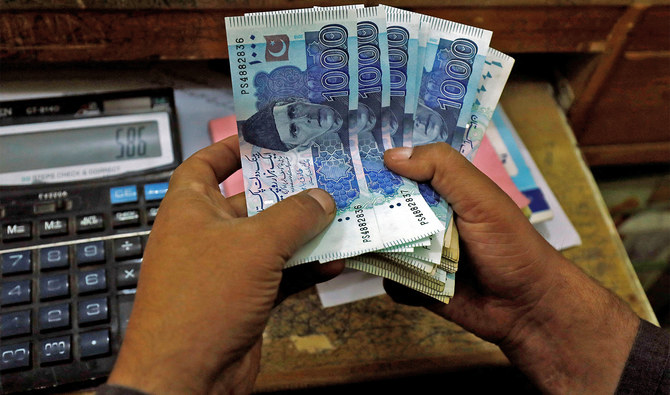
A trader counts Pakistani rupee notes at a currency exchange booth in Peshawar, Pakistan, on December 3, 2018. (REUTERS/File)
Short Url
Updated 04 July 2023
Follow

Pakistan’s liquidity risk remains high even with IMF deal — Moody’s

  • Pakistan secured a critical $3 billion short-term financial package from IMF on Friday
  • Moody’s says new IMF financing will not be enough to allow Pakistan to meet debt repayments

MUMBAI: Pakistan’s liquidity risks will remain high even if a new stand-by arrangement (SBA) with the International Monetary Fund (IMF) is approved, Moody’s Investors Service said on Tuesday.

The South Asian country secured a badly needed $3 billion short-term financial package from the IMF on Friday, giving its crisis-hit economy a much-awaited respite as it teeters on the brink of default.

“We expect government liquidity risks to remain high, even if the new SBA is approved. It is uncertain whether Pakistan will secure the full $3 billion of IMF financing during the nine-month program,” Moody’s said in a statement.

“The government’s commitment to continually implement reforms, particularly revenue-raising measures, will also be tested as it prepares for elections due by October.”

The new IMF financing on its own will not be enough to allow Pakistan to meet all its external debt repayments, Moody’s said.

However, an IMF disbursement is likely to catalyze financing from other bilateral and multilateral partners, which will be as critical in aiding Pakistan meet its financing needs, it said.

“Pakistan will need a longer-term financing plan to meet its large external financing needs over the next few years,” it said.

Pakistan could look at another IMF program which could be in place for a few years but this is likely to become clear only after the general election, it said, adding that negotiations over future programs would take time even if they do succeed.

“Until a new program is agreed, Pakistan’s ability to secure loans from other bilateral and multilateral partners will be severely constrained beyond the period of this new SBA.

Pakistan vaccinates over 43 million children as last polio drive of 2025 enters 6th day

Updated 8 sec ago
Follow

Pakistan vaccinates over 43 million children as last polio drive of 2025 enters 6th day

  • Campaign running simultaneously in Pakistan and Afghanistan, last two polio-endemic countries
  • Health authorities urge parents and communities to fully cooperate with anti-polio vaccinators

ISLAMABAD: Pakistan has vaccinated more than 43.8 million children in five days of its last nationwide polio campaign of 2025, health authorities said on Saturday, as the drive entered its sixth day amid renewed efforts to curb the virus.

The campaign, running from Dec. 15 to 21, targets children under the age of five and is being conducted simultaneously in Pakistan and Afghanistan, according to Pakistan’s National Emergency Operations Center (NEOC) which oversees eradication efforts.

Pakistan and neighboring Afghanistan are the only two countries where wild poliovirus transmission has never been interrupted, keeping global eradication efforts at risk. The virus, which can cause irreversible paralysis, has no cure and can only be prevented through repeated oral vaccination.

“The last nationwide polio campaign of 2025 continues in full swing on the sixth day,” the NEOC said in a statement. “Over 43.8 million children have been vaccinated in five days so far.”

Provincial data released by the National EOC showed that around 22.7 million children had been vaccinated in Punjab province, more than 10.2 million in Sindh, approximately 6.9 million in Khyber Pakhtunkhwa and about 2.5 million in Balochistan. In Islamabad, over 450,000 children received polio drops, while more than 274,000 were vaccinated in Gilgit-Baltistan and over 714,000 in Azad Jammu and Kashmir.

“The polio campaign is being conducted simultaneously in Pakistan and Afghanistan,” the NEOC said. “More than 400,000 polio workers are going door to door across the country to administer vaccines.”

Pakistan has logged 30 polio cases so far in 2025, underscoring the fragility of progress against the virus. The country recorded 74 cases in 2024, a sharp rise from six cases in 2023, reflecting setbacks caused by vaccine hesitancy, misinformation and access challenges in high-risk areas.

Health officials say insecurity remains a major obstacle. Polio workers and their security escorts have repeatedly been targeted in militant attacks, particularly in parts of northwestern Khyber Pakhtunkhwa and southwestern Balochistan, complicating efforts to reach every child. Natural disasters, including flooding, have further disrupted vaccination campaigns in recent years.

“Parents and communities are urged to fully cooperate with polio workers,” the NEOC said, stressing that every child under the age of five must be given polio drops.

Pakistan has dramatically reduced polio prevalence since the 1990s, when annual cases exceeded 20,000. Health authorities, however, warn that without sustained access to children in underserved and conflict-affected areas, eradication will remain out of reach.