Saudi minister meets Huawei CEO to expand partnership and boost digital economy

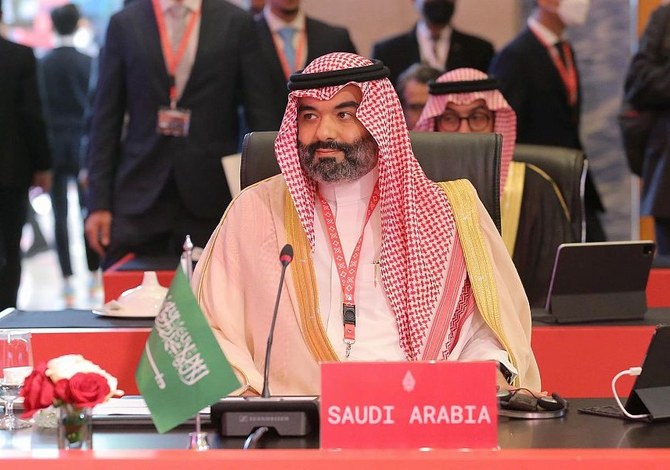
ICT Minister Abdullah Al-Swaha met with Huawei CEO Ren Zheng in Shenzhen to enhance the current partnerships in digital fields while promoting capacity development. (File)
Short Url
Updated 04 July 2023
Follow

Saudi minister meets Huawei CEO to expand partnership and boost digital economy

RIYADH: Saudi Arabia and China are exploring opportunities to cooperate in technology and related infrastructure, with the Kingdom’s top minister meeting top Chinese executives during his official visit. 

On Tuesday, Saudi Minister of Communication and Information Technology Abdullah Al-Swaha met with Huawei CEO Ren Zheng in Shenzhen to enhance the current partnerships in digital fields while promoting capacity development, the Saudi Press Agency reported.

During his visit to Huawei’s headquarters, the minister also met with several Saudi students and technical talent undergoing training for a Huawei ICT Academy program in partnership with the Saudi Digital Academy.

Being one of the fastest-growing economies in the world, the Kingdom has been focused on building a strong foundation for its booming digital economy. 

Huawei has been supporting the Kingdom’s efforts to develop a digital economy by signing multiple deals and forming partnerships. 

During the Mobile World Congress held in Spain in March, Huawei signed a memorandum of understanding with Saudi Arabia’s telecommunication operator Zain KSA to form a joint innovation project. 

The deal was to promote innovation in 5.5G technology and expand scalable offerings to individuals, enterprises, and governments.

Under the agreement, both parties will work together to strengthen the digital infrastructure in Saudi Arabia by building a global 5.5G network aligned with Vision 2030. 

The minister’s visit to China comes in light of strengthening Saudi-Chinese relations, which will promote the growth of the digital economy and achieve prosperity in innovation and space. 

The minister was accompanied by a high-level delegation representing entities affiliated with the digital economy, space and innovation system in the Kingdom.    

Additionally, the minister met with his Chinese counterpart and several other officials to enhance partnerships and attract more technological investments into the Kingdom.    

Saudi Arabia has achieved notable advancements in the global digital arena, ranking 31st in the UN e-Government Development Index for 2022.  

Additionally, the country has secured the top position in the Middle East and North Africa region for digital government services in the Government Electronic and Mobile Services Maturity Index for 2021. 


Artificial intelligence is transitioning into a ‘digital employee’

Updated 27 February 2026
Follow

Artificial intelligence is transitioning into a ‘digital employee’

  • AI can be an effective tool, business leaders tell Arab News
  • Not about jobs, but ‘convergence of human capital and AI’

RIYADH:  Artificial intelligence is fundamentally reshaping the world of work, transitioning from a supporting tool to an active partner that is radically changing the nature of professions and productivity standards.

Amidst the current global transformations, an active regional digital environment is emerging.

This is being led by Saudi Arabia through Vision 2030 and massive investments in smart infrastructure, providing a living model for studying the implications of this partnership between humans and machines on the future of work in the region.

Arab News spoke to various business leaders about the emerging shape of the sector.

Salem Bagami, co-founder of Metatalent, said the ideal relationship between humans and machines at work should be complementary and collaborative.

Humans would bring creativity, emotional intelligence, and complex decision-making, while machines excel at processing big data and performing repetitive, precise tasks.

He believes that this type of balanced partnership would lead to unprecedented productivity and innovation.

While machines excel at processing big data and performing repetitive, precise tasks, humans would bring creativity, emotional intelligence, and complex decision-making. (Supplied)

Mohammad Al-Jallad, chief technologist and director at HPE, said AI has gone beyond being merely an executive tool to becoming a “digital employee” entrusted with automating routine tasks and providing insights based on data analysis.

He believes that the real opportunity lies not in the debate over job replacement, but in “the convergence of human capital and artificial intelligence.”

AI should augment human teams by taking on menial and routine tasks, enabling employees to focus on critical thinking, creativity, and ethical reasoning, significantly improving operational results.

Bagami also emphasized the complementary nature of this partnership. “The ideal relationship between humans and machines at work is one of collaboration, where each complements the others.”

He explained that humans bring creativity, emotional intelligence, and nuanced decision-making, while machines excel at processing big data and performing repetitive tasks efficiently, leading to increased productivity and innovation.

Opinion

This section contains relevant reference points, placed in (Opinion field)

Salem Alanazi, chairman of Jathwa Technology Co., notes a significant trend among Saudi Arabia companies toward using AI applications to provide faster services to customers at lower costs.

The emergence of the “virtual employee” available around the clock has eliminated the need for some traditional jobs in specific sectors.

Alanazi warns that some companies’ reluctance to adopt AI may expose them to real risks. “All those who hesitated to benefit from AI applications have a lack of understanding of these technologies.”

He said those who adopt these technologies will be able to offer lower-cost, higher-quality services, which will affect the market position of companies that lag behind.

Ali Aljumhour, CEO of VALUE Consultancy, said that the transition of AI into a partner has reshaped the list of most in-demand skills in the job market.

Skills such as “prompt engineering,” “human-machine integration,” and “digital ethics” are becoming increasingly important.

He added that AI has become an instantly available “technical knowledge base,” shifting the criteria for professional distinction toward those capable of smart interaction with these technologies.

In terms of ethics, transparency, and trust, Alanazi points to the complexities of global AI governance, where legislation overlaps and evolves rapidly to keep pace with potential risks, particularly in the areas of cybersecurity and privacy.

Ali Aljumhour, CEO of VALUE Consultancy. (Supplied)

Al-Jallad emphasizes this crucial dimension, noting that providing responsible and reliable AI solutions that meet the highest standards of transparency is a key priority, especially in regulated sectors.

Bagami believes there should be basic standards for the ethical use of Al, emphasizing the need for transparency, accountability, and fairness, along with using diverse data sets to prevent bias and protect privacy.

He believes that building trust between humans and machines requires clear explanations of how systems work, giving users the opportunity to provide feedback and conducting periodic performance reviews.

On performance evaluation, Aljumhour said: “I expect radical changes in standards, shifting from measuring individual effort to evaluating the quality of the partnership between humans and machines.”

There should be a focus on the quality of inputs provided to intelligent systems, the accuracy of review and modification, and complex decision-making based on outputs.

He warns, however, of new risks that may arise, such as over-reliance on AI or difficulty in determining responsibility for mistakes.

In the employment sector, Aljumhour expects fundamental changes in standards.

There will be questions and tests focusing on measuring skills in dealing with AI, such as asking candidates about their experiences of collaborating with these systems, or testing their ability to formulate effective requests for complex tasks.

Aljumhour identifies significant human challenges in this transition, with “fear, loss of power, and exclusivity of knowledge” being the biggest concerns for experienced employees.