

Organisation of Islamic Cooperation calls for measures against Qur’an burning

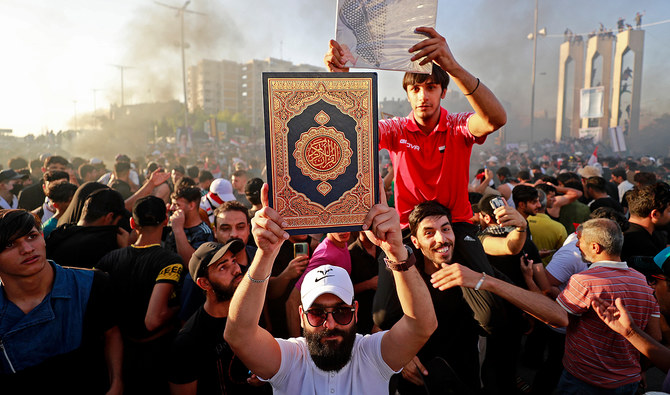
A demonstrator holds up the Qur'an outside the Swedish embassy in Baghdad on June 30, 2023 for a second day of protests against a Qur'an burning in Stockholm that outraged Muslims around the world. (AFP)
Short Url
Updated 02 July 2023
Follow

Organisation of Islamic Cooperation calls for measures against Qur’an burning

  • The announcement came during an OIC session over burning of a copy of Qur’an in Sweden on Eid Al-Adha
  • The meeting, held at the OIC’s headquarters in Jeddah, was called following an invitation from Saudi Arabia

RIYADH: The Organisation of Islamic Cooperation on Sunday said that measures need to be taken to avoid repeated acts of desecration to the Qur’an, Saudi state TV  al-Ekhbariya reported.
The announcement was made during an emergency session over the repercussions of burning a copy of the Qur’an in Sweden on the first day of Eid Al-Adha, the Saudi Press Agency reported on Saturday.

"We must send constant reminders to the international community regarding the urgent application of international law, which clearly prohibits any advocacy of religious hatred," OIC Secretary-General Hissein Brahim Taha said.

The meeting, held at the OIC’s headquarters in Jeddah, was called following an invitation from Saudi Arabia — the chairman of the Islamic Summit in its current session and the OIC’s Executive Committee.

There has been widespread outrage and condemnation in the Muslim and Arab world since Salwan Momika, 37, a refugee from Iraq, desecrated the Qur’an and set fire to its pages in front of Stockholm’s largest mosque on Wednesday.

The “meeting is scheduled to discuss measures against these despicable acts to express a united position against the desecration of the Holy Qur’an,” the statement said.

The OIC warned of the seriousness of these acts, which undermine mutual respect and harmony among peoples and contradict international efforts to spread the values ​​of tolerance, moderation and rejection of extremism.

The organization urged the governments of the countries concerned to take effective measures to prevent their recurrence, denouncing the repetition of these “despicable attacks” and all attempts to desecrate the sanctity of the Qur’an and other Islamic values, symbols and sanctities.

The OIC reaffirmed the obligation that all states have undertaken, under the UN Charter, to promote and encourage universal respect for and observance of human rights and fundamental freedoms for all, without distinction of race, sex, language or religion.

It noted the need to ensure that everyone exercises the right to freedom of expression with “responsibility and in accordance with relevant international human rights laws,” stressing the importance of promoting dialogue, understanding and cooperation between religions, cultures and civilizations for global peace and harmony.


Algeria inaugurates strategic railway to giant Sahara mine

President Tebboune attended an inauguration ceremony in Bechar. (AFP file photo)
Updated 02 February 2026
Follow

Algeria inaugurates strategic railway to giant Sahara mine

  • The mine is expected to produce 4 million tons per year during the initial phase, with production projected to triple to 12 million tons per year by 2030
  • The project is financed by the Algerian state and partly built by a Chinese consortium

ALGEIRS: Algerian President Abdelmadjid Tebboune on Sunday inaugurated a nearly 1,000-kilometer (621-mile) desert railway to transport iron ore from a giant mine, a project he called one of the biggest in the country’s history.
The line will bring iron ore from the Gara Djebilet deposit in the south to the city of Bechar located 950 kilometers north, to be taken to a steel production plant near Oran further north.
The project is financed by the Algerian state and partly built by a Chinese consortium.
During the inauguration, Tebboune described it as “one of the largest strategic projects in the history of independent Algeria.”
This project aims to increase Algeria’s iron ore extraction capacity, as the country aspires to become one of Africa’s leading steel producers.
The iron ore deposit is also seen as a key driver of Algeria’s economic diversification as it seeks to reduce its reliance on hydrocarbons, according to experts.
President Tebboune attended an inauguration ceremony in Bechar, welcoming the first passenger train from Tindouf in southern Algeria and sending toward the north a first charge of iron ore, according to footage broadcast on national television.
The mine is expected to produce 4 million tons per year during the initial phase, with production projected to triple to 12 million tons per year by 2030, according to estimates by the state-owned Feraal Group, which manages the site.
It is then expected to reach 50 million tons per year in the long term, it said.
The start of operations at the mine will allow Algeria to drastically reduce its iron ore imports and save $1.2 billion per year, according to Algerian media.