HUNZA: Bibi Amina was one among only two women in Pakistan’s northern Hunza valley who were trained in the male-dominated craft of carpentry a few years ago. Now, 16 other women have taken up the craft and are using it skillfully to fashion furniture out of wood to provide for their families.
Flanked by soaring mountain ranges and glaciers in Pakistan’s northern Gilgit-Baltistan (GB) region, a non-profit organization named the Aga Khan Cultural Service Pakistan (AKCSP) launched a project called ‘Ciqam’ (well-being in the local Hunza language) in 2003 in Hunza valley.
The purpose of the project— which was funded by the Norwegian embassy in Pakistan as well from 2008-2017— is to train women in topographic and building surveys, carpentry, design and drafting, plumbing, and hospitality. Amina initially took up carpentry as a profession and hasn’t looked back since then.
“The women who work here support their family; they [support] their children, brothers, and sisters for study and other expenses,” Amina told Arab News. “And the important thing is that they are confident. They do their work and go home.”
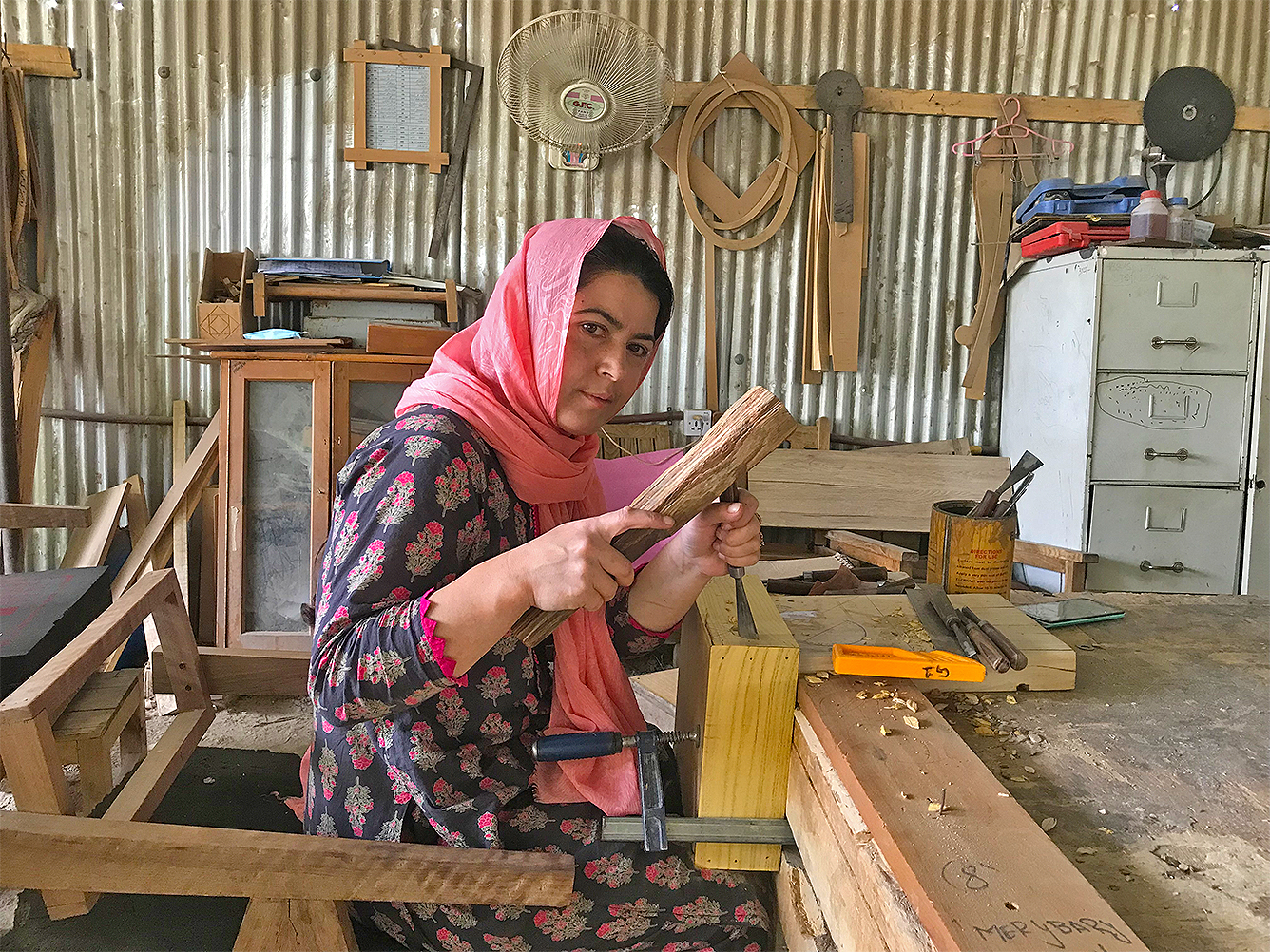
A women carpenter is busy designing a product in their factory located in Hunza Valley of Gilgit-Baltistan, Pakistan, on June 16, 2023. (AN photo)
Amina acknowledged that the women had to face issues initially, as Hunza’s residents were not used to women taking up carpentry as a profession.
“Now, there is no issue and people accept them [women carpenters],” she said.
Nazia, who wanted to be identified by her first name, also said she uses the income generated from carpentry to support her family and pay for her children’s education expenses.
“Earlier, people used to criticize our work and say this is the work of men; [say to us that], ‘How could you do this work?’ Our families supported us and due to their support, we started carpentry,” Nazia told Arab News.
“Neglecting other things, we continued our work.”

A group of women carpenters pose for a group photograph in their factory located in Hunza Valley of Gilgit-Baltistan, Pakistan, on June 16, 2023. (AN photo)
Women trained under the program use wood to craft furniture such as chairs, tables, and beds, and can also make doors, windows, and frames.
Yasmeen, who also used her first name only, said she took up carpentry in 2015 as a trainee. After three years of training, Yasmeen learned the ropes and started working with the group.
“Earlier, we used to do work for homes,” Yasmeen told Arab News. “I also used to sew clothes, but that was not beneficial. But I earn from here and run my home. I earn Rs20,000 ($69.81) per month,” she added.
Ciqam CEO Aqeela Bano said the main function of the project is to empower women, adding that girls and women did not easily have access to education from 2008-2017 in GB hence the program was launched to equip them with technical skills.
“In the short-term benefit of this project, hundreds of women were trained and their immediate needs were fulfilled,” Bano told Arab News. “For the long run, the carpenters who joined this field in the start are now master trainers.”
Bano said the project not only empowered women but also catered to environmental concerns.
“The [women carpenters] use locally grown trees and strictly avoid using forest timbers,” Bano said. “And the two main objectives of this project are to ensure gender equality and make women skillful,” she added, vowing to extend the project to other districts as well.
Amina is adamant about sharing her technical expertise and enabling more women to provide for their families in a profession usually dominated by men not only in Pakistan but around the world.
“We worked and proved ourselves that we could do anything side by side with men,” she said. “And whenever the products become ready, we feel happy.”