

Russian firms are keen to develop further ties with the UAE: deputy PM

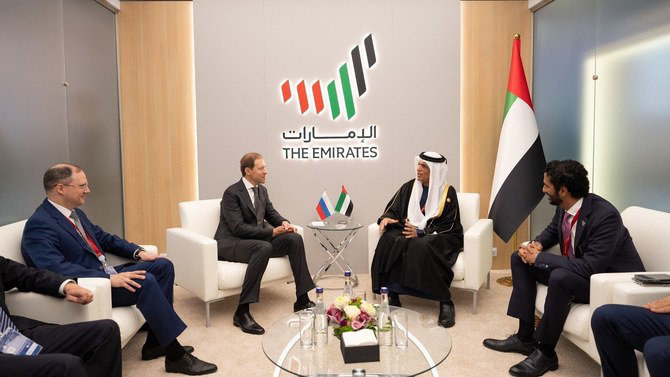
Russia’s Deputy Prime Minister Denis Manturov holds talks with Ruler of Ras Al-Khaimah Sheikh Saud bin Saqr Al-Qasimi. (AN photo)
Short Url
Updated 01 July 2023
Follow

Russian firms are keen to develop further ties with the UAE: deputy PM

  • Trade turnover between the two countries has doubled over the past year

ST. PETERSBURG: Russian firms are keen to develop further ties with the UAE, the country’s deputy prime minister has insisted in a speech lauding economic links between the two nations.

Speaking at the St. Petersburg International Economic Forum, Denis Manturov — also Russia’s industry and trade minister — noted the special nature of Russian-Emirati relations, which includes strong ties of friendship and a rich history of cooperation based on the principles of mutual respect and trust.

His comments came after the ruler of the emirate of Ras Al-Khaimah, Sheikh Saud Al-Qasimi, took part in the opening of the UAE’s pavilion at the forum, marking the country’s role as a guest at the event.

Trade turnover between the two countries has doubled over the past year and now amounts to $10 billion, and Manturov said: “We are constantly expanding the range of areas in which we build joint work.

“We are implementing a number of industrial cooperation projects, initiatives in the field of transport and services, energy and food security.

“We have started an active negotiation process on a free trade agreement between the UAE and the states of the Eurasian Economic Union.

“This will give an additional impetus to the comprehensive development of our multilateral trade and economic ties.”

After the opening ceremony for the pavilion, Manturov and the Minister of Economy of the UAE Abdullah bin Touq Al-Marri joined the Russia-UAE business dialogue, during which priority areas for the development of further cooperation were considered.

“I would like to note that our companies from both sides are interested in continuing work on different vectors of cooperation,” Manturov said, adding: “Russian business is showing great interest in locating production and logistics facilities in the UAE.”

He went on: “We also expect continued investment cooperation with the UAE. In recent years, Emirati companies have invested in various sectors of the Russian economy, and these investments have paid off — this is reflected in the figures of foreign trade turnover.

“I would like to emphasize that industrial cooperation is the basis for increasing investment and trade turnover.

“Today, opportunities for cooperation, projects in the aviation and automotive industries, metallurgy, mechanical engineering, and pharmaceuticals are being successfully implemented and worked out with our colleagues from the UAE.”

In a speech, Al-Marri marked the strong participation of his country in the forum, which includes 18 companies in various sectors of the economy.

Speaking about the trade turnover between Abu Dhabi and Moscow, Al-Marri noted its growth has doubled over the past year.

The minister said: “On the aspect of engagement, we really built a strong and significant approach in areas that we are looking forward to engage with, more specifically on the aspects of science, AI (artificial intelligence), green energy, and technology.

“The UAE and Russia have a very strategic partnership and we are engaged in this partnership in a very robust way and our trade has grown since then.”

The participation of the UAE as a guest country at the St. Petersburg International Economic Forum is an important step in strengthening trade, economic and investment cooperation between the two countries.

The pavilion’s motto — “Impossible is Possible” — is seen as perfectly corresponding to the spirit of Russian- Emirati relations.


First EU–Saudi roundtable on critical raw materials reflects shared policy commitment

Updated 16 January 2026
Follow

First EU–Saudi roundtable on critical raw materials reflects shared policy commitment

RIYADH: The EU–Saudi Arabia Business and Investment Dialogue on Advancing Critical Raw Materials Value Chains, held in Riyadh as part of the Future Minerals Forum, brought together senior policymakers, industry leaders, and investors to advance strategic cooperation across critical raw materials value chains.

Organized under a Team Europe approach by the EU–GCC Cooperation on Green Transition Project, in coordination with the EU Delegation to Saudi Arabia, the European Chamber of Commerce in the Kingdom and in close cooperation with FMF, the dialogue provided a high-level platform to explore European actions under the EU Critical Raw Materials Act and ResourceEU alongside the Kingdom’s aspirations for minerals, industrial, and investment priorities.

This is in line with Saudi Vision 2030 and broader regional ambitions across the GCC, MENA, and Africa.

ResourceEU is the EU’s new strategic action plan, launched in late 2025, to secure a reliable supply of critical raw materials like lithium, rare earths, and cobalt, reducing dependency on single suppliers, such as China, by boosting domestic extraction, processing, recycling, stockpiling, and strategic partnerships with resource-rich nations.

The first ever EU–Saudi roundtable on critical raw materials was opened by the bloc’s Ambassador to the Kingdom, Christophe Farnaud, together with Saudi Deputy Minister for Mining Development Turki Al-Babtain, turning policy alignment into concrete cooperation.

Farnaud underlined the central role of international cooperation in the implementation of the EU’s critical raw materials policy framework.

“As the European Union advances the implementation of its Critical Raw Materials policy, international cooperation is indispensable to building secure, diversified, and sustainable value chains. Saudi Arabia is a key partner in this effort. This dialogue reflects our shared commitment to translate policy alignment into concrete business and investment cooperation that supports the green and digital transitions,” said the ambassador.

Discussions focused on strengthening resilient, diversified, and responsible CRM supply chains that are essential to the green and digital transitions.

Participants explored concrete opportunities for EU–Saudi cooperation across the full value chain, including exploration, mining, and processing and refining, as well as recycling, downstream manufacturing, and the mobilization of private investment and sustainable finance, underpinned by high environmental, social, and governance standards.

From the Saudi side, the dialogue was framed as a key contribution to the Kingdom’s industrial transformation and long-term economic diversification agenda under Vision 2030, with a strong focus on responsible resource development and global market integration.

“Developing globally competitive mineral hubs and sustainable value chains is a central pillar of Saudi Vision 2030 and the Kingdom’s industrial transformation. Our engagement with the European Union through this dialogue to strengthen upstream and downstream integration, attract high-quality investment, and advance responsible mining and processing. Enhanced cooperation with the EU, capitalizing on the demand dynamics of the EU Critical Raw Materials Act, will be key to delivering long-term value for both sides,” said Al-Babtain.

Valere Moutarlier, deputy director-general for European industry decarbonization, and directorate-general for the internal market, industry, entrepreneurship and SMEs at European Commission, said the EU Critical Raw Materials Act and ResourceEU provided a clear framework to strengthen Europe’s resilience while deepening its cooperation with international partners.

“Cooperation with Saudi Arabia is essential to advancing secure, sustainable, and diversified critical raw materials value chains. Dialogues such as this play a key role in translating policy ambitions into concrete industrial and investment cooperation,” she added.