

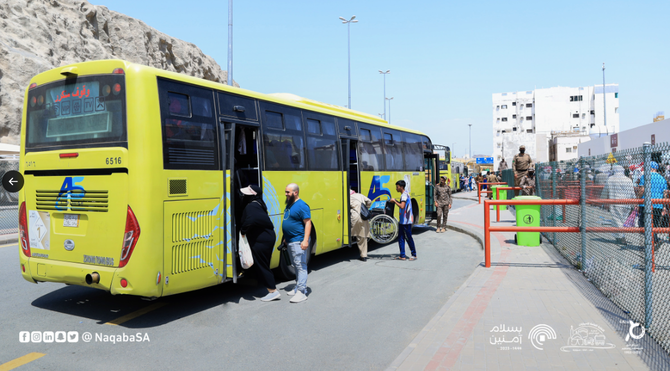
Pilgrims taking part in King’s Guests program arrive in Madinah

1 / 2
Guests of the King’s program arrive in Madinah after they completed their Hajj rituals in Makkah. (Twitter)
2 / 2
Guests of the King’s program arrive in Madinah after they completed their Hajj rituals in Makkah. (Twitter)
Short Url
Updated 01 July 2023
Follow

Pilgrims taking part in King’s Guests program arrive in Madinah

  • The Custodian of the Two Holy Mosques’ Guests Program for Hajj and Umrah has been in operation for 28 years
  • The Transport General Authority has been busy preparing the roads utilized by the pilgrims’ buses to reach Madinah

JEDDAH: The 4,951 pilgrims who are part of this year’s Custodian of the Two Holy Mosques’ Guests Program for Hajj and Umrah have completed their Hajj rituals.

The pilgrims, who come from 92 different countries, are now scheduled to visit the Prophet’s Mosque and other religious and cultural landmarks in Madinah as part of an itinerary organized by the committees that oversee their transportation, accommodation, and other services.

The participants thanked the staff of the program for their exceptional service and attentive care during their stay in the Kingdom, and expressed their heartfelt gratitude and deep appreciation to the Saudi government for its unfailing support and hospitality.

The beneficiaries of this year’s program include 1,000 Yemeni pilgrims, 280 pilgrims from Syria, and 130 from the Arab League Educational, Cultural, and Scientific Organization.

The Custodian of the Two Holy Mosques’ Guests Program for Hajj and Umrah has been in operation for 28 years, with annual arrangements overseen by the Ministry of Islamic Affairs, Dawah, and Guidance. Since its launch, the program has welcomed more than 62,000 pilgrims from 140 countries to the Kingdom.

Its services include greeting and assisting pilgrims on their arrival in the Saudi Arabia, arranging their accommodation and transportation between the holy sites, and coordinating visits to Madinah prior to their departure.

According to a report by the Saudi Press Agency, the first group of pilgrims participating in the program reached Madinah on Saturday.

The Transport General Authority has been busy preparing the roads utilized by the pilgrims’ buses to reach Madinah, including the repair of a 405-kilometer stretch of asphalt, painting roads spanning a total length of 514 km, and fixing expansion joints over a distance of 5 km. The maintenance teams also installed metal barriers across a distance of approximately 33 linear kilometers.

The TGA has also been improving road infrastructure elsewhere in the region, installing concrete barriers spanning 135 meters, repairing 36 intersections, erecting 38 kilometers of fencing, and lighting 96 km of road using both solar and conventional energy sources.

The authority’s on-site teams have conducted regular inspections of the Hijrah highway and the roads leading to the northern ports of the Kingdom within the administrative scope of the Madinah region. Road quality has also been evaluated across the region to ensure travelers’ needs are catered for.


Northern Borders rock art reveals ancient life

Updated 07 March 2026
Follow

Northern Borders rock art reveals ancient life

  • Among the most notable remains are stone structures scattered northwest of Arar
  • Evidence ranges from the Neolithic era to Islamic times, forming a chronological record

JEDDAH: Saudi Arabia’s Northern Borders region contains numerous archaeological sites, reflecting a long history of human settlement dating back to early periods, the Saudi Press Agency reported.
Among the most notable remains are stone structures scattered northwest of Arar.
Varying in shape, size and design, specialists believe these structures date to the end of the Neolithic period and the beginning of subsequent eras. They are thought to have been used as stone tombs to preserve the remains of the dead.
Evidence ranges from the Neolithic era to Islamic times, forming a chronological record that highlights the diversity of communities that once lived in the region and how they interacted with their natural environment over centuries.
Ajab Al-Otaibi, director general of antiquities at the Heritage Commission, said the stone structures and rock art sites in the Northern Borders region represent an integral part of Saudi Arabia’s national cultural heritage and serve as an important resource for archaeological studies and scientific research.
He highlighted the importance of surveys, documentation and protection efforts to preserve these cultural landmarks as a historical legacy for future generations.
The region is also home to several important rock art sites, such as Shu’ayb Hamer, which features a wide and diverse collection of drawings carved on natural rock surfaces, marking it as a key site that documented early human activity in the area.
The artworks depict scenes of hunting, horsemanship, dancing, daily life and social rituals. They were created using a variety of artistic styles, most notably framed and abstract forms, and produced through different techniques including incizing and pecking, both direct and indirect.
The carvings portray human figures and a range of animals, including camels, horses and gazelles, as well as some wild and predatory species that have long since disappeared.
These images provide insight into the richness of the natural environment in earlier periods and help researchers understand the evolving relationship between humans and their surroundings.