

Iraq’s prized modern art plagued by forgery, trafficking

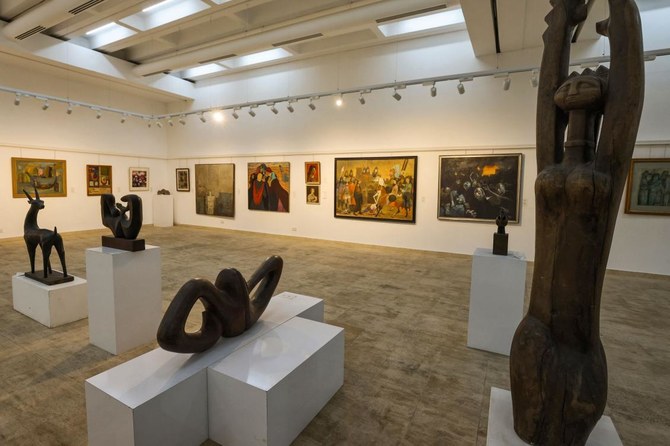
Paintings and sculptures at the Museum of Modern Art in Baghdad. Many masterpieces of Iraqi painting were looted or destroyed during the years of war, but now the country's artistic heritage faces another threat: rampant counterfeiting and illicit trafficking. (AFP)
Short Url
Updated 30 June 2023
Follow

Iraq’s prized modern art plagued by forgery, trafficking

  • Ministry of Culture are fighting to return some of Iraq’s stolen art, provided Interpol with information about 100 missing pieces

BAGHDAD: Many masterpieces of Iraqi painting were looted or destroyed during the years of war, but now the country’s artistic heritage faces another threat: rampant counterfeiting and illicit trafficking.
Adorning a wall of Baghdad’s modern art museum, the painting “Death to Colonialism,” with its somber blues and greys, by pioneering Iraqi artist Shakir Hassan Al-Said is one of the rare pieces from its era still on public display.
Painted in the 1970s, toward the end of the heyday of Iraq’s modern art movement, it survived the chaos that followed the 2003 US-led invasion when the museum’s 8,000-strong collection was decimated by looters.
“The works of Shakir Hassan Al-Said are extremely valuable as far as Iraqi modern art goes as well as art from the Middle East,” said Tamara Chalabi, co-founder and head of the Ruya Foundation for Contemporary Art.
Paintings by Said, who established the influential Baghdad Modern Art Group alongside painter and sculptor Jewad Salim, can fetch up to $100,000 at auction.
The late artist’s family says it has successfully prevented the sale of numerous counterfeits of his works, and is in regular contact with international auction houses and galleries about his oeuvre.
“Recently, we spotted a fake in Baghdad,” said the artist’s 50-year-old son, Mohammed Shakir Hassan Al-Said.
He contacted the gallery through social media to demand the painting be taken down — but said the management refused, claiming it was authentic.
Said’s family, in an effort to safeguard his legacy after his death in 2004, has meticulously documented his comprehensive works, comprising around 3,000 pieces.
Today, they are working on the publication of a catalogue to provide “immunity” against the fakes that have proliferated after 2003, his son told AFP.
The primary targets of forgers and traffickers within and outside Iraq are the works of its modern pioneers from the 1940s, 1950s and 1960s.


Many of them were among the thousands of pieces looted from the country’s museums and homes during the security vacuum after dictator Saddam Hussein fell.
“Iraqi art is today one of the most important sources of artistic production in the Arab world,” said Sultan Sooud Al-Qassemi, the founder of the Barjeel Art Foundation, a museum in Sharjah in the United Arab Emirates.
Kadhim Hayder and Dia Azzawi are among some of the most sought-after artists.
“Nowadays some Iraqi artworks are sold for hundreds of thousands of dollars,” the Emirati art collector told AFP. “Forgers are noticing the auction results... It’s enticing them to create better and better forgeries.”
The authentication problem arises across the region — notably in Egypt, Lebanon and Syria — but “with Iraq it is especially acute because of the multiple layers of challenges: the exile of artists, the successive wars,” said Qassemi.


For Chalabi, “forgery is part of the overall problem of corruption in Iraq which has become embedded in the system and is accepted by people.”
One of the largest collections lost was at the National Museum of Modern Art in Baghdad, which housed some of the country’s most treasured artworks from the 21st century.
“Before 2003, we had 8,000 works,” said Ali Al-Doulaimi, the museum’s former director. “Today, there are around 2,000.”
In the years after the invasion, “we acquired new works, and lost pieces were returned,” said Doulaimi.
The museum and Ministry of Culture are fighting to return some of Iraq’s stolen art. They have provided Interpol with information about 100 missing pieces, said Doulaimi, who recently retired.
However, it is difficult to determine the true extent of what is missing — with the unreliable inventory hand-written by the previous administration.
In 2017, British auction house Christie’s announced it was withdrawing a painting by Iraqi artist Faeq Hassan after a “disagreement over ownership.”
An Iraqi official explained at the time that the painting was likely smuggled out of the country after being on display at an officer’s club affiliated with the Ministry of Defense.
The painting was never returned to Iraq.
At the Akkad gallery in Baghdad, owner Hayder Hachem Naji said the increase in counterfeits “damages the reputation of Iraqi art.”
“Sometimes forgers will use an old painting to repaint on — the frame and the canvas will be old,” said the 54-year-old gallery owner.
Recently, he was asked to exhibit a painting attributed to well-known Cubist-influenced painter Hafidh Al-Droubi.
Its owner hoped to sell it for $40,000 — but Naji politely declined.
“Honestly, it was a very high-quality counterfeit,” he said.


Lebanon approves financial gap draft law despite opposition from Hezbollah and Lebanese Forces

Lebanon's Prime Minister Nawaf Salam speaking during a press conference after a cabinet session in Beirut on December 26, 2025.
Updated 26 December 2025
Follow

Lebanon approves financial gap draft law despite opposition from Hezbollah and Lebanese Forces

  • Legislation aims to address the fate of billions of dollars in deposits that have been inaccessible to Lebanese citizens during the country’s financial meltdown

BEIRUT: Lebanon’s Cabinet on Friday approved a controversial draft law to regulate financial recovery and return frozen bank deposits to citizens. The move is seen as a key step in long-delayed economic reforms demanded by the International Monetary Fund.

The decision, which passed with 13 ministers voting in favor and nine against, came after marathon discussions over the so-called “financial gap” or deposit recovery bill, stalled for years since the banking crisis erupted in 2019. The ministers of culture and foreign affairs were absent from the session.

The legislation aims to address the fate of billions of dollars in deposits that have been inaccessible to Lebanese citizens during the country’s financial meltdown.

The vote was opposed by three ministers from the Lebanese Forces Party, three ministers from Hezbollah and the Amal Movement, as well as the minister of youth and sports, Nora Bayrakdarian, the minister of communications, Charles Al-Hajj, and the minister of justice, Adel Nassar.

Finance Minister Yassin Jaber broke ranks with his Hezbollah and Amal allies, voting in favor of the bill. He described his decision as being in line with “Lebanon’s supreme financial interest and its obligations to the IMF and the international community.”

The draft law triggered fierce backlash from depositors who reject any suggestion they shoulder responsibility for the financial collapse. It has also drawn strong criticism from the Association of Banks and parliamentary blocs, fueling fears the law will face intense political wrangling in Parliament ahead of elections scheduled in six months.

Prime Minister Nawaf Salam confirmed the Cabinet had approved the bill and referred it to Parliament for debate and amendments before final ratification. Addressing public concerns, he emphasized that the law includes provisions for forensic auditing and accountability.

“Depositors with accounts under $100,000 will be repaid in full with interest and without any deductions,” Salam said. “Large depositors will also receive their first $100,000 in full, and the remainder will be issued as negotiable bonds backed by the assets of the Central Bank, valued at around $50 billion.”

He said further that bondholders will receive an initial 2 percent payout after the first tranche of repayments is completed.

The law also includes a clause requiring criminal accountability. “Anyone who smuggled funds abroad or benefited from unjustified profits will be fined 30 percent,” Salam said.

He emphasized that Lebanon’s gold reserves will remain untouched. “A clear provision reaffirms the 1986 law barring the sale or mortgaging of gold without parliamentary approval,” he said, dismissing speculation about using the reserves to cover financial losses.

Salam admitted that the law was not perfect but called it “a fair step toward restoring rights.”

“The banking sector’s credibility has been severely damaged. This law aims to revive it by valuing assets, recapitalizing banks, and ending Lebanon’s dangerous reliance on a cash economy,” he said. “Each day of delay further erodes people’s rights.”

While the Association of Banks did not release an immediate response after the vote, it previously argued during discussions that the law would destroy remaining deposits. Bank representatives said lenders would struggle to secure more than $20 billion to cover the initial repayment tier and accused the state of absolving itself of responsibility while effectively granting amnesty for decades of financial mismanagement and corruption.

The law’s fate now rests with Parliament, where political competition ahead of the 2025 elections could complicate or delay its passage.

Lebanon’s banking sector has been at the heart of the country’s economic collapse, with informal capital controls locking depositors out of their savings and trust in state institutions plunging. International donors, including the IMF, have made reforms to the sector a key condition for any financial assistance.